


The Core Logic: How Item Selection Works
How does a machine actually decide what question comes next? It isn't just guessing. Most modern engines rely on Item Response Theory (IRT), a framework that assigns a mathematical value to the difficulty of every single question in a bank. In a traditional test, you might get ten questions of medium difficulty. In an adaptive system, the engine uses a "seed" question to start. If you answer correctly, the engine shifts the probability curve to select a more difficult item. If you miss it, it drops down. This process is called Computerized Adaptive Testing (CAT). The goal is to reach a point where the student has a 50% chance of answering correctly; that's where the most precise measurement of their ability happens. This means a student who knows the material can finish a 100-question exam in 20 questions with the same level of accuracy.| Feature | Traditional Testing | Adaptive Assessment |
|---|---|---|
| Question Order | Fixed for everyone | Dynamic and personalized |
| Time Spent | High (many irrelevant questions) | Low (optimized for efficiency) |
| Difficulty Curve | Linear or random | Matches user's current level |
| Accuracy | Broad estimation | High precision (Theta value) |
Building the Item Bank: The Secret Sauce
An adaptive engine is only as good as its library. You can't just throw a few hundred questions together and hope for the best. You need a curated item bank where every question is calibrated. This usually involves "pre-testing" items on a large group of people to determine their actual difficulty level-this is where the data comes from to feed the Psychometrics models. For instance, if 90% of students answer Question A correctly, the engine flags it as "Easy." If only 10% get it right, it's "Hard." But the engine also looks at the "discrimination index." Does the hard question actually separate the experts from the novices, or is it just worded confusingly? If a question is too ambiguous, it ruins the data and the engine tosses it out. This ensures that the path a learner takes is based on skill, not on luck or a trick question.
Closing the Loop with Intelligent Feedback
Assessment isn't just about a final score; it's about growth. Static tests give you a grade at the end, which is often too late to be useful. Adaptive Learning systems integrate feedback directly into the assessment loop. When a learner misses a question, the engine doesn't just say "Wrong." It analyzes the specific error pattern. If a student fails a geometry question involving the Pythagorean theorem but gets the basic algebra right, the feedback should be targeted. Instead of telling them to "study Chapter 4," the system provides a micro-lesson on right-angle triangles. This is where Learning Analytics come into play. By tracking the time spent on a question and the specific distractors (wrong answer choices) selected, the engine can determine if the user is guessing or if they have a fundamental misconception. Effective feedback in these systems follows a three-step rhythm:- Immediate Correction: Telling the user they were incorrect to stop the reinforcement of a mistake.
- Scaffolded Hinting: Providing a clue that nudges the user toward the right logic without giving away the answer.
- Concept Re-routing: If the user fails multiple times, the engine temporarily shifts from "testing mode" to "teaching mode," presenting a short instructional video or text before returning to the assessment.
Avoiding the Common Pitfalls
It sounds perfect, but adaptive engines can go wrong. One major issue is "test anxiety through escalation." When a student realizes every question is getting harder, they might panic, thinking they're doing poorly, even though the engine is actually praising them by giving them harder challenges. This psychological pressure can lead to a performance dip that doesn't reflect their actual knowledge. Another risk is the "ceiling effect." If your item bank doesn't have enough ultra-difficult questions, your top performers will hit a wall. They'll get everything right, and the engine will stop being able to differentiate between a "very good" student and a "world-class" student. To solve this, developers must constantly inject new, high-difficulty items and validate them through continuous sampling.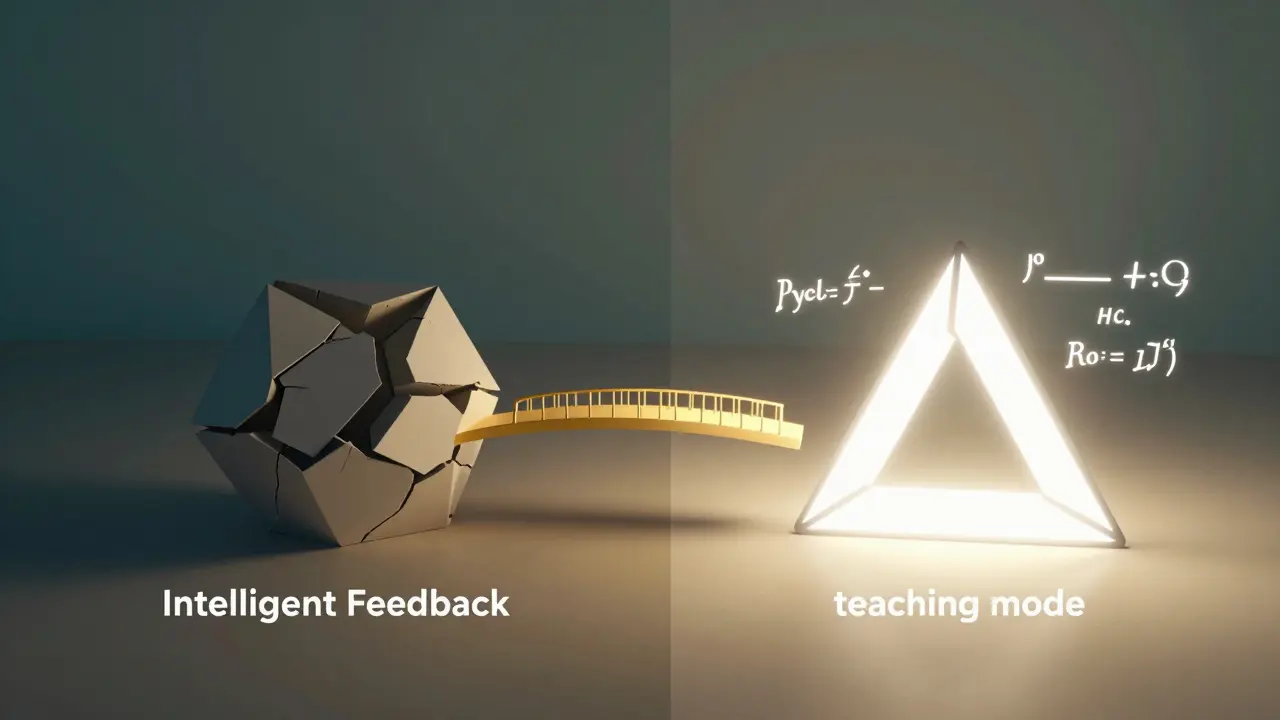
The Future of Personalized Evaluation
We're moving beyond simple multiple-choice questions. The next generation of these engines uses Natural Language Processing (NLP) to assess open-ended responses. Imagine writing a short essay, and the engine identifies that you understand the concept of "inflation" but struggle with "fiscal policy." It then selects a follow-up question specifically to probe that gap. Furthermore, we're seeing the rise of multimodal assessments. The engine might start with a text question, and if you struggle, it presents a visual diagram to see if the issue is the medium of delivery rather than the conceptual understanding. This turns the assessment into a diagnostic tool that identifies not just *what* a person knows, but *how* they learn best.Do adaptive tests take longer to complete?
Actually, they are usually much faster. Because the engine skips questions that are too easy or too hard for the user, it reaches a statistically confident score with far fewer items than a traditional linear test.
Is it possible to "game" an adaptive assessment engine?
It's very difficult. Some users try to intentionally miss early questions to get easier ones later, but modern IRT models detect these "erratic response patterns" and flag them as anomalies, often penalizing the score or requiring a re-test.
What is a "Theta" value in adaptive testing?
Theta represents the latent trait or ability level of the test-taker. It's a numerical value (often centered around 0) that the engine constantly updates as you answer questions, serving as the coordinate to pick the next item.
Can these engines be used for formative rather than summative assessment?
Yes, and that's where they shine. When used formatively, the engine acts as a tutor, identifying gaps in real-time and providing the specific feedback needed to bridge those gaps before a final exam.
What happens if the item bank is too small?
If the bank is small, the engine will start repeating questions or run out of items at certain difficulty levels, which leads to "measurement error." This makes the final score less reliable and less precise.
Comments
John Fox
sounds like a breeze compared to those old school tests where u just guess and pray
sampa Karjee
The obsession with efficiency over deep, rigorous academic struggle is exactly why modern education is collapsing. Using a machine to "find your floor" is merely a euphemism for coddling the mediocre. True intellectual growth requires the friction of facing questions that are far beyond one's current capacity, not some curated, sanitized path designed to keep the ego intact. This approach reduces a scholar to a data point in a psychometric model, stripping away the nobility of academic perseverance. It is utterly pedestrian to believe that a Theta value can encapsulate the complexity of human cognition. Those who crave these adaptive shortcuts are simply admitting they lack the discipline for a traditional, comprehensive examination.
Patrick Sieber
I think this is a great way to handle certification exams. It definitely saves a lot of time for everyone involved.
Kieran Danagher
Oh sure, because nothing says "effective learning" like a black-box algorithm deciding you're too dim for the hard questions based on one wrong click. I'm sure the "discrimination index" is totally foolproof and doesn't just punish people who don't think exactly like the test designer. Pure magic.
OONAGH Ffrench
the conceptual shift from measurement to diagnostics is the real win here
it turns the test into a mirror of the mind
poonam upadhyay
Ugh!!! The "test anxiety through escalation" part is just... SO real!!! Imagine the sheer PANIC when the questions start looking like ancient Sanskrit and you realize you're actually doing well but your brain is just SCREAMING!!! It's an absolute psychological rollercoaster, honey!!! Totally chaotic energy!!!
Shivam Mogha
Very efficient system.
mani kandan
The integration of NLP for open-ended responses is an exquisite touch. It transforms a rigid assessment into a fluid, intellectual odyssey that respects the learner's unique cognitive trajectory.
Rahul Borole
It is imperative that educators recognize the potential of Computerized Adaptive Testing to optimize student outcomes. By precisely identifying knowledge gaps, we can implement highly targeted interventions that accelerate the mastery of complex subjects. I strongly encourage the adoption of these frameworks in professional development environments to ensure peak performance and continuous growth for all practitioners.
Sheetal Srivastava
The paradigm shift towards latent trait estimation via IRT is fundamentally disruptive to the traditional pedagogical hegemony. However, if the item bank lacks sufficient granularity in its high-end calibration, the resultant ceiling effect creates a systemic failure in distinguishing top-tier cognitive capabilities. This is an epistemological nightmare for anyone seeking absolute precision in high-stakes evaluation. We are essentially gambling with the validity of our psychometric constructs if the sampling distribution is skewed!
Bhavishya Kumar
The technical descriptions provided are largely accurate though the lack of formal punctuation in some discussions is distressing. One must ensure that the calibration of the item bank adheres to the strictest statistical standards to avoid measurement error.