


Choosing the right courses can feel overwhelming. You’re not just picking classes-you’re building a path that affects your grades, your confidence, your career, and even your mental health. Too many students pick courses based on what’s easy, what their friends are taking, or what sounds cool on paper. Then they hit week three and realize they’re stuck in a class that doesn’t fit their goals, their pace, or their strengths. It doesn’t have to be this way.
Start with your end goal, not your schedule
Before you even open your university’s course catalog, ask yourself: What do I want to be able to do after I graduate? Not what job title you want. Not what salary you hope for. What actual skills, experiences, or knowledge will get you there?
For example, if you’re aiming for a job in environmental policy, you don’t just need one environmental science class. You need to understand how policy is written, how data is used in advocacy, how to communicate complex ideas to non-experts. That means looking for courses in public administration, data visualization, or science communication-even if they’re outside your major. Many students miss this because they think their major is the only path. It’s not.
Write down three things you want to be good at by the time you finish your degree. Then look for courses that build those skills. Don’t just check boxes. Build competence.
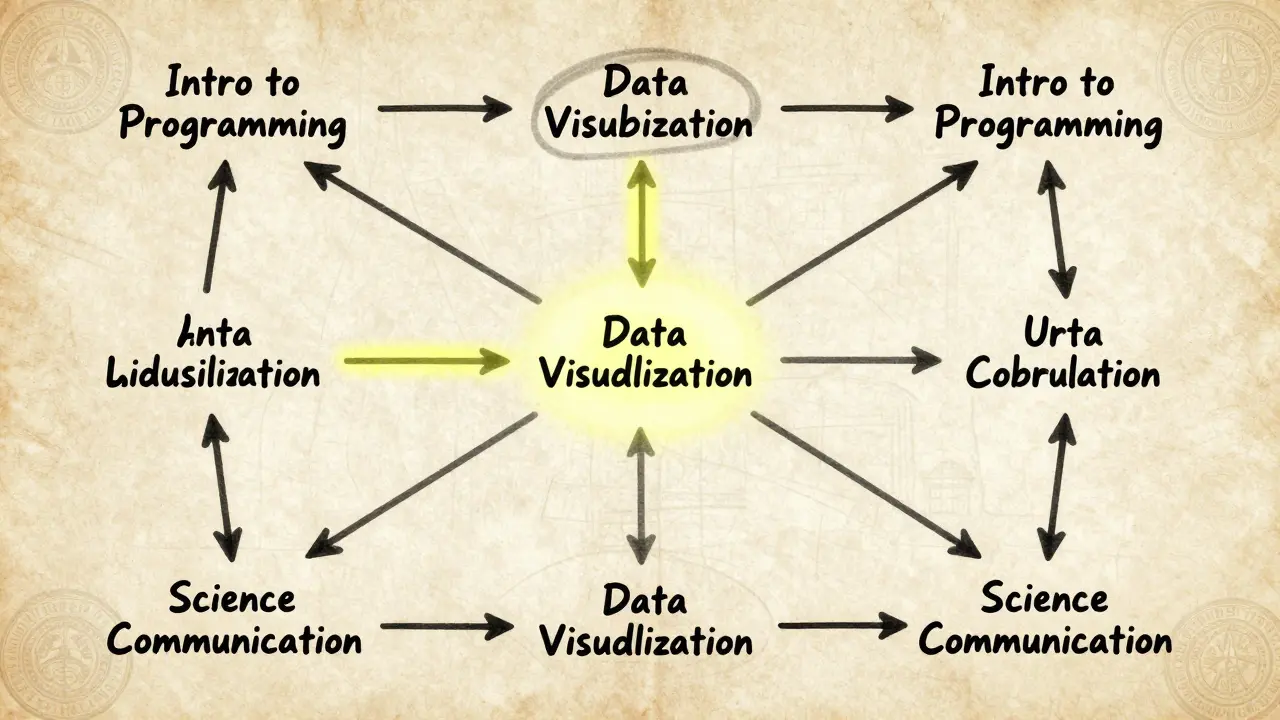
Understand how courses connect
Every course you take is part of a larger system. Some are foundations. Others are applications. Some are prerequisites. Others are electives that open doors.
Take computer science as an example. If you skip the intro programming class because you think you already know how to code, you might struggle later in data structures or algorithms-classes that assume you’ve learned how to think like a programmer. On the flip side, if you take every advanced course too early, you’ll burn out. The sequence matters.
Look at your program’s curriculum map. Most universities publish one. It shows which courses lead to which others. If yours doesn’t, ask your advisor for a flowchart. If they don’t have one, make your own. Draw lines between courses. Ask: What happens if I take this before that? Sometimes the answer is nothing. Sometimes it’s failure.
Don’t ignore the hidden curriculum
There’s a lot you won’t find in the course description. A class might be labeled "Introduction to Psychology," but if the professor grades heavily on participation and you’re shy, you’ll struggle. Another might sound dry but have a final project that lets you build a real app or write for a local nonprofit. Those details change everything.
Check student reviews on your university’s portal. Look for comments like: "This class saved my GPA," or "The workload was insane, but I learned more than in any other course." Talk to students who’ve taken it. Ask: What did you wish you knew before signing up?
Also, pay attention to the professor. Are they accessible? Do they respond to emails? Do they care if you’re struggling? A great course with a disengaged instructor can feel like a waste. A decent course with a supportive teacher can be transformative.
Balance challenge with sustainability
It’s tempting to pack your semester with hard classes to look impressive. But if you’re taking five demanding courses, working 20 hours a week, and volunteering on weekends, you’re not being ambitious-you’re being unsustainable.
Research from the University of Auckland shows that students who take 3-4 challenging courses per semester, with one lighter class for mental breathing room, perform better long-term than those who overload. The difference isn’t just grades. It’s sleep. It’s time to eat. It’s not crying in the library at 2 a.m.
Build in recovery. One easy class. One that’s fun. One that lets you breathe. That’s not lazy. That’s strategic.
Use your advisor like a GPS, not a gatekeeper
Academic advisors are there to help you navigate, not to say "no." Too many students treat them like permission slips. They walk in with a list of courses and ask, "Can I take these?" That’s the wrong question.
Instead, go in with: "Here’s what I want to achieve. Here’s what I’ve tried so far. Where are the gaps? What am I missing?"
Bring your transcript. Bring your goals. Bring your worries. Advisors have seen thousands of students. They know which courses are over-enrolled, which professors are retiring, which electives are being cut next year. They can warn you before you waste a semester.
Don’t wait until the last minute to meet them. Schedule a 30-minute slot early in the term. Bring coffee. Ask questions. Make it a conversation, not a formality.
Track your progress like a project
Most students don’t track their academic progress. They just register, show up, and hope for the best. That’s like driving without a map.
Create a simple spreadsheet. List your degree requirements. Mark off what you’ve completed. Highlight what’s left. Color-code by difficulty, interest, or requirement type. Seeing it visually makes it real.
For example:
- Core Requirements: 8/12 completed
- Electives: 3/5 taken (2 in data analysis, 1 in ethics)
- Capstone prep: 0/1 completed
- Internship requirement: Not started
Update it every semester. You’ll start seeing patterns. Maybe you’re avoiding writing-heavy courses but your career needs strong communication skills. Maybe you’ve taken all the math classes but none of the applied ones. Adjust before it’s too late.

Watch out for these three traps
Here are the most common mistakes students make-and how to avoid them:
- The "easy A" trap: Taking a class just because the grading is lenient. You’ll get a good grade, but you won’t learn anything useful. That gap shows up later in interviews or grad school applications.
- The "everyone’s doing it" trap: Taking a class because your friends are. Your interests, strengths, and goals are different. Don’t let peer pressure steer your future.
- The "I’ll fix it later" trap: "I’ll take statistics next year." But next year, you’re swamped. Or the class is full. Or the professor is gone. Delaying essential courses is the #1 reason students graduate late.
Ask yourself: If I don’t take this now, will it block me later? If yes, prioritize it.
When things go wrong
What if you’ve already picked the wrong courses? What if you’re halfway through a semester and realize you hate the class, it’s not helping your goals, and you’re falling behind?
You’re not stuck. You have options.
If it’s early enough (usually within the first 2-3 weeks), you can drop it without penalty. If it’s later, you might still be able to switch to a different section, audit it, or talk to the professor about a pass/fail option. Don’t wait until finals week to panic.
And if you’re already overwhelmed? Talk to someone. A counselor. A peer mentor. A trusted professor. You don’t have to fix everything alone.
Next steps
Here’s what to do this week:
- Open your degree requirements document. Print it or save it on your phone.
- Write down your top three goals after graduation.
- Find your academic advisor’s email. Send them a short message: "Hi, I’m planning my courses for next term and want to make sure I’m on track. Can we meet for 20 minutes?"
- Check your university’s course reviews. Find one class you’re considering and read 3 student comments.
- Make a simple spreadsheet with your remaining requirements.
Small actions now prevent big regrets later. You’re not just choosing classes. You’re choosing the person you’ll become.
What if I’m unsure about my career path? How do I choose courses then?
If you’re unsure, pick courses that build transferable skills: writing, data analysis, public speaking, research methods, critical thinking. These show up in almost every career. Also, take electives in different departments-philosophy, economics, design, psychology. Exposure helps you discover what excites you. Many students change their major after taking one unexpected class.
Can I take courses outside my major?
Yes, and you should. Most degrees allow 20-40% of your credits to be electives. These are your chance to explore. A business major who takes a creative writing course might end up better at marketing communications. An engineering student who takes sociology might understand user behavior better. Cross-disciplinary learning is one of the most valuable parts of university.
How do I know if a course is too hard for me?
It’s not about whether you can pass-it’s about whether you can grow. If a course challenges you but you’re motivated, it’s worth it. If it overwhelms you and drains your energy, it might be too much right now. Talk to the professor before enrolling. Ask about workload, grading, and past student outcomes. You can always audit a class first or take it pass/fail if available.
Should I take summer courses to lighten my load?
Summer courses can help if you’re behind on requirements or want to free up space for internships or part-time work during the regular term. But don’t assume they’re easier. Many are fast-paced and intense. Only take them if you have the time and energy. Use summer to catch up, not to overload.
What if my advisor pushes me toward courses I don’t want?
Your advisor’s job is to guide, not control. If they suggest something that doesn’t fit your goals, ask why. "Can you explain how this course supports my interest in X?" If they can’t give a clear answer, it’s okay to push back. You have the right to choose your path. Just be ready to explain your reasoning and show you’ve done your research.
If you’re feeling lost, remember: course selection isn’t about perfection. It’s about progress. One thoughtful choice at a time adds up.
Comments
Jess Ciro
This post is everything I hate about academia
They act like choosing classes is some grand strategic game when really it’s just a lottery rigged by professors who hate you
Who even writes this stuff? Some overpaid advisor with a PowerPoint and a caffeine addiction
Drop a class? Sure if you’re rich enough to afford the tuition hit
My school charges $400 to drop after week one
And don’t get me started on ‘course reviews’
Half of them are written by the TA’s cousin
‘This class saved my GPA’ yeah because the prof gave out A’s like candy
Meanwhile I’m in Organic Chem with a guy who grades on ‘effort’ and cries if you ask for clarification
They say ‘build competence’
Try building competence when your only elective is ‘Introduction to Bureaucracy’
And advisors? They’re just glorified receptionists who say ‘have you tried psychology?’ to everyone
saravana kumar
Highly formal observation: This guide is structurally impeccable and logically coherent
However, it assumes universal access to resources
In India, course catalogs are often outdated
Professors change syllabi without notice
Student reviews are non-existent or manipulated
Advisors are overworked and underpaid
Spreadsheets? Many students use handwritten notebooks with ink smudges
The ‘hidden curriculum’ is not hidden - it is a labyrinth of nepotism and favoritism
One must pray to the gods of departmental politics
Yet, the core philosophy remains valid
One must choose with intention
Even if the system is broken
Intention is the only currency that cannot be devalued
Tamil selvan
Thank you for this thoughtful, well-structured, and deeply compassionate guide.
As someone who has guided dozens of students through academic crossroads, I can say with absolute certainty that your points are not just correct-they are life-changing.
Too many students treat university as a checklist, not a journey.
The emphasis on transferable skills is especially vital-writing, critical thinking, and communication are the invisible pillars of every successful career.
I encourage every student to print this out and keep it beside their planner.
And please, do not underestimate the power of a single conversation with an advisor.
I once had a student who dropped out because she thought she wasn’t smart enough.
She came back two years later after reading a similar article.
She’s now a lead engineer at Google.
One choice. One moment of clarity.
You’ve given students that moment.
Thank you.
Mark Brantner
bro i just dropped a class called ‘intro to data viz’ because the prof said ‘if you can’t code in python you’re gonna cry’
turns out i could code in python but i couldn’t cry on command
also the syllabus had a typo on page 3 that said ‘this class will make you rich’
so i emailed the dean
he replied ‘we are working on it’
it’s been 3 months
also my advisor told me to take ‘philosophy of socks’
idk what that is but i’m 90% sure it’s a cult
anyway i’m taking ‘how to not fail’ next semester
it’s not on the catalog
but everyone knows about it
it’s just a room with a beanbag and a guy named dave who says ‘you got this’
Kate Tran
the part about balance made me cry
i took 5 hard classes last semester
didn’t sleep for 11 days
ate 3 meals total
and still failed one
my mom said ‘you’re not a machine’
i didn’t talk to her for a month
now i’m taking one easy class just to breathe
it’s called ‘gardening for beginners’
we grow basil
and i cry when it dies
but it’s okay
because i’m alive
amber hopman
I’m not sure I agree with the ‘easy class for breathing room’ advice
What if your ‘easy class’ is just a glorified nap time?
I took ‘Film and Society’ last term and learned nothing
But I did learn how to fake attention
And that’s not a skill you want on your resume
Maybe instead of easy classes, take classes that are *different*?
Like if you’re a math major, take creative writing
If you’re an art student, take statistics
Not because it’s easy
But because it’s unexpected
That’s where real growth happens
Not in the comfort zone
But in the awkward middle
Jim Sonntag
the advisor as gps analogy is genius
but what if your gps keeps rerouting you to a cornfield
also why do all university websites look like they were coded in 2007
and why is the course catalog a 300 page pdf with 8 fonts
also i tried making a spreadsheet
it turned into a fever dream with color codes and emojis
now i just ask my roommate
she’s in psych
she says ‘if it’s taught by dr. bell
run’
so i run
and somehow i’m still graduating
Deepak Sungra
yo this whole thing is just a scam
they want you to think you’re in control
but the system is designed to break you
they give you 200 courses
but only 10 are actually open
the rest are full before registration even starts
and the ‘advisor’? they’re just there to say ‘oh you can’t take that’
then they sell you the 300 level class you’ve already taken 3 times
and don’t get me started on the ‘course reviews’
half of them are bots
the other half are professors’ pets
and the ‘spreadsheet’? lol
i use a napkin
and a prayer
and a vape
and a therapist
Samar Omar
How utterly pedestrian this advice is
One must ask: Is this not merely the rehashing of bourgeois academic platitudes dressed in the flimsy garb of ‘self-help’?
Who are these ‘transferable skills’ for? The corporate machine? The neoliberal university-industrial complex?
Why must one ‘build competence’ in a world that commodifies even the act of thinking?
And to suggest a spreadsheet? A mere accounting tool for the soul?
One’s academic journey is not a spreadsheet
It is a poem
Written in silence
Between the lines of syllabi
And the hollow echo of administrative emails
And yet-
Even poetry must be read
Even silence must be heard
So perhaps… this guide
Is not a guide at all
But a mirror
And we
Are the ones who must decide
Whether to look away
chioma okwara
u spelled 'coursse' wrong in the title
and 'univeristy' in the intro
and 'profesor' twice
also 'seperate' not 'separate'
and 'recieve' not 'receive'
and 'definately' not 'definitely'
and 'accomodate' not 'accommodate'
and 'occured' not 'occurred'
and 'judgement' not 'judgment'
and 'goverment' not 'government'
and 'embarras' not 'embarrass'
and 'existance' not 'existence'
and 'priviledge' not 'privilege'
and 'relevent' not 'relevant'
and 'conscience' not 'conscious'
and 'seperate' again
you need a spellchecker
and a life
John Fox
took a class on medieval poetry
didn't know why
ended up writing a song about it
got signed by a indie label
now i tour
still haven't graduated
but i'm happy
so maybe the system works
or maybe i just got lucky
either way
i don't care
Tasha Hernandez
I cried reading the part about the library at 2 a.m.
I was there last week
with a 3 a.m. coffee
and a broken laptop
and a professor who ghosted me
and a roommate who said 'just drop it'
so i did
but then i cried harder
because dropping it meant admitting i wasn't enough
and then i found a cat in the hallway
she sat on my lap
and purred
and i realized
i didn't need to be perfect
i just needed to be alive
so i took a nap
on the library floor
and woke up
and registered for a new class
and it's called 'how to be kind to yourself'
and it's the only one that matters
Anuj Kumar
everyone is wrong
you don't need to plan
you don't need advice
you just need to take the hardest class
and fail
and fail again
and again
until you learn
that nothing matters
except the fact that you're still here
so take the class
and fail
and laugh
because the system is a lie
and you're the only truth