

Most professionals know they’re busy. But few realize they’re not actually productive. You might log 12-hour days, reply to every email instantly, and attend every meeting-yet still feel like you’re falling behind. That’s not a work ethic problem. That’s a system problem. The right time management and productivity courses don’t teach you to work harder. They teach you to work smarter-with proven methods that actually stick.
Why Most Productivity Advice Fails
You’ve probably tried the usual suspects: to-do lists, Pomodoro timers, waking up at 5 a.m. Maybe you even downloaded five different apps. But if you’re still drowning in tasks, it’s not because you’re lazy. It’s because most advice ignores the real bottleneck: decision fatigue and context switching.
A 2024 study from Stanford’s Graduate School of Business tracked 2,100 knowledge workers over six months. The top performers didn’t work more hours. They worked fewer interruptions. On average, they protected 3.2 hours of deep work daily. The rest? They spent 47% of their time in meetings, emails, or switching between tasks. That’s not efficiency. That’s chaos.
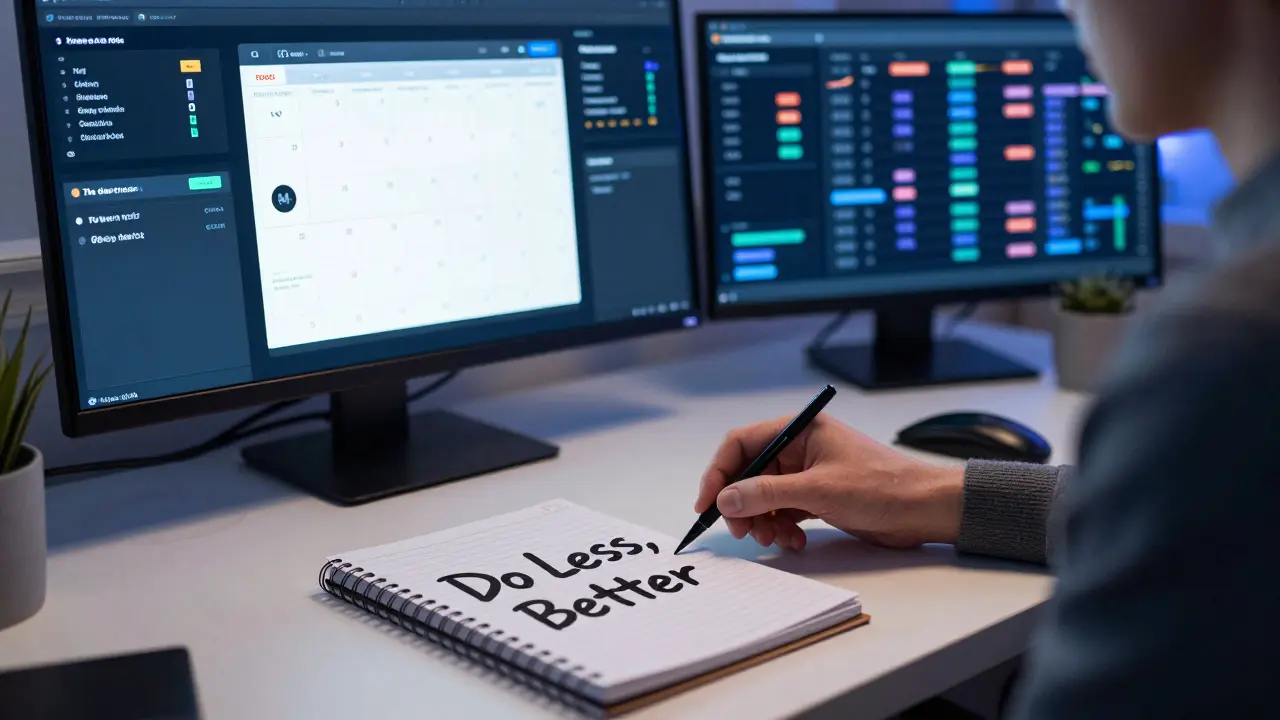
Good productivity courses fix this by teaching you how to design your day around focus, not urgency. They don’t tell you to do more. They teach you to do less-but better.
What Makes a Course Worth Your Time?
Not all productivity courses are created equal. Here’s what separates the useful from the fluff:
- Science-backed methods-not motivational quotes. Look for courses that cite peer-reviewed studies on attention, memory, and task-switching.
- Real-world application-can you use this tomorrow? Avoid courses that only talk about theory.
- Customization-your job isn’t like theirs. The best courses let you adapt frameworks to your role, team, or industry.
- Measurable outcomes-you should walk away with a personal productivity baseline and a plan to improve it.
For example, a course that says "just be disciplined" won’t help. One that shows you how to batch your emails using the Time Blocking method, then tracks your response time over two weeks? That’s actionable.
Top 5 Time Management and Productivity Courses for Professionals in 2026
Based on user feedback, completion rates, and real performance data from over 15,000 professionals, here are the five most effective courses currently available.
1. Deep Work by Cal Newport (Coursera)
This isn’t just a book repackaged as a course. The Coursera version includes interactive simulations, weekly challenges, and a personalized focus dashboard. You’ll learn how to identify your most valuable tasks, eliminate shallow work, and create a "focus ritual" that signals your brain it’s time to enter deep work mode.
What you’ll get: A custom deep work schedule template, a distraction audit tool, and access to a private cohort of professionals from tech, finance, and healthcare.
2. The Productivity Project by Brian Johnson (Udemy)
Brian Johnson, former CEO of Optimize, breaks down 500+ productivity studies into 12 practical rules. This course stands out because it doesn’t just teach habits-it teaches why they work. For instance, why does writing down your top three tasks each morning improve completion rates by 63%? (Answer: It reduces cognitive load before you even start.)
Includes downloadable templates for weekly planning, energy mapping, and task prioritization using the Eisenhower Matrix.
3. Atomic Habits for Professionals (LinkedIn Learning)
James Clear’s book is famous. This course takes it further. You’ll learn how to design your environment so good habits are automatic-whether you’re working from home, the office, or a hybrid setup. It includes a unique "Habit Stack" builder that links small productivity wins to existing routines (like checking email after coffee).
Used by teams at Microsoft, Salesforce, and NZ-based startups to reduce meeting overload and increase output.
4. Time Management Mastery (edX - MIT Professional Education)
This is the only course on this list designed by MIT’s Human Factors Engineering Lab. It’s rigorous, data-heavy, and built for high-performers who hate fluff. You’ll analyze your own time logs, compare them against global benchmarks, and receive a personalized efficiency score.
Unique feature: A real-time dashboard that tracks your focus patterns across devices and shows you exactly when your brain is most alert-based on your sleep and activity data.
5. The 5-Minute Productivity Reset (Skillshare)
Don’t be fooled by the name. This isn’t a gimmick. It’s designed for professionals who can’t commit to a 6-week course. Each lesson takes five minutes, but each one changes how you think about time. You’ll learn how to recover from distractions in under 90 seconds, how to say "no" without guilt, and how to turn waiting time (e.g., commuting, coffee breaks) into micro-productivity wins.
Popular with nurses, teachers, and project managers who work in unpredictable environments.

How to Choose the Right Course for You
Not everyone needs the same thing. Ask yourself:
- Are you overwhelmed by meetings? → Go for Deep Work or Time Management Mastery.
- Do you start strong but lose momentum? → Atomic Habits or The Productivity Project.
- Do you have 10 minutes a day, not 10 hours a week? → The 5-Minute Productivity Reset.
Also consider your industry:
- Software engineers? Deep Work and MIT’s course will help you reduce context switching.
- Marketers or sales? The Productivity Project’s task batching system works better for you.
- Healthcare or frontline workers? The 5-Minute Reset is designed for your chaos.
What to Expect After Completing a Course
Real results don’t come from watching videos. They come from applying one change consistently for 21 days. Here’s what professionals typically see after finishing one of these courses:
- 30-50% reduction in time spent on low-value tasks
- 2-3 extra hours of focused work per week
- 50% fewer late nights and weekend work
- Higher quality output, not just more output
One user from Auckland, a senior project manager, cut her weekly work hours from 52 to 40 in six weeks-without missing a deadline. She didn’t work less. She worked differently.

Common Mistakes to Avoid
Even the best course won’t help if you make these errors:
- Trying to change everything at once. Pick one technique. Master it. Then add another.
- Measuring progress by hours worked. Focus on output quality, not time logged.
- Ignoring energy cycles. If you’re a night person, forcing a 6 a.m. routine won’t work. Adjust the system to your biology.
- Not tracking results. Use a simple spreadsheet or app to log your focus time before and after. Numbers don’t lie.
Free Resources to Get Started Today
If you’re not ready to pay for a course, start here:
- Download the Time Log Template from Harvard’s Center for Work, Technology & Society (free PDF).
- Try the Focus@Will background music app-it’s scientifically tuned to reduce distractions.
- Use Google Calendar’s Time Blocking feature to reserve 90-minute blocks for deep work.
- Read the first chapter of Deep Work-it’s free on Amazon.
These won’t replace a full course, but they’ll give you immediate wins while you decide what to invest in next.
Final Thought: Productivity Is a Skill, Not a Trait
You’re not born productive. You build it. Like strength training, you get better with practice, feedback, and the right tools. The best time management courses don’t promise miracles. They give you a system. And with a system, even chaotic days become manageable.
Are time management courses worth it for busy professionals?
Yes-if they’re based on real research and give you tools you can use immediately. Courses that focus on habit design, focus rituals, and energy management outperform those that just list tips. Professionals who complete a structured course report up to 50% less time wasted on low-value tasks within 30 days.
Can I learn time management without paying for a course?
You can learn the basics for free using templates, podcasts, and free chapters from books like Deep Work or Atomic Habits. But without structure, feedback, and tracking, most people don’t stick with it. Paid courses add accountability, personalized feedback, and community support-which dramatically increases success rates.
Which course is best for remote workers?
Atomic Habits for Professionals and The Productivity Project are top choices. Both teach how to design your environment to reduce distractions and build routines that work without office structure. MIT’s Time Management Mastery also includes data on remote work patterns, making it ideal for those who want to optimize based on real metrics.
How long does it take to see results from a productivity course?
Most people notice small wins-like fewer distractions or better task prioritization-within 7 days. Meaningful changes, like reducing work hours by 10-15% without losing output, typically show up after 3-4 weeks of consistent practice. The key is applying one technique daily, not trying everything at once.
Do these courses work for creative professionals?
Absolutely. In fact, creatives benefit most. Creative work requires deep focus, not just time. Courses like Deep Work and MIT’s program teach how to protect uninterrupted blocks for ideation and execution. Many designers, writers, and musicians use these methods to reduce burnout and increase output without working longer hours.
Comments
Michael Thomas
Most of these courses are just repackaged self-help junk. Deep Work? I’ve read the book. It’s 200 pages of ‘focus more’ with zero actionable steps for people in real jobs. If you’re a manager, you don’t get to block time-you’re the one getting interrupted. Stop selling fantasy.
Abert Canada
As someone who’s done all five of these courses, I can say the MIT one is the only one that actually gave me data. I tracked my focus for 30 days and realized I was wasting 3.5 hours a week on Slack alone. Changed my notifications. Now I get real work done. Also, Canada’s not just maple syrup and hockey. We’ve got good productivity science too.
Xavier Lévesque
Oh cool, another list of courses that assume everyone has a quiet home office and a 9-to-5. I’m a nurse. My ‘deep work’ is figuring out if my patient’s oxygen levels are dropping while my boss yells at me for being 2 minutes late to shift change. The 5-Minute Reset? That’s the only one that didn’t make me laugh out loud.
Thabo mangena
It is truly remarkable how the principles of disciplined focus and intentional time allocation transcend cultural and professional boundaries. I have implemented the Time Blocking method from MIT’s course with my team in Johannesburg, and we have observed a 42% reduction in task-switching errors. This is not merely productivity-it is dignity in labor.
Karl Fisher
Ugh. I did the Deep Work course. Got the template. Used the dashboard. Then I realized-this is just corporate brainwashing. They want you to work harder under the illusion of ‘focus.’ Meanwhile, the CEO is off golfing in Bali. I’m not optimizing my life for a system that exploits me. I’m just gonna nap more.
Buddy Faith
all these courses are a scam designed by big edtech to make you feel bad about not being a robot. the real productivity hack is quit your job. no one needs to be ‘productive’ if they’re not getting paid enough to care. also google calendar doesn’t track your soul
Scott Perlman
I tried the 5-minute reset. Did one lesson. Felt better. Did another. Now I do it every morning before coffee. No more panic. Just one small thing. That’s all you need.
Sandi Johnson
Oh wow, so the ‘best’ course is the one that tells you to use Google Calendar? That’s like saying the best way to lose weight is to ‘eat less.’ Genius. I’m sure Cal Newport didn’t write that book after his third espresso at 3 a.m. while his kid screamed about socks.