


Imagine handing over your hard-earned degree or certificate not to a dusty filing cabinet in a university registrar’s office, but to a secure, immutable ledger that you own completely. No more waiting weeks for transcript verification when applying for jobs. No more worrying if the institution that issued your credential has closed down or lost its records. This isn’t some distant sci-fi scenario; it’s the emerging reality of decentralized learning networks, powered by blockchain technology that enables secure, transparent, and user-owned educational records.
If you’ve heard buzzwords like "Web3," "NFTs," or "DAOs" thrown around in education circles and felt confused, you’re not alone. The intersection of blockchain and a distributed ledger technology that records transactions across many computers so that the record cannot be altered retroactively with traditional schooling seems counterintuitive at first glance. Schools are hierarchical; blockchains are flat. Universities gatekeep knowledge; decentralized networks open it up. But beneath the hype lies a practical shift in how we verify skills, share knowledge, and pay for education.
Why Centralized Education Systems Are Cracking
Let’s look at the current state of affairs. You spend four years and thousands of dollars getting a degree. You graduate. Then what? You send a PDF of your diploma to an employer. They call your university. A clerk checks a database. Everyone waits. If you move countries, you might need notarized translations. If you want to prove you took a specific online course from Coursera five years ago, good luck finding that email confirmation.
This friction costs time and money. More importantly, it locks students into institutions. Once you leave, you often lose access to the community, the resources, and sometimes even the proof of what you learned. Centralized databases, single points of failure where data is stored and managed by one entity, are vulnerable to hacks, budget cuts, and administrative errors. Remember when certain universities merged or shut down, leaving alumni scrambling for transcripts? That’s a systemic flaw, not just bad luck.
Decentralized learning networks aim to fix this by shifting power from the institution to the individual. Instead of the school owning your record, you hold the keys. Literally. Through cryptographic wallets, you manage your own educational history.
How Blockchain Actually Works in Learning
You don’t need to be a coder to understand this. Think of blockchain as a shared notebook that everyone can see, but no one can erase pages from. When you complete a module, earn a badge, or finish a thesis, that achievement is written into a "block." This block is linked to previous blocks using cryptography. Because it’s distributed across thousands of computers (nodes), changing one entry requires changing every subsequent entry on every computer simultaneously. It’s practically impossible to fake.
In this ecosystem, your achievements become Non-Fungible Tokens (NFTs), unique digital certificates stored on a blockchain that prove ownership and authenticity of a specific asset. Unlike a JPEG of a cat, these NFTs represent verifiable data: who taught you, when you finished, what criteria you met, and even peer reviews. Employers can instantly verify these tokens without contacting the issuer. It’s trustless verification-meaning you don’t need to trust the middleman, just the math.
| Feature | Traditional System | Decentralized Network |
|---|---|---|
| Verification Speed | Days to Weeks | Seconds |
| Ownership | Institution-held | Learner-held |
| Portability | Low (Region-specific) | High (Global) |
| Cost | High Admin Fees | Low Transaction Fees |
| Tamper Resistance | Moderate | Very High |
The Rise of Micro-Credentials and Skill Badges
One of the biggest shifts we’ll see is the death of the "all-or-nothing" degree. In a decentralized network, learning is continuous. You might take a coding workshop today, a design sprint next month, and a leadership seminar next year. Each of these generates a micro-credential, a small, focused certification that validates a specific skill or competency.
These aren’t just pretty icons. They are smart contracts. Imagine a badge that automatically updates if the underlying curriculum changes, or one that unlocks further courses only after you’ve mastered the prerequisite. Platforms like Blockcerts or various Ethereum-based protocols are already testing this. For learners, this means building a portfolio that reflects actual skills rather than just attendance. For employers, it means hiring based on verified capability, not prestige.
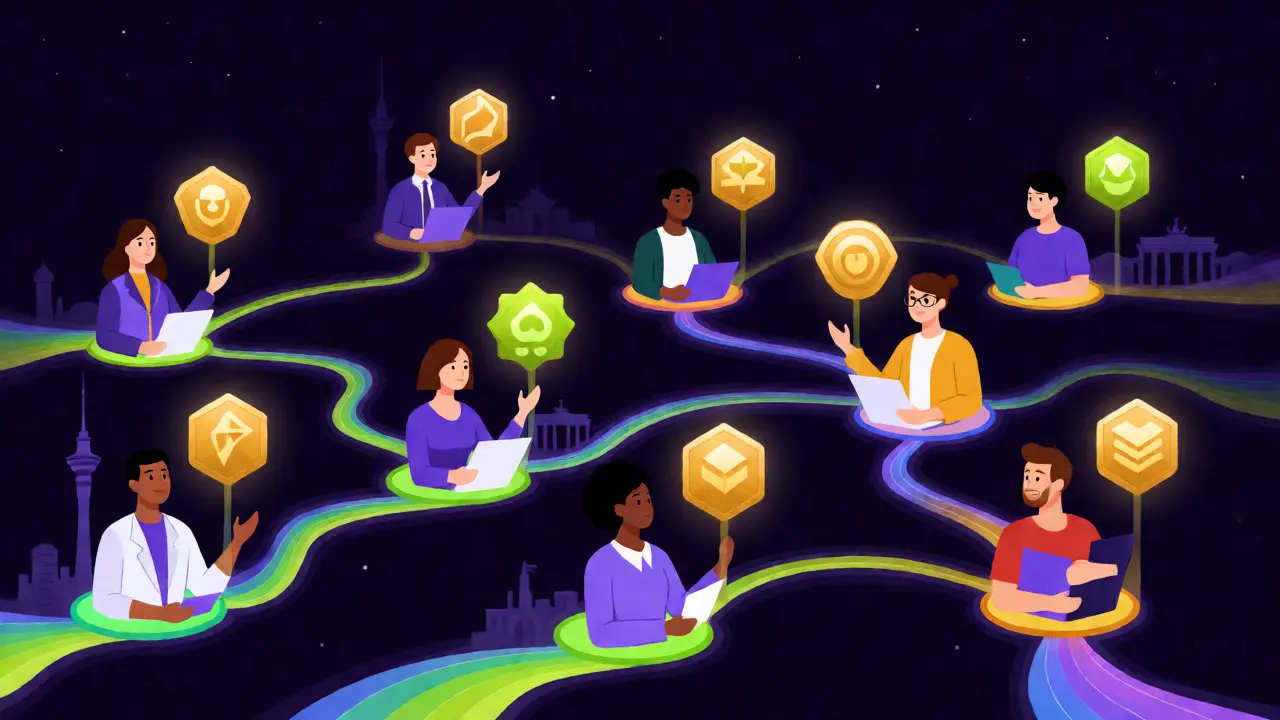
Consider a graphic designer in Auckland. She completes a specialized UX course on a decentralized platform. The credential is minted on the blockchain. She applies for a job in Berlin. The hiring manager scans her QR code-linked wallet. Instantly, they see the syllabus, the grade, and the verifier’s signature. No phone calls. No delays. Just pure, verifiable data.
Financial Models: Paying for Knowledge Without Banks
Money is another area where decentralization disrupts education. Traditional tuition involves loans, interest rates, and bank intermediaries. Decentralized networks often use cryptocurrencies, digital assets secured by cryptography that operate independently of a central bank, enabling peer-to-peer payments.
This opens doors for global access. A student in a developing nation can pay a tutor in New Zealand directly, bypassing expensive international wire fees. Furthermore, tokenomics allow new funding models. Learners can stake tokens to access premium content, earning rewards for participation. Tutors can receive tips instantly. Some platforms even offer income-share agreements coded into smart contracts-if you get hired after completing a bootcamp, a percentage of your salary automatically flows back to the educators until the debt is paid. It aligns incentives: educators only win if students succeed.
Governance: Who Runs the School?
In a traditional university, the board of directors makes decisions. In a Decentralized Autonomous Organization (DAO), an organization represented by rules encoded as a computer program that is transparent, controlled by organization members and not influenced by a central government, the community decides. Students, teachers, and investors hold governance tokens. These tokens give voting rights on curriculum changes, fund allocation, and platform upgrades.
This sounds chaotic, but it creates extreme accountability. If a professor stops teaching well, the community can vote to remove their access to the treasury. If a course becomes outdated, users can propose updates. It turns education from a service you buy into a community you co-create. This model fosters engagement because participants have skin in the game. They aren’t just consumers; they’re stakeholders.

Challenges You Shouldn’t Ignore
It’s not all smooth sailing. The energy consumption of some blockchains is still a concern, though newer networks like Solana or Polygon are far greener. There’s also the issue of digital literacy. Managing private keys is terrifying for non-techies. Lose your key, lose your degree. While recovery solutions are improving, the fear factor remains high.
Then there’s regulation. Governments are slow to recognize blockchain credentials. Will a hospital accept a DAO-certified nursing credential? Not yet. We need interoperability standards so that different blockchains can talk to each other. Right now, we have fragmented islands of trust. The future depends on creating a unified layer where a credential earned on Chain A is respected on Chain B.
What to Expect in the Next Five Years
By 2031, expect hybrid models to dominate. Top-tier universities won’t disappear, but they will integrate blockchain rails for issuing diplomas. Corporate training departments will switch to tokenized badges to track employee upskilling in real-time. Lifelong learning accounts will become standard, allowing individuals to carry their educational identity across borders and careers seamlessly.
You should start paying attention to which platforms support open standards. Look for those using W3C Verifiable Credentials. Ask if your current certifications are portable. And consider experimenting with a crypto wallet-not to trade coins, but to store a digital badge. It’s a small step, but it puts you ahead of the curve.
The promise of decentralized learning isn’t about replacing teachers with robots. It’s about removing the friction between learning and proving. It’s about giving power back to the learner. As someone living in a hub of innovation like Auckland, I see this shift happening in real-time. The tools are ready. The question is whether we have the collective will to adopt them.
Are blockchain degrees recognized by employers?
Currently, recognition varies. Tech companies and startups are early adopters, valuing the verifiable nature of skills. Traditional sectors like law or medicine still require accredited institutional degrees. However, as interoperability improves, hybrid credentials combining traditional accreditation with blockchain verification are becoming more accepted.
Is it safe to store my academic records on the blockchain?
Yes, generally safer than centralized servers regarding tampering. However, security depends on your personal management of private keys. If you lose your password or seed phrase, you may lose access to your credentials permanently. Reputable platforms offer recovery options and custodial wallets to mitigate this risk.
Do decentralized learning networks replace universities?
Not entirely. They complement traditional education by offering flexibility, lower costs, and specific skill validation. Universities provide networking, social development, and deep theoretical foundations that decentralized micro-learning often lacks. The future likely holds a blend of both.
How much does it cost to join a decentralized learning network?
Costs vary widely. Some networks are free to join, charging only transaction fees (gas fees) for minting credentials, which can range from cents to a few dollars depending on the blockchain used. Others require subscription fees or token staking. Always check the specific economic model of the platform.
Can I transfer my existing credits to a blockchain system?
Directly transferring old paper transcripts is difficult. Most systems currently issue new credentials on-chain. However, some pilot programs allow universities to upload historical data to a blockchain, creating a digital twin of your record. This process is still evolving and not universally available.
Comments
Joanna Mucha
How utterly pedestrian to reduce the sublime architecture of human knowledge acquisition to mere transactional verification. You speak of "friction" as if it were a bug rather than a feature, a necessary ritual that forces the mind to slow down and truly absorb the weight of what has been learned. The centralized institution is not merely a database; it is a temple of authority, a sacred hierarchy where the gatekeepers have earned their place through centuries of accumulated wisdom. To hand your degree over to a "dusty filing cabinet" is to acknowledge the sanctity of tradition, whereas handing it to a blockchain wallet is akin to selling your soul for convenience.
The pretense that we can simply mint our intellect into non-fungible tokens betrays a profound misunderstanding of epistemology. Knowledge is not an asset to be traded on a decentralized exchange; it is a state of being, a transformation of the self that cannot be captured in cryptographic hashes. When you strip away the institutional prestige, you are left with nothing but hollow data points, devoid of context, devoid of mentorship, devoid of the very social fabric that gives learning its meaning. This obsession with "user-owned records" is just another symptom of our narcissistic age, where every individual believes themselves to be the sole arbiter of truth, ignoring the collective consensus that has sustained academia for millennia.
Moreover, the energy consumption argument is a red herring, but the digital literacy barrier is real and damning. Are we really prepared to entrust the legacy of human achievement to private keys managed by people who struggle to remember their email passwords? The fragility of this system is terrifying. One lost seed phrase, one forgotten password, and the entire edifice of your educational history evaporates into the ether, unverified and unrecoverable. It is a dystopian vision dressed up in the clothes of innovation, promising freedom while delivering only isolation. I suspect that those most eager to adopt these networks are those least equipped to handle the philosophical burden of true autonomy.
Kim Edwards
I am absolutely SHAKING reading this! Can you believe they want us to trust a computer code with our life's work?? It’s terrifying!! Imagine waking up tomorrow and your whole degree is gone because some random node crashed or you forgot your password!!! I would literally pass out from the anxiety!!! 😱😱😱
Bonnie Watt
Oh please. Another tech bro fantasy. Universities aren't broken, people are just lazy and want shortcuts. If you actually cared about learning you wouldn't care how fast you can prove it to a recruiter. This whole thing is just a way for corporations to avoid paying fair wages by pretending skills are easily verifiable commodities. It's insulting to actual scholars.
Meagan Mueller
wake up sheeple
this isn't about education
it's about surveillance
they want to track every single thing you learn forever
no more anonymity
no more starting fresh
your mistakes will haunt you on the ledger until the heat death of the universe
i told you so
Dave Gibbeson
Listen, the potential here is massive if we execute it right. We need to focus on interoperability standards immediately. Without cross-chain compatibility, we're just creating new silos. Let's push for W3C Verifiable Credentials adoption now. This is the future of workforce development and we cannot afford to lag behind.
Sabrina Newland
wait but like... 🤔
if i lose my key do i lose my brain?? lol jk mostly
but seriously though does this mean my bad grades from freshman year are there forever?? 😬
feels kinda heavy but also cool?? idk im confused 🧠💭
Amara Akbar
This perspective offers a compelling glimpse into the evolving landscape of credentialing. While the technical hurdles are significant, the empowerment of the learner is a noble goal. It is essential that we approach this transition with patience and robust support systems to ensure no student is left behind due to technological barriers.
Mark Harvey
love the energy here
just remember to take it one step at a time
start small
maybe just try storing one badge first
you got this!
Art HND
Inefficient. Blockchain adds complexity without solving the core issue of quality assurance. A hash proves existence, not merit. Garbage in, garbage out.
Brandon Olvera
Foreign tech nonsense. American universities are fine. Don't fix what isn't broken.
Elizabeth Brooks
hey guys great post! just wanted to add that gas fees can get pretty high on eth mainnet during congestion so maybe look at layer 2 solutions like polygon or arbitrum for cheaper transactions. also make sure your wallet supports erc-721 standards properly so the metadata doesn't break. hope that helps! :)
Deb Kortyna, MBA
I must express my profound concern regarding the implications of this shift. The decentralization of academic records removes the crucial element of institutional accountability. Who bears the responsibility when a credential is disputed? In a traditional setting, there is a clear chain of command. Here, it is ambiguous. Furthermore, the environmental impact of proof-of-work chains remains a significant ethical consideration that cannot be ignored in favor of mere convenience.