


Changing careers is expensive. You trade months of unpaid study time for a promise that the future will pay off. In 2026, that promise feels riskier than ever. The tech hiring boom has cooled, and entry-level roles are harder to land than they were in 2021. So, before you hand over $15,000 or sign an Income Share Agreement, you need cold, hard math. Not marketing fluff.
This guide breaks down the real return on investment (ROI) for coding bootcamps. We’ll look at tuition, hidden costs, opportunity costs, and realistic salary expectations. If you’re switching from marketing, teaching, or retail into software development, this is your financial stress test.
The True Cost of a Coding Bootcamp
Tuition is just the headline number. To calculate accurate ROI, you must account for every dollar leaving your pocket. Most full-time immersive programs run between $10,000 and $20,000. Part-time options often cost less but take longer, increasing your total expenditure.
- Tuition Fees: Average $14,000 for a 12-week intensive program in 2026.
- Living Expenses: If you quit your job to attend, add $3,000-$5,000 per month for rent, food, and bills. For a 3-month bootcamp, that’s $9,000-$15,000 extra.
- Opportunity Cost: This is the salary you lose by not working. If you earn $40,000/year as a teacher, quitting for three months costs you $10,000 in lost wages.
- Hidden Fees: Textbooks, software licenses, portfolio hosting, and application fees can add $500-$1,000.
Let’s say you pay $15,000 tuition and live frugally during the course. Your direct cash outlay is $15,000. But if you also lose $10,000 in wages, your true investment is $25,000. That’s the number you use for ROI calculations.
Calculating Your Break-Even Point
Break-even is the moment when your new salary covers all costs incurred during training. It’s not about profit yet; it’s about recovering your investment. Here’s how to estimate it.
First, determine your post-bootcamp starting salary. According to recent labor market data, junior developers in the US start around $70,000-$85,000 annually. In high-cost areas like San Francisco or New York, this jumps to $90,000+. In lower-cost regions, it might be closer to $60,000.
Next, subtract your pre-bootcamp annual salary. If you earned $45,000 as a graphic designer and now earn $75,000 as a junior developer, your annual gain is $30,000.
| Cost Category | Amount ($) |
|---|---|
| Tuition | 15,000 |
| Lost Wages (3 months) | 11,250 |
| Living Expenses (above normal) | 3,000 |
| Total Investment | 29,250 |
| Annual Salary Increase | 30,000 |
| Break-Even Time | ~12 Months |
In this example, you break even in roughly one year. After that, every paycheck is pure gain compared to your old career. If your previous job paid minimum wage, your break-even could be under six months. If you were already earning $60,000, it might take two years.
Income Share Agreements vs. Upfront Payment
Many bootcamps offer Income Share Agreements (ISAs). With an ISA, you pay little or nothing upfront. Instead, you agree to pay a percentage of your salary for a set period after landing a job. Typically, this is 10-15% of income for 24-36 months.
ISAs shift the risk from you to the school. If you don’t get a job, you don’t pay. But if you do well, you may end up paying more than the upfront price. Let’s compare.
- Upfront Tuition: $15,000 paid immediately. Total cost: $15,000.
- ISA Option: 10% of salary for 24 months. On a $75,000 salary, that’s $7,500/year. Over two years, you pay $15,000. Same cost?
Not quite. With ISAs, there are often caps. If the cap is $20,000, and you earn $90,000, you still only pay $20,000. But if you earn $60,000, you pay $12,000 over two years-cheaper than upfront. However, ISAs restrict your ability to negotiate salaries or switch jobs quickly because payments continue regardless.
Also, ISAs rarely include interest-free financing. Some schools charge late fees or administrative costs. Always read the fine print. Ask: What happens if I change careers again? Do I owe money if I work freelance?

Job Placement Rates: The Real Risk Factor
A bootcamp’s advertised placement rate isn’t always reliable. Schools define “placed” differently. Some count internships, part-time gigs, or roles unrelated to coding. Others require full-time employment within six months.
To assess risk, ask these questions:
- What percentage of graduates land relevant jobs within six months?
- How many alumni are still employed after one year?
- Can I speak with recent graduates directly?
If a school claims 90% placement but won’t provide verifiable data, treat it as a red flag. In 2026, the average verified placement rate for reputable bootcamps hovers around 70-80%. That means 1 in 5 students struggle to find work immediately.
Your personal risk depends on your background. A former marketer with strong communication skills may adapt faster than someone with no professional experience. Build a portfolio early. Contribute to open-source projects. Network aggressively. These actions boost your chances beyond what the bootcamp alone provides.
Alternative Paths to Consider
Coding bootcamps aren’t the only way to switch careers. Self-study, university degrees, and apprenticeships offer different trade-offs.
| Path | Time Commitment | Cost Range | Support Level | Employer Perception |
|---|---|---|---|---|
| Coding Bootcamp | 3-6 months | $10k-$20k | High (career services) | Mixed (growing acceptance) |
| Self-Study | 6-12 months | $0-$500 | Low (community-driven) | Varies (portfolio-dependent) |
| University Degree | 4 years | $20k-$60k+/year | Medium (structured) | High (traditional credential) |
| Apprenticeship | 1-2 years | $0-$5k | Very High (on-the-job) | Growing (employer-specific) |
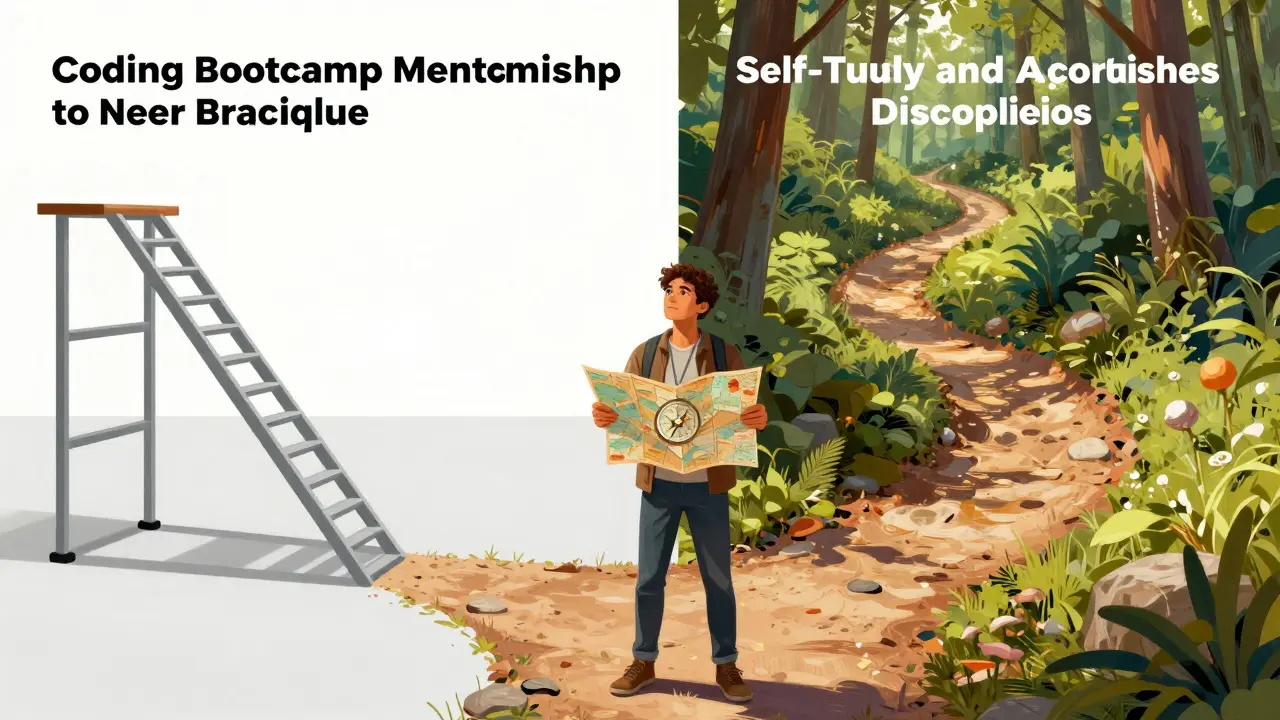
Self-study works if you’re disciplined. Free resources like freeCodeCamp, The Odin Project, and YouTube tutorials cover most fundamentals. But without structure, many learners burn out. Bootcamps force accountability through deadlines, peer pressure, and mentorship.
University degrees offer depth but lack speed. They’re ideal if you want long-term flexibility or plan to move into management later. Apprenticeships combine learning with earning, reducing financial risk. Look for programs sponsored by companies like Google, Microsoft, or local tech hubs.
When Is a Bootcamp Worth It?
A bootcamp makes sense if:
- You need structured learning and external accountability.
- You value networking and career support services.
- You can afford the cost without going into debt.
- You have some prior technical exposure (even basic HTML/CSS).
- You’re targeting roles where portfolios matter more than degrees.
Avoid bootcamps if:
- You expect guaranteed job placement.
- You’re willing to self-teach for free.
- You need immediate income (bootcamps delay earnings).
- You’re switching into fields requiring formal credentials (e.g., healthcare IT).
Remember, ROI isn’t just financial. It includes skill growth, confidence, and network expansion. A bootcamp might not double your salary overnight, but it can accelerate your transition significantly.
Pro Tips for Maximizing Your Return
To get the most out of your investment, follow these strategies:
- Build Projects Early: Don’t wait until graduation. Start building apps during the bootcamp. Employers hire builders, not certificate holders.
- Network Aggressively: Attend meetups, join Slack communities, connect with alumni. Referrals beat cold applications.
- Negotiate Salaries: Use platforms like Levels.fyi and Glassdoor to benchmark offers. Never accept the first offer without research.
- Continue Learning: Tech evolves fast. Keep studying new frameworks, tools, and best practices. Stagnation kills ROI.
- Track Metrics: Monitor your spending, job application response rates, and interview outcomes. Adjust tactics based on data.
Your success depends less on the bootcamp brand and more on your effort outside class hours. Treat the program as a launchpad, not a finish line.
Is a coding bootcamp worth it in 2026?
It depends on your goals and budget. If you need fast, structured training and career support, yes. But weigh costs against alternatives like self-study or apprenticeships. Verify placement rates and talk to alumni before committing.
How long does it take to recoup bootcamp costs?
Typically 12-24 months, depending on your previous salary and new role compensation. Lower-cost regions and higher-paying jobs shorten this timeline. Calculate your break-even point using total investment divided by annual salary increase.
Are Income Share Agreements better than upfront payment?
ISAs reduce upfront risk but may cost more over time. They’re ideal if you’re unsure about job prospects. Compare total repayment amounts, caps, and terms carefully. Read contracts thoroughly to avoid surprises.
What’s the average starting salary for bootcamp grads?
In 2026, junior developers typically start at $70,000-$85,000 in the US. High-cost cities push this above $90,000. Regional variations apply. Check local job boards and salary surveys for accurate benchmarks.
Can I succeed without a bootcamp?
Yes. Many developers learn through self-study, online courses, or apprenticeships. Success requires discipline, consistent practice, and a strong portfolio. Bootcamps provide structure and support, which help some learners thrive.
Do employers care about bootcamp certificates?
Most employers prioritize skills and portfolios over credentials. Certificates signal commitment but don’t guarantee hiring. Focus on demonstrating practical ability through projects and interviews.
What’s the biggest risk in choosing a bootcamp?
Overestimating job placement likelihood. Even top schools face market fluctuations. Research thoroughly, verify claims independently, and prepare backup plans. Diversify your job search strategy beyond school referrals.
Should I pause my current job for a bootcamp?
Only if financially feasible. Full-time immersion accelerates learning but increases opportunity cost. Part-time programs allow continued income but extend duration. Balance lifestyle, finances, and learning pace accordingly.