


When you sign up for an online course, you’re not just buying lessons-you’re signing up for a journey. But here’s the truth: most people don’t finish. Not because they’re lazy. Not because the material is too hard. But because they’re alone. Without someone to check in with, without someone who notices when you’ve gone quiet, motivation fades fast. That’s where accountability partnerships come in. Not as a fancy buzzword. As a simple, powerful tool that turns passive learners into consistent doers.
Why accountability matters more than motivation
Motivation is a spark. Accountability is the fuel. You might start a course because you’re excited. But excitement fades. Life gets busy. Kids get sick. Work piles up. That’s when accountability saves you. It doesn’t ask you to feel inspired. It just asks you to show up. And when someone else is counting on you to report progress, you do. It’s that simple.
Research from the American Society of Training and Development shows people are 95% more likely to complete a goal when they have a commitment partner. That’s not a guess. That’s data from real people in real learning situations. In course communities, this isn’t theoretical. It’s happening every day in discussion boards, private Slack channels, and weekly Zoom check-ins.
What an accountability partnership actually looks like
It’s not a mentor. It’s not a tutor. It’s not a coach. An accountability partner is someone just like you-enrolled in the same course, facing the same deadlines, feeling the same overwhelm. You don’t need to be experts together. You just need to be honest together.
Here’s how it works in practice:
- You pick a partner from your course group-someone whose pace feels similar.
- You agree on a weekly check-in time (15 minutes is enough).
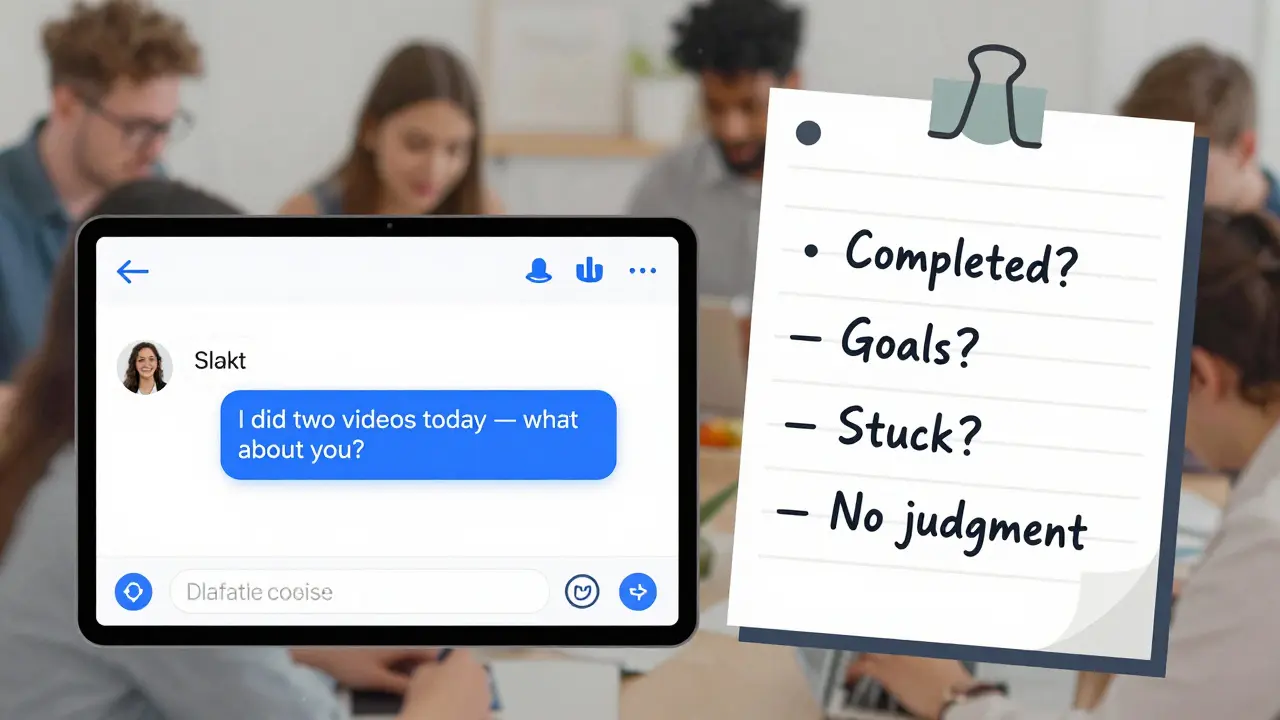
- You each share: what you completed last week, what you’re doing this week, and where you’re stuck.
- No judgment. No pressure. Just clarity.
One student in a digital marketing course told me she didn’t finish her first module for three weeks. She felt guilty. Ashamed. Then she paired up with another student who was also behind. They didn’t fix each other’s work. They just said: "I did two videos. What about you?" That tiny exchange broke the cycle. She finished the module the next day.
How to find your accountability partner in a course community
Most course platforms have forums, chat groups, or cohort pages. But finding the right person isn’t about who’s most active. It’s about who’s most honest.
Here’s how to spot a good fit:
- Look for people who post about struggles, not just wins. They’re more likely to be real.
- Reply to a post that says something like, "I’m falling behind and I don’t know why." That’s your opening.
- Send a short, direct message: "Hey, I’m in the same boat. Want to check in every Monday?"
- Test it for two weeks. If it feels forced, try someone else. No pressure.
You don’t need to be friends. You don’t need to chat every day. You just need to show up once a week and say: "Here’s what I did. Here’s what I didn’t. Can you help me think about why?"
Setting up a system that sticks
Most accountability systems fail because they’re too vague. "Let’s hold each other accountable" sounds nice. But it doesn’t work. You need structure.
Here’s a simple template that works across courses:
- Weekly format: 15-minute video call or voice message.
- Three questions:
- What did you complete since we last spoke?
- What’s your goal for the next week?
- What’s blocking you?
- One rule: No excuses. Just facts.
Example: A student in a data science course had trouble with Python loops. Instead of saying, "I just don’t get it," she said: "I spent 90 minutes on this one exercise. I got stuck on the indentation. I tried three tutorials. Still no luck." That’s specific. That’s actionable. Her partner suggested a YouTube video she hadn’t tried. She watched it. Got it.
That’s the power of specificity. Vague goals fail. Clear statements stick.
What to do when your partner disappears
It happens. Someone gets sick. A job takes over. Life interrupts. Don’t take it personally. Accountability partnerships are fragile. They need care.
If your partner goes quiet for more than two weeks:
- Send one kind message: "Hey, just checking in. Hope you’re okay. No pressure to reply."
- If you get no reply, let it go.
- Find someone new. Don’t wait. Don’t guilt yourself.
The system isn’t broken. You just need a new partner. That’s normal. It happens in every course community.
Why this works better than solo learning
When you’re alone, your brain lies to you. "I’ll do it tomorrow." "I don’t need to do it now." "I’m not ready." But when someone else knows what you’re supposed to do, your brain shifts. You start seeing yourself differently. Not as someone who "might" finish. But as someone who does.
One study from Stanford’s Graduate School of Education tracked 300 learners in online certificate programs. Those with accountability partners completed 78% more modules than those who learned alone. The gap wasn’t in intelligence. It wasn’t in time. It was in consistency.
Consistency doesn’t come from willpower. It comes from connection.
What to avoid
Not all partnerships work. Here’s what to watch out for:
- One-sided effort: If you’re always the one checking in, it’s not a partnership. It’s a chore.
- Overly critical partners: Accountability isn’t about shaming. It’s about support.
- Too many goals: Trying to track 10 tasks at once? That’s overwhelm, not accountability. Stick to one or two.
- Waiting for perfection: You don’t need to have it all figured out. Just show up with what you’ve got.
The best partnerships are messy. They’re real. They’re imperfect. And that’s why they work.
Start today
You don’t need a fancy app. You don’t need a coach. You just need one person who knows your name and your goal. Go to your course community right now. Find one person who seems real. Send them this:
"Hi, I’m also in this course and I’m trying to stay on track. Would you be open to a 15-minute check-in every Monday? Just to share what we’ve done and what’s next. No pressure-just a little nudge."
That’s it. That’s all it takes.
Accountability isn’t about being perfect. It’s about being present. And in a world full of distractions, that’s the most powerful thing you can do for your learning.
Can accountability partners be from different courses?
Yes, but it’s harder. Accountability works best when you’re working on the same material at the same pace. If your partner is in a completely different course, you won’t understand their struggles or help them with specific content. It’s better to pair with someone in your own course-even if they’re ahead or behind you. You’ll still learn from each other.
What if I’m shy and don’t want to talk on video?
You don’t need video. A voice message, a text thread, or even a shared Google Doc works just as well. The key is consistency, not format. Some people prefer writing because it gives them time to think. That’s fine. What matters is that you both report progress regularly, no matter how you do it.
How often should we check in?
Once a week is the sweet spot. More often feels like pressure. Less often feels like forgetting. A weekly check-in gives enough time to make real progress but keeps the momentum alive. Choose a day that works for both of you-like Monday mornings or Sunday nights-and stick to it.
What if my partner is ahead of me? Will that make me feel worse?
Not if you frame it right. Seeing someone ahead doesn’t mean you’re failing. It means you have a roadmap. Ask them: "How did you get through this part?" or "What helped you stay consistent?" You’re not competing. You’re learning from their experience. That’s the whole point.
Can I have more than one accountability partner?
You can, but don’t start there. Managing one partnership takes focus. If you try to juggle two or three, you’ll burn out. Wait until you’ve nailed one. Then, if you want, add a second-maybe for a different course or a different type of goal. But one is enough to change your results.
Comments
Jeremy Chick
This is so true. I tried doing a data science course alone and lasted 3 days. Then I paired up with some random guy from the forum who was also behind. We didn’t even talk about the content. Just: "Did you do the lab?" "No." "Me neither. Let’s do it together tomorrow." And we did. No drama. Just two lazy people holding each other accountable. 10/10 would do it again.
Renea Maxima
Hmm. Accountability... sounds like a corporate buzzword dressed up as self-help. 🤔 What if you're just not meant to be consistent? What if the system is broken, not you? Maybe the real problem is that we're taught to grind instead of to breathe. I once skipped a whole month of learning and it was the most productive time of my life. I reevaluated my values. Found my inner peace. Maybe accountability is just another way to sell you the illusion of progress. 🌿
Seraphina Nero
I love how simple this is. No fluff. Just two people saying what they did. I tried a buddy system last year and it fell apart because we turned it into therapy sessions. This? This is clean. I’m going to send a message right now. Just: "Hey, same course. Want to check in every Monday?" That’s it. No pressure. Just presence. 💛
Sagar Malik
Accountability partnerships? How quaint. In the post-capitalist paradigm, individual agency is a myth constructed by neoliberal pedagogical apparatuses. The real issue is not loneliness-it’s the commodification of learning under algorithmic surveillance capitalism. Your Slack channel is just another data point harvested by edtech conglomerates. You think you’re being held accountable? You’re being monitored. And the partner you find? Probably a bot. Or a ghost. Or both. 🤖
Megan Ellaby
I did this last semester and it changed everything. I was stuck on a stats module for weeks. Then I found a girl who was also struggling. We didn’t solve each other’s problems. We just said: "I did 2 videos. You?" She did 3. I did 3 next time. It wasn’t about being perfect. It was about showing up. Now I’m done with the whole course. Just one tiny check-in. That’s all it took.
Rahul U.
I agree with the structure. Weekly check-ins are ideal. But I’d add one more thing: document it. Use a shared Notion page or even a Google Doc. Write down what you did, what you didn’t, and why. It creates a trail. And when you look back? You see progress. Not just effort. That’s powerful. Also, emoji for emotional weight: 📈✅🧠
E Jones
Let me tell you what they don’t want you to know. Accountability partnerships? They’re a gateway drug. First it’s a weekly chat. Then it’s a shared calendar. Then it’s a Zoom group with 12 people. Then you’re signing NDAs. Then you’re being asked to rate your partner’s emotional availability. Then you’re being sold a $299/month app that tracks your keystrokes and sends you motivational affirmations based on your cortisol levels. This isn’t about learning. It’s about surveillance. And the worst part? You’ll thank them for it. 🧠💀
Lissa Veldhuis
You people are so naive. Accountability? That’s just code for "I’m too weak to do this alone so I’m dragging someone else down with me." I did a course once. I didn’t need a partner. I needed discipline. And if you’re falling behind because you don’t have someone to nag you? Maybe you shouldn’t be in this course at all. Just say no. Be alone. Be strong. Or don’t bother.
Michael Jones
You don’t need a system. You don’t need a partner. You just need to decide one morning that you’re not the person who quits. That’s it. That moment when you look in the mirror and say "I’m done lying to myself." That’s when the change happens. Not because someone asked you. But because you finally stopped running. Stop looking outside. Start looking inside. The answer was always there. You just had to be brave enough to see it. 🔥
allison berroteran
I really appreciate how this post doesn’t sugarcoat it. I tried accountability once and it felt like homework. Then I found someone who was also behind, and we just texted once a week. No calls. No video. Just: "Did the thing?" "Not yet." "Me neither. Tomorrow?" "Yeah." And we did. It wasn’t about fixing each other. It was about not being alone in the mess. I didn’t finish first. But I finished. And that mattered more than being fast. Sometimes the quietest wins are the ones that last. 🌱
Gabby Love
I’m a grammar nerd, so I’ll say this: your wording is perfect. Clear. Direct. No fluff. That’s how accountability should feel. No jargon. No pressure. Just facts. I’ve been in 3 course communities and this is the only method that actually stuck. I’m sending a message now. Just: "Hey, same course. Want to check in Monday?" Simple. Real. Done.
Jen Kay
I love this. But I have to say-I’ve seen too many of these partnerships collapse because one person started treating it like a performance. "I did 10 videos!" "I only did 2..." That’s not accountability. That’s competition. The magic is in the honesty. "I didn’t do anything. I was exhausted." "Same. Let’s try again next week." That’s the real connection. No trophies. Just humanity. 🙏