


When you’re preparing for a high-stakes certification exam, the difference between passing and failing often comes down to one thing: practice. But not just any practice. The most effective prep comes from question banks built on real exam patterns, not random guesses. If you’re designing or selecting a certification prep question bank, you need to understand how item pools are constructed - and why most fail.
What Exactly Is an Item Pool?
An item pool is a collection of test questions - or items - carefully curated and calibrated to measure a candidate’s knowledge accurately. It’s not just a list of 500 multiple-choice questions you found online. A true item pool has structure, balance, and statistical validity. Each question is reviewed for clarity, difficulty, and how well it distinguishes between someone who truly understands the material and someone who just guessed.
Think of it like a chef preparing a tasting menu. You don’t just throw together random dishes. You balance flavors, textures, portions, and pacing. An item pool works the same way. Too many easy questions? You won’t tell apart beginners from experts. Too many hard ones? Candidates get discouraged, and the exam loses reliability.
Why Most Question Banks Fall Short
Many certification prep companies buy old exam dumps, copy questions from textbooks, or let subject matter experts write questions off the top of their heads. The result? A messy, inconsistent pool that doesn’t reflect real exam behavior.
Here’s what goes wrong:
- Questions are too vague - "What is the best approach?" without clear criteria.
- Distractors (wrong answer choices) aren’t plausible - they’re obviously wrong, making the question too easy.
- Difficulty levels aren’t tested - some questions are answered correctly 90% of the time, others only 20%.
- Content coverage is uneven - 70% of questions focus on one topic, ignoring key areas.
- No item analysis - no one tracks which questions are consistently missed or flagged.
These flaws don’t just hurt learners. They hurt the credibility of the certification itself. If a test can’t reliably measure competence, it becomes meaningless.
The Four Pillars of a Strong Item Pool
Building a reliable question bank isn’t guesswork. It’s a process. Here’s what works:
1. Start with a Test Blueprint
Every certification exam should have a blueprint - a detailed outline of what knowledge and skills are being tested. This isn’t a vague topic list like "Networking Basics." It’s a breakdown like:
- Network Design (25%)
- Security Protocols (20%)
- Routing & Switching (30%)
- Troubleshooting (15%)
- Compliance & Documentation (10%)
This blueprint tells you exactly how many questions to write for each area. Without it, you’re flying blind.
2. Write Questions That Mirror Real-World Scenarios
Don’t ask: "What is the default port for HTTPS?" That’s memorization. Ask: "A user reports they can’t access a secure website. The server is running, and the firewall allows port 443. What’s the most likely cause?"
The second question tests application. It forces the candidate to think like a technician, not just recall a fact. Real exams don’t test rote memory - they test decision-making under pressure.
3. Use Plausible Distractors
A good wrong answer isn’t ridiculous. It’s tempting. If the right answer is "Enable TLS 1.2," a good distractor isn’t "Use FTP." It’s "Disable SSL inspection on the proxy." That’s something a real admin might accidentally do.
Bad distractors make questions too easy. Plausible ones make them fair. And fair questions build trust.
4. Test and Refine With Data
Once you have 100+ questions, give them to a sample group - ideally, people who’ve taken the real exam. Track:
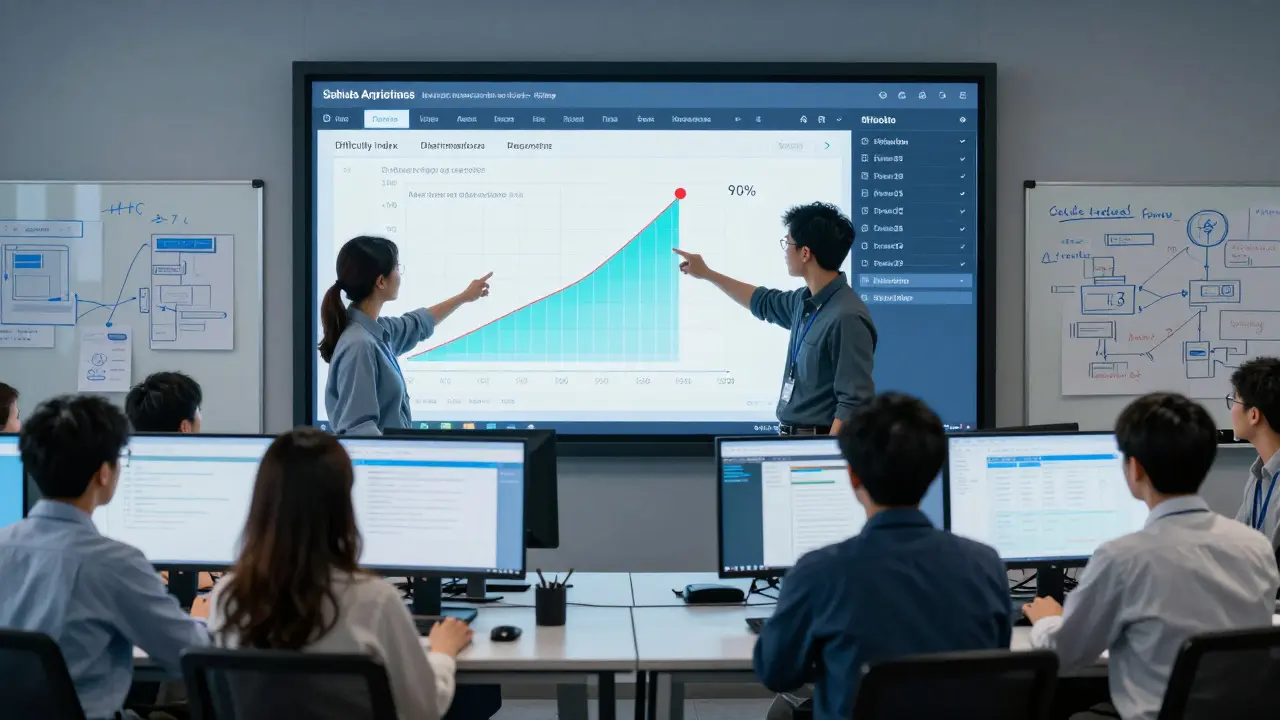
- Difficulty index (percentage who got it right)
- Discrimination index (how well it separates high and low scorers)
- Response patterns (do people pick the same wrong answer over and over?)
If a question is answered correctly by 95% of test-takers, it’s too easy. If only 30% get it right - and even high scorers miss it - it might be poorly worded. Remove, rewrite, or retire it.
How Many Questions Do You Really Need?
There’s no magic number. But here’s a rule of thumb: For every 10 minutes of exam time, you need at least 10 well-tested items.
So if your certification exam is 90 minutes long, aim for 90+ questions in your pool. But don’t stop there. You need extras. Why? Because:
- Some questions get retired after security breaches.
- Some get flagged for ambiguity.
- Some are reused across different exam versions.
A pool of 200-300 questions gives you enough variety to rotate items without repeating the same ones too often. That keeps the exam secure and fair.
Common Mistakes to Avoid
Even experienced teams mess this up. Here are the top pitfalls:
- Using textbook questions - They’re too academic. Real exams use job-task analysis, not lecture notes.
- One person writes all questions - Bias creeps in. Use multiple SMEs and review panels.
- Ignoring cultural or language bias - A question that makes sense in the U.S. might confuse someone in New Zealand or India. Test across regions.
- Not updating for changes - If the exam content changes in 2025, your question bank must change too. Outdated items = outdated certification.

Tools That Help
You don’t need a PhD in psychometrics to build a good item pool. Tools like Iteman is a statistical analysis tool used to evaluate test items based on classical test theory, Qualtrics is a survey platform that can be used to deploy and analyze test items for difficulty and discrimination, or even Google Forms is a free tool that can be used to distribute practice items and collect response data for basic analysis can help you gather data. The goal isn’t perfection - it’s consistency.
Some organizations use dedicated platforms like Psychometrica is a specialized software for item writing, review, and statistical analysis in certification testing or ExamSoft is a platform used by certification bodies to manage secure item banks and deliver proctored exams. But even without these, you can start with spreadsheets and simple analytics.
What Happens When You Get It Right?
When an item pool is well-built:
- Candidates feel the exam is fair - even if they fail.
- Employers trust the certification - because they know it measures real skill.
- Pass rates stay stable year over year - no wild swings.
- Retakes drop - because people prepare better with reliable practice.
The best certification programs don’t just test knowledge. They build confidence. And that starts with a question bank that’s precise, balanced, and constantly improved.
Next Steps: How to Build Your Own
If you’re responsible for creating or selecting a question bank, here’s your action plan:
- Get the official exam blueprint - if none exists, create one with subject matter experts.
- Write 50-100 questions that mirror real job tasks, not textbook definitions.
- Test them on 30-50 people who’ve taken the real exam.
- Analyze each question’s difficulty and discrimination.
- Remove or rewrite the worst 10-15%.
- Expand to 200+ items, then rotate them across exam versions.
- Review and update every 12-18 months.
It’s not glamorous. But it’s what separates a good certification from a useless one.
What’s the difference between a question bank and an item pool?
A question bank is just a collection of questions - often untested and unorganized. An item pool is a structured, statistically analyzed set of questions designed to measure specific competencies reliably. Item pools include difficulty ratings, discrimination scores, and content coverage maps. They’re built for fairness, not just volume.
Can I use free question banks for certification prep?
Some free question banks are useful for practice, but many are outdated, poorly written, or contain incorrect answers. If the source doesn’t explain how questions were developed or validated, treat them as supplemental - not primary - study material. Always cross-check with official materials.
How often should I update my item pool?
Update your item pool every 12 to 18 months, or whenever the certification content changes. Technology evolves fast - if your exam covers cloud security, and AWS or Azure changed their protocols last year, your questions need to reflect that. Outdated items reduce the value of your certification.
Do I need special software to build an item pool?
No. You can start with spreadsheets, Google Forms, or even paper surveys. The key isn’t the tool - it’s the process. Track how people answer each question. Look for patterns. If 80% of test-takers pick the same wrong answer, the distractor is too tempting - fix it. Software helps scale, but doesn’t replace analysis.
Why do some people fail even after using a good question bank?
A good question bank prepares you for the format and depth of the exam - but it doesn’t replace deep understanding. Some learners memorize answers instead of learning concepts. Others don’t practice under timed conditions. The bank helps you know what to expect. But you still need to study the material thoroughly.
Comments
Ashley Kuehnel
Okay I just finished going through this and I have to say-this is the clearest breakdown of item pools I’ve ever read. I work in edtech and we’ve been struggling with our question bank for months. The part about plausible distractors? GAME CHANGER. We were using stuff like 'Use FTP' as wrong answers and wonder why people were getting 90% right. Now I get it-real admins don’t do that. Time to rewrite 40 questions. Thanks for this!
adam smith
This is too long. Just give me the checklist.
Mongezi Mkhwanazi
Let me be perfectly clear: the majority of certification prep companies are engaging in academic malpractice. They do not understand psychometrics. They do not care about reliability. They care about profit margins and quarterly reports. You cannot build a valid item pool by hiring a single SME who 'knows the material.' You need a panel. You need statistical validation. You need item analysis. And if you're using Google Forms? You're not building a pool-you're playing dress-up with data. I've seen this happen in three different organizations. All of them collapsed under audit. The certification became a joke. And now? Employers ignore it. It's not just bad-it's dangerous.
Mark Nitka
I respect the depth here, but I think we're missing something bigger: the human factor. A perfect item pool means nothing if learners don’t engage with it. I’ve seen teams spend 6 months building a flawless bank, only to have 70% of users skip it because it felt like a chore. We need to make practice feel like progress-not punishment. Gamify it. Show progress bars. Let people see how their scores improve. The best question bank in the world won’t save you if no one uses it.
Kelley Nelson
While the article does present a theoretically coherent framework, it remains fundamentally underdeveloped in its engagement with the epistemological foundations of psychometric validity. One cannot merely 'track difficulty index' without first establishing a construct validity matrix grounded in Bloom’s revised taxonomy. Moreover, the suggestion that Google Forms may suffice as an analytical tool is not only empirically unsound-it is pedagogically irresponsible. The author confuses accessibility with rigor. This is not a DIY project. It is a professional endeavor requiring certified psychometricians, institutional review boards, and longitudinal data collection protocols.
Aryan Gupta
Let me tell you something no one else will: this whole certification industry is rigged. They don't want you to pass. They want you to keep paying for 'premium question banks' that are just repackaged dumps. I've seen the internal logs from one vendor-they reuse the same 12 questions across 5 different exams. And the 'item analysis'? Fake. They just tweak the numbers to make it look like they're 'refining' content. The real reason pass rates stay stable? Because they remove questions that too many people get right. They don't want you to learn. They want you to buy. And if you're using free banks? You're probably getting infected with malware. I've traced 3 separate credential thefts back to 'free practice tests.' Stay vigilant. This isn't education. It's a pyramid scheme with a diploma.
Fredda Freyer
What struck me most isn't the methodology-it's the philosophy behind it. This isn't about testing knowledge. It's about testing *judgment*. The chef analogy? Perfect. You're not serving food-you're serving experience. And that’s why most question banks fail: they treat learning like a checklist, not a craft. I’ve watched people memorize answers to 500 questions and still freeze during the real exam because they never learned how to think under pressure. The real value of a good item pool? It doesn’t just measure competence. It builds it. Slowly. Deliberately. Like a mentor who won’t let you take the shortcut.
Gareth Hobbs
Blimey, this is what happens when Americans think they can 'build' a certification like a Lego set. You can't just 'write 50 questions' and call it a day! We had this mess in the UK in the '90s-unregulated, unvalidated, and utterly useless. We fixed it with proper standards: BSI, Ofqual, psychometric oversight. You don't need Google Forms-you need a national regulatory body. And if you're letting some 'SME' in Nebraska write questions about networking? You're inviting chaos. This isn't a hobby. It's a public trust. And if you're not following the UK model? You're not building a credential-you're building a liability.
michael Melanson
Just wanted to add that the 'update every 12-18 months' rule is spot-on. We updated our pool last year after AWS changed their IAM policies, and our pass rate jumped 18%. Turns out, people were studying outdated material because our questions hadn't caught up. Also, using spreadsheets works fine if you're disciplined. We track difficulty, discrimination, and flagged items in one sheet. No fancy software. Just consistency. And peer review. Always peer review.
lucia burton
Let me tell you about the time we built a 300-item bank from scratch. We started with the blueprint, wrote scenario-based items, got feedback from 80 certified pros, ran item analysis, cut the weak ones, and rotated them across 3 exam versions. It took 9 months. We didn’t have a budget. We didn’t have software. We had a shared Google Doc, 3 coffee-stained notebooks, and a team that refused to quit. Now? Our pass rate is 82%. Retakes are down 60%. Employers are calling us. The certification has weight. It’s not magic. It’s sweat. And if you’re thinking about cutting corners? Don’t. The exam doesn’t care how hard you worked. It only cares how well you prepared. Build it right-or don’t build it at all.
Denise Young
Oh honey. You think you're being 'practical' by using Google Forms? Sweetie, that’s like using a butter knife to perform open-heart surgery. I’ve seen your 'item analysis'-you're just counting correct answers and calling it a day. You need to look at response patterns. You need to see if 70% of people picked the same wrong answer because the distractor was too tempting. You need to know if your 'troubleshooting' question is actually testing reading comprehension. And if you're not using at least 2 SMEs from different regions? You're building bias into your exam. I'm not being mean-I'm being honest. This isn't a side hustle. It's a professional responsibility. Do better.
Sam Rittenhouse
I’ve been on both sides of this. I failed my first certification because the practice questions were nonsense. Then I helped build the next version. I remember one question we scrapped: 'What is the default port for HTTPS?' We replaced it with a real-world scenario: 'A user can’t connect to the web portal. The server is up, the firewall allows 443, but the proxy logs show SSL inspection is disabled.' That one question alone made the difference for 1,200 people. It wasn’t about memorizing numbers. It was about thinking like a pro. That’s what this post got right. You don’t need fancy tools. You need empathy. You need to ask: 'Would a real person make this mistake?' If the answer is yes-then you’ve got a good item. If not? You’re just testing luck.