


Most course creators treat their audience like a bucket of water. You fill it up with ads, wait for the leak to stop, and then pour more in. It’s exhausting, expensive, and frankly, boring. What if you stopped trying to sell to strangers and started building a neighborhood instead?
In 2026, attention is cheap, but trust is expensive. Students don’t just buy course marketing promises; they buy belonging. When you build a community around your curriculum, you aren't just teaching skills-you're creating a tribe. This shifts the dynamic from transactional (one-time sale) to relational (lifetime value). The result? Lower churn, higher referrals, and a product that markets itself.
The Psychology Behind Community-Driven Sales
Why does a group chat feel more valuable than a PDF? It comes down to social proof and accountability. When a student sees others asking questions, sharing wins, or struggling through the same module, the isolation of self-study vanishes. This phenomenon is known as "social learning." It transforms passive consumption into active participation.
Consider the difference between buying a gym membership and joining a running club. The gym sells access; the club sells identity. In the educational space, this means your course isn't just about Python coding or digital marketing-it's about becoming a developer or a marketer. The community validates that identity. When you position your course as the gateway to this group, the perceived value skyrockets. You’re no longer competing on price; you’re competing on connection.
This psychological shift also reduces buyer’s remorse. A solo learner might question their purchase after a tough lesson. A community member asks a question, gets an answer within minutes, and feels supported. That support loop cements the decision to stay enrolled. It turns skepticism into advocacy.
Choosing the Right Platform for Your Tribe
You can’t build a house without a foundation, and you can’t build a community without a platform. But picking the wrong one is a common pitfall. Many creators start with Facebook Groups because they are free. While functional, Facebook algorithms bury content, and data ownership is zero. If Facebook changes its rules tomorrow, your community disappears.
In 2026, dedicated platforms offer better control and deeper integration. Tools like Circle.so, Skool, or Discord provide structured environments where learning and chatting coexist. Let’s break down the options:
| Platform | Best For | Key Feature | Cost Model |
|---|---|---|---|
| Circle.so | Cohort-based courses | Integrated curriculum & forums | Monthly subscription ($99+) |
| Skool | Gamified learning paths | Leaderboards & quizzes | Flat fee ($99/mo) |
| Discord | Tech-heavy or Gen Z audiences | Real-time voice/video channels | Free (Nitro optional) |
| Mighty Networks | Brand-focused communities | Customizable mobile app | Tiered pricing ($83-$417/mo) |
If your course is highly interactive, like a writing workshop or a coding bootcamp, real-time interaction is key. Discord or Slack might work well here. However, if your course is asynchronous, like a photography masterclass, a forum-style platform like Circle allows students to post at their own pace while keeping discussions organized by topic. The choice dictates the rhythm of your community.
Structuring Engagement: From Lurkers to Leaders
A dead community kills conversion rates faster than a high price tag. Silence makes new members feel awkward. To prevent this, you need intentional engagement structures. You cannot rely on organic chaos; you must design interactions.
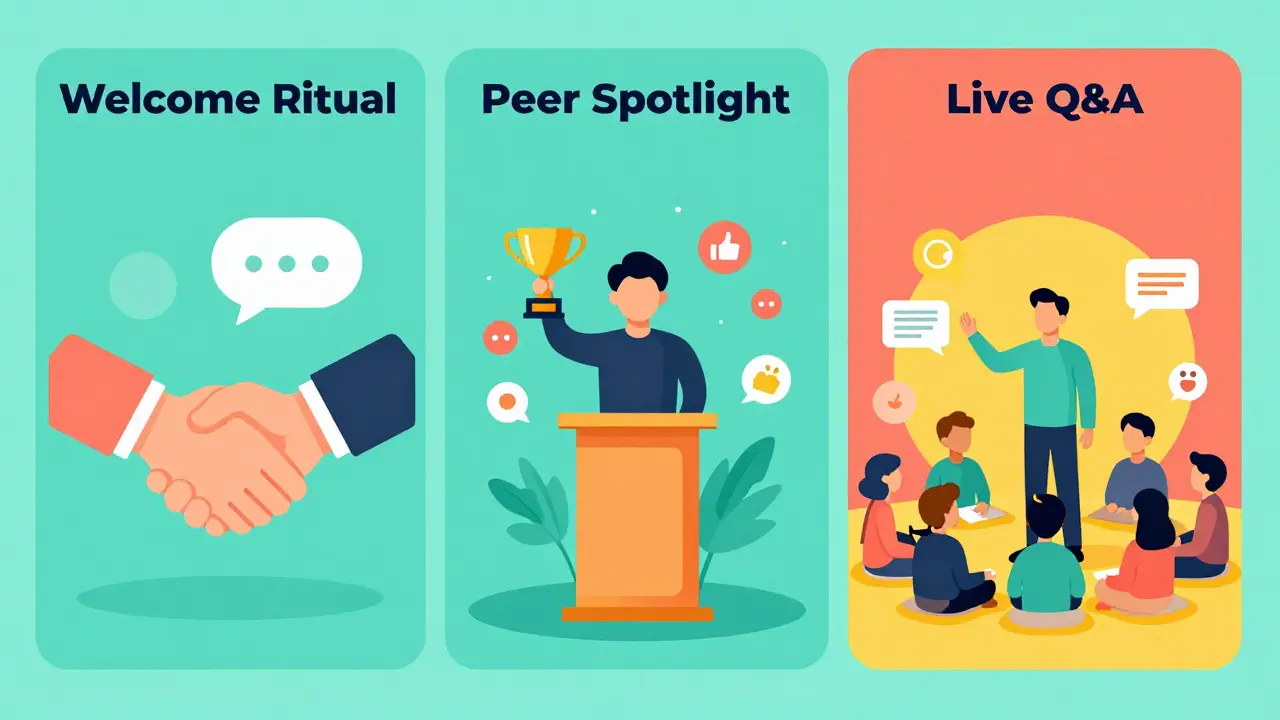
- The Welcome Ritual: Every new member should be greeted within 24 hours. Automate a welcome message that prompts them to introduce themselves using a specific template. This lowers the barrier to entry. Instead of “Say hi,” ask “What’s one goal you have for this month?” Specificity breeds response.
- Weekly Themes: Dedicate each week to a specific module or challenge. If you’re teaching SEO, Week 3 could be “Keyword Research Deep Dive.” Post a prompt related to that week’s lesson. This ties community activity directly to course progress, reinforcing the learning material.
- Peer-to-Peer Spotlights: Highlight student wins publicly. Share screenshots of their projects, celebrate their certifications, or interview them in short video clips. This creates aspirational content for others and rewards active participants.
- Live Q&A Sessions: Host monthly live calls. These don’t need to be lectures. Make them office hours. Answering questions in real time shows expertise and builds personal rapport. Record these sessions and add them to the course library as bonus content.
Notice how these steps create a feedback loop. Activity leads to visibility, which leads to more activity. Over time, super-users emerge. These are the students who answer questions, moderate discussions, and welcome newcomers. Identify them early and give them special roles or badges. Empowering peers to lead scales your community management efforts significantly.

Leveraging Social Proof for Enrollment
Once your community is humming, it becomes your most powerful sales asset. Traditional testimonials are static; community activity is dynamic. Prospective buyers want to see that real people are getting real results right now.
Create a public-facing page or a feed that showcases community highlights. This could be a curated Instagram account, a LinkedIn newsletter, or a dedicated section on your website. Show snippets of conversations where students help each other solve problems. This demonstrates two things: the quality of your teaching and the supportive nature of the environment.
Use case studies derived from community members. Interview a student who applied your strategies and saw a 20% increase in revenue. Break down their journey step-by-step. This provides tangible evidence of ROI. When prospects see that others like them are succeeding, the risk of purchasing diminishes. They aren’t just buying information; they’re buying a proven path.
Furthermore, encourage user-generated content. Ask students to share their progress using a branded hashtag. Repost their stories. This not only fills your social media pipeline with authentic content but also incentivizes students to engage because they know they might be featured. It’s a win-win: you get marketing material, and they get recognition.
Monetization Beyond the Initial Sale
Community building isn’t just about acquiring customers; it’s about maximizing lifetime value (LTV). A student who joins your community is far more likely to buy your next course, attend your workshop, or hire you for coaching. Trust compounds over time.
Consider tiered membership models. Offer a basic course with access to a general discussion forum. Then, create a premium tier that includes direct access to you, small-group masterminds, or advanced modules. This segment allows you to capture higher value from your most engaged users without alienating budget-conscious beginners.
Another strategy is affiliate partnerships within the community. If your course teaches graphic design, partner with software companies or stock photo sites. Offer exclusive discounts to your community members. You earn commissions, and students save money. This adds immediate utility to their membership and reinforces the value of being part of the group.
Don’t overlook the power of referrals. Implement a referral program that rewards both the referrer and the referee. Give existing members a discount or bonus content for bringing friends. Since community members already love the experience, they become natural advocates. Word-of-mouth marketing fueled by genuine enthusiasm is unbeatable.
Pitfalls to Avoid in Community Growth
Building a community is hard work. It requires consistency, empathy, and strategic planning. Many creators stumble by making avoidable mistakes. Here’s what to watch out for:
- Neglecting Moderation: Unchecked toxicity drives away good members. Establish clear community guidelines early. Enforce them consistently. Hire moderators if necessary. A safe space is non-negotiable.
- Over-Automation: While bots can handle welcomes, human connection is irreplaceable. Don’t automate every interaction. Show up personally. Reply to comments. Like posts. Your presence signals that you care.
- Ignoring Feedback: Listen to what your community says. If multiple students struggle with a particular module, update the content. If they request a specific topic, consider adding it. Treat your community as a focus group for continuous improvement.
- Burnout: Trying to do everything alone leads to exhaustion. Delegate tasks. Train community managers. Use templates for recurring posts. Protect your energy so you can sustain long-term engagement.
Remember, a community is a living organism. It needs nurturing. If you treat it as a set-and-forget tool, it will wither. But if you invest in relationships, it will thrive and drive sustainable growth for your business.
Measuring Success: Metrics That Matter
How do you know if your community strategy is working? Vanity metrics like member count can be misleading. A thousand silent members are worth less than fifty active ones. Focus on engagement and retention metrics.
Track daily active users (DAU) and weekly active users (WAU). Monitor the number of posts, replies, and likes per week. Calculate the average time spent in the community. Look at retention rates-are students staying enrolled longer than before? Measure referral rates. How many new sign-ups come from existing members?
Survey your community regularly. Ask net promoter score (NPS) questions: “How likely are you to recommend our course to a friend?” Analyze open-ended feedback for qualitative insights. Combine quantitative data with human sentiment to get a holistic view of health.
Adjust your strategy based on these insights. If engagement drops during certain weeks, introduce new challenges or guest speakers. If retention is low, investigate where students drop off and address those pain points. Data-driven decisions keep your community vibrant and relevant.
Is community building suitable for all types of courses?
While highly effective for skill-based, professional development, and hobbyist courses, purely informational or reference-style courses may benefit less. However, even simple topics can foster discussion if framed around application and shared experiences. Consider the level of interaction required for mastery in your niche.
How much time does community management take?
Initially, expect to spend 5-10 hours per week. As the community matures and peer leaders emerge, this can decrease to 2-3 hours. Automation tools help with routine tasks, but human oversight remains crucial for maintaining culture and resolving conflicts.
Can I build a community without spending money on platforms?
Yes, starting with free tools like Facebook Groups or Reddit is possible. However, you’ll face limitations in customization, data ownership, and algorithmic reach. Dedicated platforms offer better scalability and integration with your course infrastructure, justifying the investment as you grow.
What if my community becomes too large to manage?
Scale by empowering sub-communities or interest groups within the main hub. Recruit and train community moderators from your most active members. Create clear hierarchies and responsibilities. Use automated workflows for common queries to reduce manual load.
How do I handle negative feedback in the community?
Address it promptly and transparently. Move heated discussions to private messages if needed. Acknowledge valid criticisms and outline steps for improvement. Demonstrate that you listen and act. Turning detractors into advocates requires empathy and consistent follow-through.