

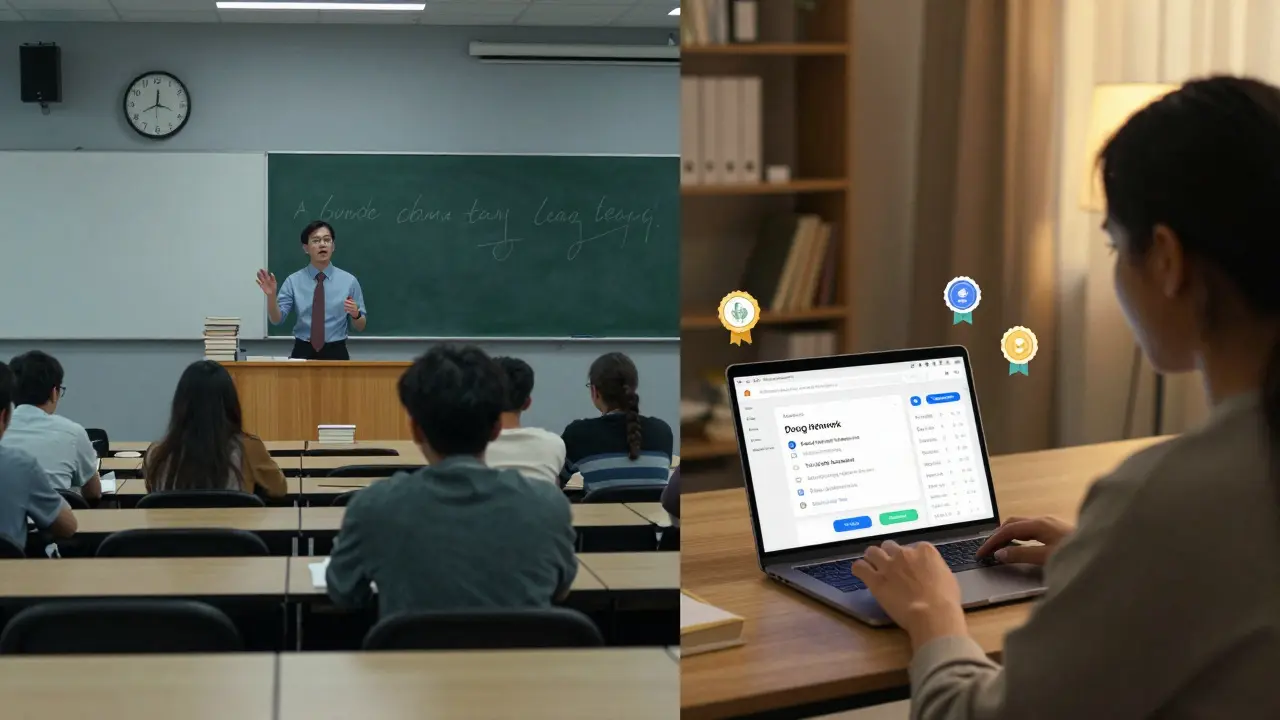
For decades, getting a degree meant one thing: spend four years in college, pass your classes, and walk away with a diploma. But today, that model is cracking. Employers are asking different questions. Instead of "Where did you go to school?" they’re asking, "What can you actually do?" That shift is pushing competency-based education into the spotlight-and making traditional credentials feel outdated for many careers.
What Is Competency-Based Education?
Competency-based education (CBE) flips the script. Instead of measuring learning by time spent in a classroom, it measures learning by what you can do. You don’t move forward because you finished Week 12 of a course. You move forward when you prove you can write a budget, diagnose a patient, debug a network, or lead a team. It’s not about hours logged. It’s about skills mastered.
Think of it like learning to drive. You don’t get your license after 30 hours of driver’s ed. You get it when you pass the road test. CBE works the same way. Programs are designed around clear, measurable outcomes. You take assessments. You get feedback. You retry until you nail it. There’s no penalty for taking longer. There’s no reward for rushing through.
Colleges like Western Governors University and Southern New Hampshire University have built entire degree programs around this model. Students can move quickly through material they already know and focus on what they don’t. Some finish a bachelor’s degree in under two years. Others take five. It doesn’t matter. What matters is the skill.
How Traditional Credentials Still Work-And Why They’re Struggling
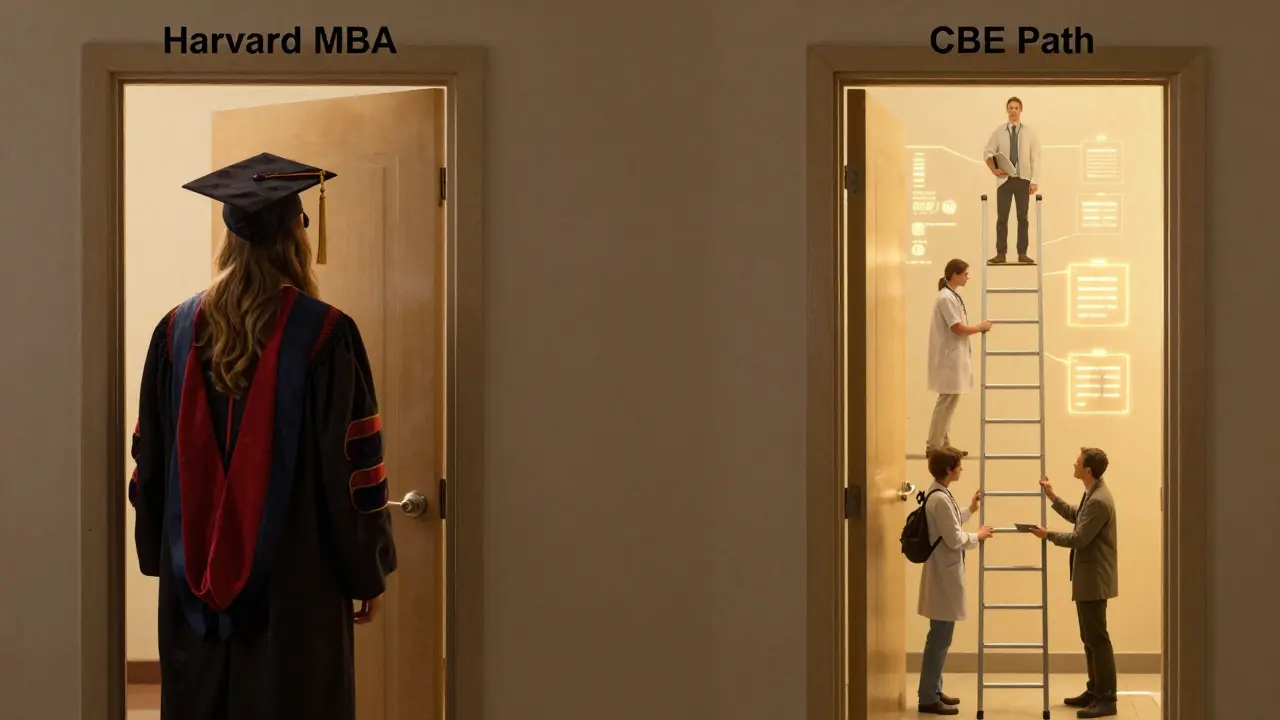
Traditional degrees still have power. A Harvard MBA or a Stanford CS degree still opens doors. Employers use them as filters. They’re easy to verify. They signal discipline. They carry brand weight.
But here’s the problem: a degree doesn’t guarantee competence. A 2024 survey by LinkedIn found that 62% of hiring managers in tech said they’d rather hire someone with a portfolio of real projects than someone with a four-year degree in the same field. Why? Because too many graduates can’t solve actual problems. They’ve memorized theories but haven’t built anything.
Also, traditional education is slow and expensive. The average cost of a four-year public university in the U.S. is now over $100,000. Students graduate with an average of $37,000 in debt. Meanwhile, the job market changes faster than curriculums can update. A degree earned in 2020 might teach skills that are obsolete by 2025.
And let’s not forget access. Not everyone can quit their job, move across the country, or take on massive debt to go back to school. Traditional education was never built for working adults, single parents, or people in rural areas. CBE, on the other hand, often happens online, on your schedule, with real-world tasks.
Real-World Examples: Who’s Winning With Competency-Based Learning?
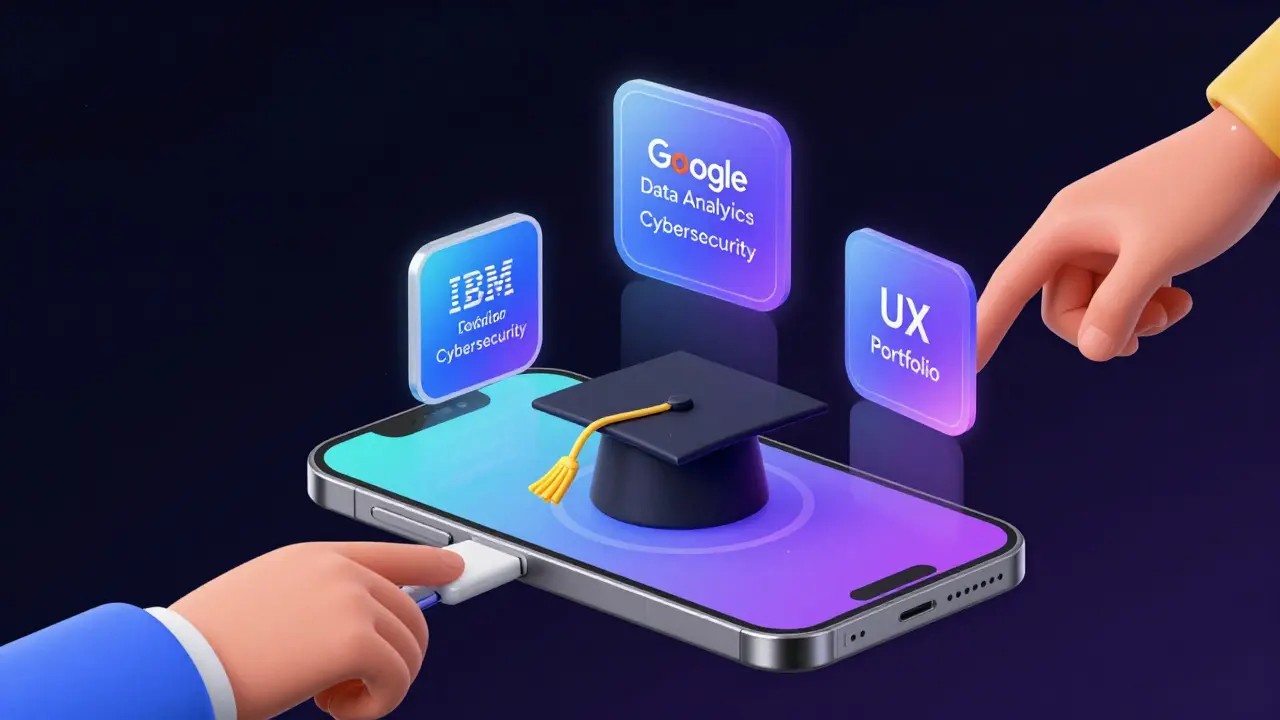
Look at cybersecurity. Companies like IBM and Google now hire for their cybersecurity certificates without requiring a degree. IBM’s Cybersecurity Analyst Professional Certificate on Coursera takes six months to complete. Graduates get hired at companies like Target and Bank of America. They earn starting salaries around $65,000. No bachelor’s needed.
In healthcare, nursing programs in states like Ohio and North Carolina are shifting to competency-based models. Students don’t just sit through lectures. They practice IV insertion, patient assessments, and emergency response in simulations until they hit 100% accuracy. Then they move on. The pass rate for these programs is 15% higher than traditional ones.
Even in trades, it’s changing. Electricians and plumbers are now trained through apprenticeships that track competencies-not semesters. The U.S. Department of Labor has funded over 200 new competency-based apprenticeship programs since 2022. These programs have a 90% job placement rate.
The Hidden Flaws in Competency-Based Models
CBE isn’t perfect. One big issue? It’s hard to standardize. If one school says "proficient in data analysis" means running Python scripts, and another says it means interpreting Excel pivot tables, employers get confused. There’s no universal rubric yet.
Also, some employers still don’t trust it. A 2025 survey by the National Association of Colleges and Employers found that 43% of HR departments at large corporations still require a bachelor’s degree for entry-level roles-even if the job doesn’t need one. They’re not sure how to evaluate CBE credentials.
And what about prestige? A degree from MIT still carries weight in ways a digital badge doesn’t. For fields like academia, law, or medicine, traditional credentials are still mandatory. You can’t become a doctor without a medical degree. You can’t teach at a university without a PhD.
That’s why the future isn’t about replacing degrees. It’s about layering them.
The Hybrid Future: Degrees + Badges + Portfolios
The most successful learners today aren’t choosing between CBE and degrees. They’re combining them.
Take Maria, a 29-year-old single mom in Atlanta. She earned her associate’s degree online while working full-time. Then she took a six-week CBE course in UX design from a platform like Coursera or Udacity. She built three real client projects. She added them to her portfolio. She got hired as a junior designer at a startup. Her degree gave her credibility. Her skills got her the job.
Companies like Salesforce and Microsoft now offer their own certifications alongside traditional degrees. They accept both. Some even let you earn college credit for completing their certifications.
That’s the new model: a degree as a foundation, and competency-based credentials as the upgrades. Think of it like a smartphone. The degree is the phone. The certifications are the apps that make it useful.
What Should You Do Right Now?
If you’re thinking about learning something new, here’s how to cut through the noise:
- Look at the job you want. Check LinkedIn job postings. What do employers actually ask for? If they list "certification in AWS" or "Google Data Analytics," that’s your path.
- Find a CBE program with industry backing. Don’t pick random online courses. Choose ones developed with companies like Google, IBM, or Cisco. They’re vetted.
- Build proof. Create a portfolio. Document your work. Record a video of you solving a problem. Share it. Employers care more about what you’ve done than where you studied.
- Use degrees as a backup, not a requirement. If you need a degree for licensing or advancement (like nursing or teaching), get it. But don’t wait to start building skills.
There’s no one-size-fits-all path anymore. The future belongs to those who can prove what they can do-not just where they went to school.
Is competency-based education cheaper than traditional college?
Yes, in most cases. Competency-based programs often charge per term, not per credit hour. For example, Western Governors University charges $3,350 per six-month term, regardless of how many courses you complete. That’s far less than the $10,000-$30,000 per year most traditional colleges charge. Many CBE programs also offer financial aid and employer partnerships that reduce costs further.
Can you get a job without a degree if you have competency-based credentials?
Absolutely. In fields like IT, digital marketing, data analysis, and cybersecurity, employers increasingly prioritize skills over degrees. Google’s Career Certificates have placed over 150,000 people in jobs since 2020, many without any college background. The key is using recognized credentials from reputable providers and showing real work through portfolios or projects.
Are competency-based credentials recognized by all employers?
Not yet. Large corporations and government agencies still often require degrees for HR compliance. But that’s changing fast. Over 60% of Fortune 500 companies now accept alternative credentials for hiring, according to a 2025 report from the World Economic Forum. The trend is clear: employers are starting to trust skills over diplomas.
How do I know if a competency-based program is legitimate?
Look for three things: industry partners (like IBM, Google, or Microsoft), accreditation from recognized bodies like the Council for Adult and Experiential Learning (CAEL), and job placement data. Reputable programs publish graduate outcomes. If they don’t, walk away. Also, check if the credential is stackable-meaning it can lead to college credit or further certification.
Do competency-based programs work for advanced careers like law or medicine?
Not yet. Fields like law, medicine, architecture, and higher education still require licensed degrees. These professions are heavily regulated and tied to national standards. But even here, CBE is playing a role-like in medical residencies, where skills are tracked and assessed in real-time. The future may see hybrid models, but for now, degrees remain mandatory in these fields.
Comments
Emmanuel Sadi
Oh wow, another woke manifesto on how degrees are obsolete. Let me grab my Google Certificate in 'Emotional Intelligence' and apply for CEO at Goldman Sachs. Meanwhile, my cousin who dropped out of community college to learn TikTok editing just bought a Tesla. Coincidence? I think not.
Real talk: if you can't pass a basic ethics exam or write a coherent essay, you shouldn't be designing systems that affect human lives. Skills are great, but discipline? That’s what a degree proves. And no, your 6-week Coursera badge doesn’t count as 'rigor'.
Nicholas Carpenter
I work in HR at a mid-sized tech firm and I can say this: we’ve hired over 40 people in the last year with no degrees-just certifications and portfolios. One guy built a full-stack app while working night shifts at a gas station. He’s now our lead dev.
The old system wasn’t broken-it was just slow. CBE isn’t replacing degrees, it’s expanding access. And honestly? It’s making our teams way more diverse and way more capable. If you’re still clinging to 'I went to Harvard' as a hiring filter, you’re missing out on real talent.
Chuck Doland
It is imperative to recognize that the evolution of educational paradigms does not inherently invalidate the epistemological foundations upon which traditional credentialing systems were constructed. The university model, while economically and temporally burdensome, remains a structured mechanism for the cultivation of critical thought, intellectual discipline, and epistemic humility.
Competency-based frameworks, while pragmatically expedient, often prioritize instrumental utility over constitutive knowledge. One may master Python syntax without understanding the philosophical underpinnings of algorithmic bias. The former is a skill; the latter, a wisdom. We must not confuse efficiency with enlightenment.
Madeline VanHorn
Ugh. Another 'just get a certificate' post. You think Google's certificate is worth something? Honey, I work at McKinsey. We don’t even look at resumes unless they have 'BA' or 'BS' in the education section.
Real people with real jobs? They went to college. Not some online course with a badge that looks like a child’s drawing. Save it for the gig economy.
Glenn Celaya
Ive seen this movie before back in 2010 when everyone was like oh coding bootcamps will replace cs degrees well guess what 15 years later im still the only one at my company who got hired without a degree and i work 80 hours a week for half the pay so yeah good luck with that
Wilda Mcgee
Let me tell you about my student, Javier-he’s a single dad, works two jobs, and finished his AWS certification in 3 months while putting his kid to bed every night. He’s now a cloud engineer at a startup. No student loans. No dorms. Just grit and a laptop.
Traditional college? That’s a luxury. CBE? That’s survival. And honestly? The people who say 'but degrees teach critical thinking'-you’ve never met someone who learned it by debugging a server at 2am while their baby naps next to them.
Chris Atkins
CBE is the future man seriously if you can do the job who cares where you learned it i mean i learned how to fix my car from youtube and now i run a shop so why should coding be any different
Jen Becker
I hate this. I worked so hard for my degree. I cried at graduation. I spent $80k. And now some guy in his basement with a free certificate gets the same job? It’s not fair.
Ryan Toporowski
Just wanted to say-this is why I love what we’re seeing now. I’ve mentored 3 people through CBE programs. One went from food stamps to $90k/year as a data analyst. No student debt. No 4-year delay.
It’s not about replacing degrees. It’s about giving people who were left out a real shot. 🙌👏
Samuel Bennett
You think Google certificates are legit? Thats a marketing scam. They dont even grade you properly. I checked the code submissions-half the people passed with copy-pasted GitHub repos. And you think employers believe this? Wake up. This is just corporate propaganda to lower labor costs.
Rob D
America is falling apart because we let some foreign online course push a fake education system. Back in my day, you had to sit in a classroom, write essays on paper, and take exams with a #2 pencil. Now? You click a button and get a badge. That’s not education, that’s a video game. And we’re letting it destroy the workforce.
Franklin Hooper
The irony is that those who champion CBE as democratizing are often the same people who dismiss liberal arts, ignore historical context, and reduce human development to a checklist of competencies. One may acquire technical skill without acquiring wisdom. One may be certified without being cultivated. The cost of this reductionism is not yet fully accounted for.