


The solution is Competency Mapping is the process of identifying the specific skills, knowledge, and behaviors required to perform a job effectively and then mapping them against the current abilities of employees. It turns training from a guessing game into a precision tool. Instead of "generic leadership," you focus on "conflict resolution in remote teams" because that's where the actual gap lies.
The Core Pillars of a Competency Framework
Before you can build a curriculum, you need to define what "competent" actually looks like. A common mistake is listing tasks instead of competencies. For example, "Using Excel" is a task. "Data-driven decision making" is a competency. The latter involves the ability to analyze data, find a trend, and suggest a business move based on that trend.
To build a robust framework, you have to look at three distinct levels:
- Core Competencies: These are the non-negotiables for everyone in the company. Think of things like company values, basic security protocols, or internal communication standards.
- Functional Competencies: These are the hard skills required for a specific role. For a software engineer, this might be TypeScript proficiency; for a salesperson, it's discovery call techniques.
- Leadership Competencies: These focus on managing people and strategy, such as emotional intelligence or strategic resource allocation.
When you define these, don't use vague words like "good communication." Use behavioral indicators. Instead of "good communicator," use "can explain complex technical concepts to non-technical stakeholders without using jargon." This gives you a measurable benchmark to train against.
Conducting a Skills Gap Analysis
Once you have your map of what is needed, you need to find out what you actually have. This is where the Skills Gap Analysis comes in. If you skip this, you'll end up training people on things they already know, which is the fastest way to make your employees hate corporate training.
The most effective way to do this isn't a self-assessment survey-people are notoriously bad at judging their own skill levels. Instead, use a mix of these three methods:
- 360-Degree Feedback: Get input from peers, managers, and subordinates. If a manager thinks an employee is a great delegator but the team feels micromanaged, you've found a competency gap in "Trust-based Leadership."
- Work Sample Tests: Give employees a real-world scenario. If the competency is "Crisis Management," give them a simulated PR disaster and see how they handle the first 30 minutes.
- KPI Correlation: Look at the data. If your customer churn rate is high but your product is great, the gap is likely in "Customer Success Management" or "Active Listening."
| Feature | Task-Based Approach | Competency-Based Approach |
|---|---|---|
| Focus | What the employee does (The "How") | What the employee achieves (The "Outcome") |
| Training Goal | Complete a checklist of courses | Demonstrate mastery of a skill |
| Measurement | Completion rates / Test scores | Performance improvement / Behavioral change |
| Flexibility | Rigid, one-size-fits-all | Personalized to the individual's gap |

Designing the Training Curriculum
Now that you have your gaps, you can build the Training Curriculum. The goal here is to move from "Content Delivery" to "Competency Acquisition." Most companies just dump a bunch of videos into a Learning Management System (LMS) and call it a day. That is not a curriculum; it's a library.
A true competency-mapped curriculum follows a logical progression. Start with the "Foundational" level (knowing the concept), move to "Applied" (using the skill in a controlled environment), and end with "Proficient" (consistently achieving the result in the real world).
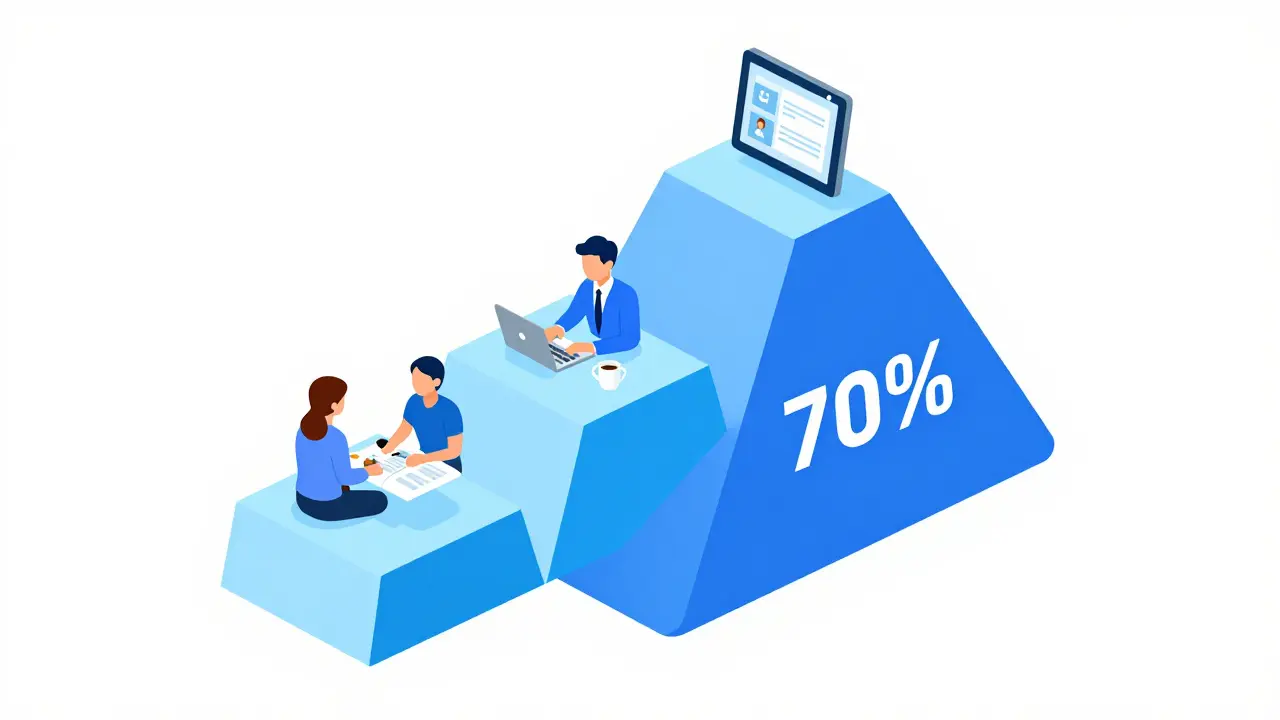
Use the 70-20-10 model for the best results. This suggests that 70% of learning happens through on-the-job experience, 20% through social learning (mentors, peers), and only 10% through formal coursework. If your curriculum is 100% videos and slides, it will fail. For a "Negotiation" competency, your curriculum should look like this:
- 10% Formal: A workshop on the principles of principled negotiation.
- 20% Social: Shadowing a senior account manager during a contract renewal.
- 70% Experiential: Leading a low-stakes vendor negotiation with a mentor observing and providing feedback.
Measuring Success and Iterating
How do you know if your mapping worked? You can't rely on "Smile Sheets" (those surveys at the end of training where people say they liked the catering). You need to track the delta in performance.
The gold standard here is the Kirkpatrick Model of training evaluation. Don't just stop at Level 1 (Reaction). Push for Level 3 (Behavior) and Level 4 (Results). If you trained employees on "Advanced Project Management," the result shouldn't be that they passed a test, but that project delivery times decreased by 15% over the next quarter.
Competency mapping is not a "set it and forget it" project. Industries change. New tools like Generative AI are currently rewriting the competency requirements for almost every white-collar job. A role that required "Technical Writing" in 2023 now requires "AI Prompt Engineering and Fact-Checking" in 2026. Your map needs to be updated every 12 to 18 months to stay relevant.
Common Pitfalls to Avoid
Many organizations overcomplicate the process. They try to map 50 different competencies for a single entry-level role. This leads to "Analysis Paralysis." If you have too many requirements, you can't prioritize training. Stick to the 5-7 most critical competencies that actually drive 80% of the results.
Another trap is ignoring the "Human Element." Mapping is a technical exercise, but training is a human one. If employees feel that competency mapping is being used as a surveillance tool to fire people who don't meet the mark, they will game the system. They'll tell you they've mastered a skill just to get off the training list. Frame the mapping as a growth roadmap, not a performance audit.
How long does it typically take to complete a competency mapping project?
For a mid-sized department, expect the process to take 2 to 4 months. This includes the initial discovery phase (interviews and job analysis), drafting the framework, conducting the skills gap analysis, and finally designing the training curriculum. Rushing this phase usually leads to generic training that doesn't solve the actual performance gaps.
Can competency mapping be used for recruitment?
Absolutely. Once you have a clear competency map, your job descriptions become much more accurate. Instead of asking for "5 years of experience," you can ask for evidence of specific competencies, such as "the ability to manage a budget of $1M+ across multiple vendors." This leads to higher-quality hires who can hit the ground running.
What is the difference between a skill and a competency?
A skill is a specific ability to perform a task, like "coding in Python." A competency is a broader capability that combines skills, knowledge, and behavior to achieve a result. For example, "Software Architecture" is a competency that requires the skill of coding, the knowledge of design patterns, and the behavior of strategic thinking.
How do I handle competencies that change rapidly due to technology?
Separate your "Durable Skills" from "Perishable Skills." Durable skills (like critical thinking or leadership) change slowly and should be the bedrock of your map. Perishable skills (like specific software versions) should be mapped as "Technical Modules" that are reviewed and updated quarterly. This prevents your entire framework from becoming obsolete every time a new software update rolls out.
Is a Learning Management System (LMS) necessary for this?
An LMS is a delivery tool, not a mapping tool. You can do the mapping on a whiteboard or a spreadsheet. However, once you have a complex curriculum with different paths for different competency levels, an LMS helps track progress and automate the delivery of content. Just remember that the mapping must happen before you touch the software.
Next Steps for Implementation
If you're starting from scratch, don't try to map the whole company at once. Pick one high-impact team-perhaps the sales team or the customer success team-and run a pilot program. Define their core and functional competencies, find the gaps, and build a targeted 90-day training sprint.
Once you can show a direct link between the mapping, the training, and an increase in a specific KPI (like a 10% increase in lead conversion), you'll have the internal buy-in needed to scale the process to the rest of the organization. If you hit a wall during the gap analysis, consider bringing in a third-party auditor to provide an objective view of the skills actually present in the workforce.