

Building an online course is not just about recording videos and uploading them to a platform. If you skip the planning phase, you end up with content that confuses students, leads to high dropout rates, and fails to deliver real value. The difference between a hit course and a forgotten one lies in the curriculum development framework. This structured approach ensures every lesson has a purpose, every activity drives engagement, and every assessment proves learning happened.
Whether you are a subject matter expert launching your first workshop or an instructional designer scaling corporate training, this guide breaks down the complete process. We will move from raw ideas to a polished, learner-centric experience using proven pedagogical models.
The Foundation: Needs Analysis and Audience Profiling
Before you write a single line of script, you need to know who you are teaching and why they care. Many creators jump straight into content creation, only to realize their material is too advanced or irrelevant for their target audience. This is where the Needs Analysis comes in. It is the diagnostic phase of your project.
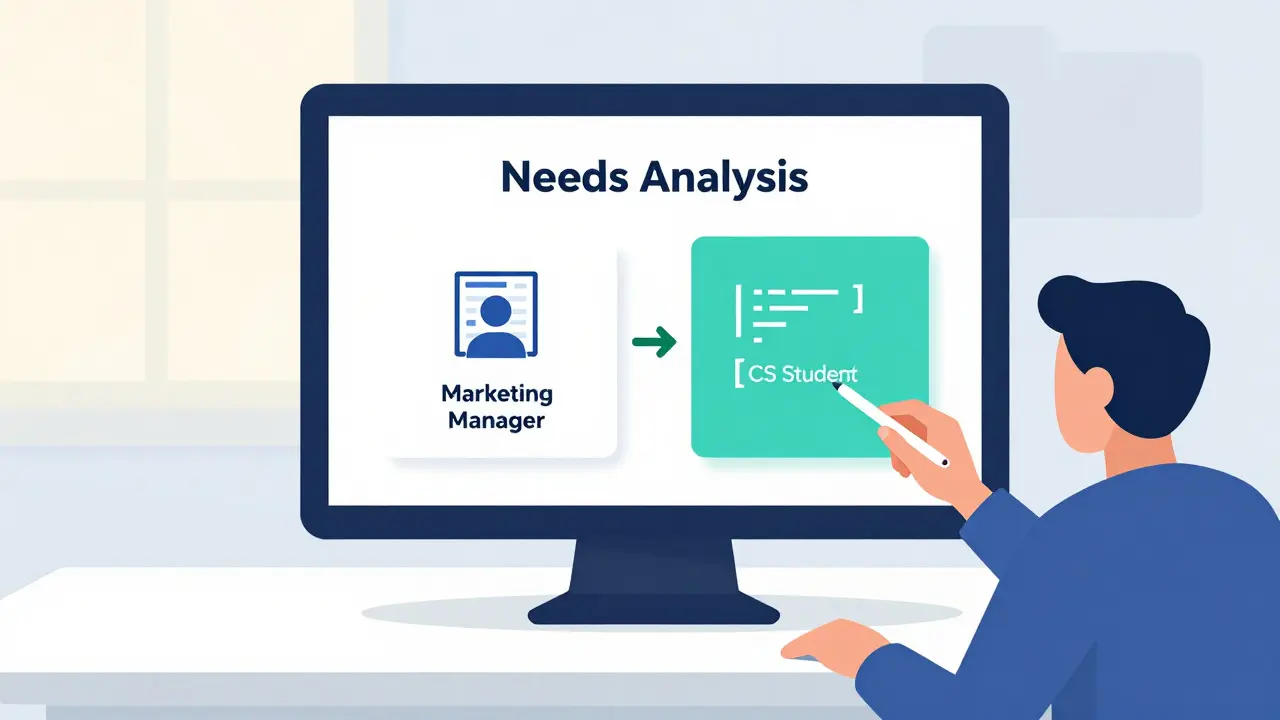
Start by defining your Target Audience. Are they beginners looking for basic literacy? Or are they professionals seeking certification? Create detailed Learner Personas. For example, if you are building a Python coding course, one persona might be "Sarah, a marketing manager who needs to automate Excel reports," while another is "David, a computer science student preparing for internships." Their goals, pain points, and technical backgrounds differ significantly.
Conduct a gap analysis. What do learners know now (current state), and what do they need to know to achieve their goal (desired state)? The bridge between these two states is your course content. Without this clarity, your curriculum will likely suffer from scope creep, trying to teach everything to everyone.
Setting Clear Learning Objectives
Vague goals lead to vague results. Instead of saying "Students will learn about digital marketing," specify exactly what they can do after the course. Use Bloom's Taxonomy to structure your objectives. This educational framework categorizes cognitive skills from simple recall to complex creation.
- Remember: Define key terms like SEO or PPC.
- Understand: Explain how search algorithms rank pages.
- Apply: Set up a Google Ads campaign for a mock business.
- Analyze: Critique a failed marketing funnel.
- Evaluate: Choose the best channel for a specific product launch.
- Create: Design a comprehensive six-month marketing plan.
Your objectives should be SMART: Specific, Measurable, Achievable, Relevant, and Time-bound. This ensures that both you and your learners have a clear benchmark for success. When objectives are clear, designing assessments becomes straightforward because you are simply testing whether the objective was met.
Structuring the Content: Modular Design
Long, unbroken blocks of text or hour-long video lectures kill engagement. The human brain processes information best in small chunks. This concept, known as Microlearning, suggests breaking content into bite-sized modules. Aim for lessons that are 5 to 10 minutes long, focusing on one single concept per module.
Organize these modules logically. Common structures include:
- Linear: Step-by-step progression from basics to advanced topics. Best for foundational skills.
- Modular/Non-linear: Independent units that learners can consume in any order. Ideal for reference materials or skill-based workshops.
- Spiral: Revisiting core concepts at increasing levels of complexity. Effective for deep mastery subjects like mathematics or language learning.
Use a storyboard to map out each module. Include the learning objective, the content format (video, text, interactive quiz), and the estimated time. This blueprint prevents you from getting lost in the weeds during production.
Selecting Instructional Strategies and Media
Not all content requires a video. In fact, overusing video can lead to "video fatigue." Match the medium to the message. This alignment is part of Multimedia Learning Theory, which posits that people learn better from words and pictures than from words alone, provided the elements are integrated correctly.
| Content Type | Recommended Format | Why It Works |
|---|---|---|
| Concept Explanation | Animated Video or Infographic | Visuals simplify abstract ideas and reduce cognitive load. |
| Process Demonstration | Screen Recording with Voiceover | Learners see exactly where to click and what actions to take. |
| Theoretical Frameworks | Text with Case Studies | Allows for self-paced reading and deeper reflection. |
| Skill Practice | Interactive Simulations or Quizzes | Immediate feedback reinforces correct behavior. |
Incorporate active learning strategies. Passive consumption leads to low retention. Ask learners to apply what they just watched. For instance, after a video on budgeting, provide a downloadable spreadsheet template for them to fill out. This bridges the gap between theory and practice.
Designing Assessments and Feedback Loops
Assessment is not just about grading; it is about validating learning. There are two main types of assessment in online courses:
- Formative Assessment: Low-stakes checks throughout the course. These include quizzes, polls, or discussion prompts. They help learners identify gaps in their understanding before moving on.
- Summative Assessment: High-stakes evaluations at the end of a module or course. These could be final projects, capstone assignments, or comprehensive exams.
Ensure your assessments align directly with your learning objectives. If your objective is "Create a social media calendar," do not test them with a multiple-choice question about social media history. Test them by having them build the calendar.
Feedback is critical. Automated quizzes should provide immediate explanations for correct and incorrect answers. For subjective assignments, establish a rubric. A rubric outlines the criteria for success, ensuring consistent and fair grading. It also helps learners understand what excellence looks like before they start working.

Pilot Testing and Iteration
No course is perfect on the first draft. Before launching publicly, conduct a Pilot Test with a small group of beta testers who match your learner personas. Watch them navigate the course. Where do they get stuck? Which videos do they skip? Do they complain about unclear instructions?
Collect qualitative feedback through surveys and quantitative data through analytics. Look at completion rates and drop-off points. If 80% of users quit after Module 3, there is likely a problem with the content difficulty, length, or relevance of that section.
Use this data to iterate. Update confusing slides, shorten long videos, or clarify ambiguous questions. Continuous improvement is a hallmark of effective Instructional Design.
Launch and Post-Launch Support
A curriculum does not end at the last lesson. Provide resources for continued learning. This might include a community forum, a Slack channel, or additional reading lists. Social interaction combats the isolation often felt in online learning environments.
Plan for updates. Information changes, especially in tech and business fields. Schedule regular reviews of your content to ensure accuracy and relevance. Outdated content damages credibility quickly.
Common Pitfalls to Avoid
Even experienced designers make mistakes. Here are the most common errors in online course development:
- Cognitive Overload: Packing too much information into one lesson. Keep it simple.
- Lack of Interactivity: Relying solely on lecture-style videos. Add activities.
- Poor Navigation: Making it hard for users to find previous lessons or resources. Ensure intuitive UI/UX.
- Ignoring Accessibility: Failing to add captions to videos or alt-text to images. This excludes learners with disabilities and hurts SEO.
By avoiding these traps and sticking to a robust framework, you create a course that not only educates but empowers your students to take action.
What is the ADDIE model in course development?
ADDIE stands for Analyze, Design, Develop, Implement, and Evaluate. It is a widely used instructional design framework that provides a systematic approach to creating educational materials. It ensures that every stage of the course creation process is covered, from identifying learner needs to assessing the final outcome.
How long should an online course lesson be?
Research suggests that microlearning is most effective when lessons are kept between 5 to 10 minutes. Shorter segments maintain attention spans and allow learners to fit study sessions into busy schedules. However, complex demonstrations may require slightly longer videos, provided they are broken up with interactions.
Do I need to use video for every lesson?
No. While video is engaging, it is not always necessary. Text, infographics, audio podcasts, and interactive simulations can be more appropriate depending on the content. Using a mix of media formats keeps the course dynamic and caters to different learning preferences.
What is the difference between formative and summative assessment?
Formative assessments occur during the learning process to monitor progress and provide feedback (e.g., quizzes). Summative assessments happen at the end of a unit or course to evaluate overall achievement (e.g., final projects or exams). Both are essential for a comprehensive curriculum.
How do I ensure my course is accessible?
Accessibility involves adding closed captions to all videos, providing transcripts for audio content, using alt-text for images, ensuring sufficient color contrast, and making navigation keyboard-friendly. Following WCAG (Web Content Accessibility Guidelines) standards helps ensure your course is usable by people with various disabilities.
Comments
Amara Akbar
I have been following this framework closely for my own instructional design projects, and I must say it is incredibly thorough. The emphasis on Needs Analysis before even touching the script is something so many creators overlook in their eagerness to start recording. It really does make a difference when you know exactly who "Sarah" or "David" are and what they need.
One thing that resonated with me was the part about avoiding scope creep. I often find myself wanting to add just one more module because it seems relevant, but then I realize it dilutes the core message. Keeping the bridge between the current state and desired state clear is vital. Thank you for laying this out so logically.
Mark Harvey
great read man
i always struggle with the assessment part like how do i know if they actually learned it without making it feel like school again
this guide makes it seem way less intimidating
Art HND
Bloom's Taxonomy is fine for academics but most online courses are just cash grabs anyway. People don't care about cognitive skills they want a quick fix. You can structure your objectives however you want but if the content isn't actionable immediately it fails. Also microlearning is overrated. Attention spans are not the problem lack of discipline is. Stop coddling learners with five minute videos.
Brandon Olvera
We used to teach things properly back in the day. No fancy frameworks no personas just straight facts and hard work. Now everyone needs a "learner persona" and a "gap analysis" for basic arithmetic. It is all too complicated. Keep it simple and toughen up the students instead of babying them with interactive simulations.
Elizabeth Brooks
hey thanks for sharing this! i found the table matching content types to media formats super helpful. i was thinking maybe we could also talk about accessibility more? like wcag standards are mentioned but sometimes people forget about color contrast specifically. its easy to mess up there. also do u think spiral structure works well for coding bootcamps?
Deb Kortyna, MBA
It is quite disheartening to see how many course creators ignore the pilot testing phase entirely. One would think that releasing an untested product into the wild is a recipe for disaster, yet here we are. The section on formative versus summative assessment is particularly crucial; without proper feedback loops, the learner is left adrift in a sea of information with no compass. We must demand higher standards in instructional design. It is not merely about uploading videos; it is about crafting an educational experience that respects the student’s time and intelligence.
alex kobri
the idea of modular design feels right to me
life is messy and linear doesn't always fit
but i wonder if non-linear structures confuse people who need handholding
maybe it depends on the audience maturity level
we should consider that when choosing our path
Zach Loescher
I am curious about the long-term retention rates for courses using microlearning versus traditional lecture formats. Does anyone have data on that? I tend to learn better with longer sessions where I can get into a flow state, but I acknowledge that might be personal preference rather than general rule.
Quintin Franzese
Sure, let us all pretend that breaking everything into five-minute chunks will magically cure procrastination. Because nothing says engagement like clicking through forty separate videos to learn how to boil an egg. But hey at least we avoided video fatigue by giving us video overload instead. Brilliant strategy truly.
Susan Cole
This is a very comprehensive overview. I appreciate the focus on SMART objectives. Too often I see goals that are vague and impossible to measure. Having a clear benchmark helps both the instructor and the student stay aligned. I will definitely keep this checklist handy for my next project.
Tamara Miller
Another generic article on instructional design... as if we needed another reminder that planning matters. It is almost insulting to assume that anyone reading this does not already know that skipping the needs analysis leads to failure. And please stop repeating the same tired tropes about Bloom's Taxonomy. It is 2024. Move on. Also the formatting is a bit cluttered with all those bullet points. Could you perhaps edit for brevity? Or is that too much to ask?
Savara Gunn
i liked the part about adding community forums. isolation is real in online learning. having a place to ask questions helps a lot. thanks for the tips!
Anthony Miller
You clearly have never tried to scale a corporate training program without this bureaucratic nonsense. Your ADDIE model is a straitjacket for creativity. Real experts just wing it and deliver results. This obsession with "learner personas" is just corporate speak for wasting time. Stop hiding behind frameworks and start teaching. The market will decide if you are good enough not some rubric.
michelle veluz
They want us to believe that these "instructional designers" are the saviors of education but it is all a front to control what we learn! Notice how they push "microlearning" to fragment our attention spans so we cannot think critically about the bigger picture? It is a conspiracy to keep us dependent on short bursts of dopamine rather than deep understanding. Wake up people! The gap analysis is just a tool to identify what knowledge gaps they WANT you to have!