

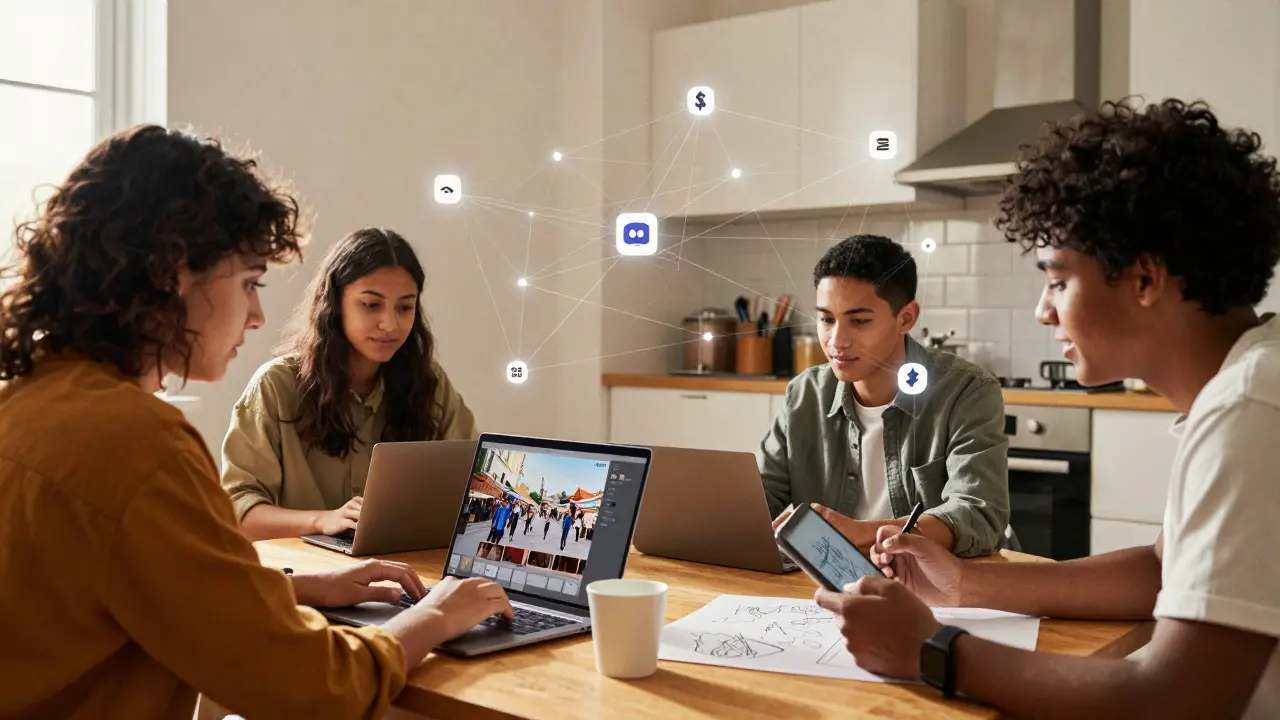
Five years ago, a student in Nairobi was working on a group project with peers in Buenos Aires, Tokyo, and Oslo-all from their dorm rooms. No one had ever met in person. They didn’t share a language, a timezone, or a cultural reference point. But they built something real together: a climate action app that got picked up by a UN youth initiative. That’s not a story from the future. That’s 2026.
What Changed? The Tech Didn’t. The Mindset Did.
People still think global learning is about video calls and translation tools. It’s not. It’s about trust. Real trust, built over months, not weeks. It’s about learning how to say "I don’t understand" without shame, and how to listen when someone explains something in a way you’ve never heard before.
In 2020, universities pushed online learning because they had to. Now, they’re keeping it because students won’t go back. Why? Because global learning communities don’t just teach content-they teach adaptability. A student in Jakarta learns how to negotiate deadlines with someone in Berlin who works 3 a.m. to noon. A learner in Lima learns how to frame feedback so it lands differently than it would in Toronto. These aren’t soft skills. These are survival skills in a world where work, innovation, and problem-solving happen across borders every day.
How These Communities Actually Work
Forget the old model: one professor, one classroom, one country. Today’s global learning groups look more like open-source software teams. They’re decentralized, self-organizing, and often lead by students, not teachers.
Take the Global History Lab, started by three grad students in 2022. It now has 1,200 active members across 47 countries. No formal enrollment. No tuition. Just a shared Google Doc, a Discord server, and a rule: every post must include a local context. So when someone writes about the Industrial Revolution, they don’t just cite Marx-they add how it played out in rural Punjab, or how textile workers in Guadalajara responded to similar shifts.
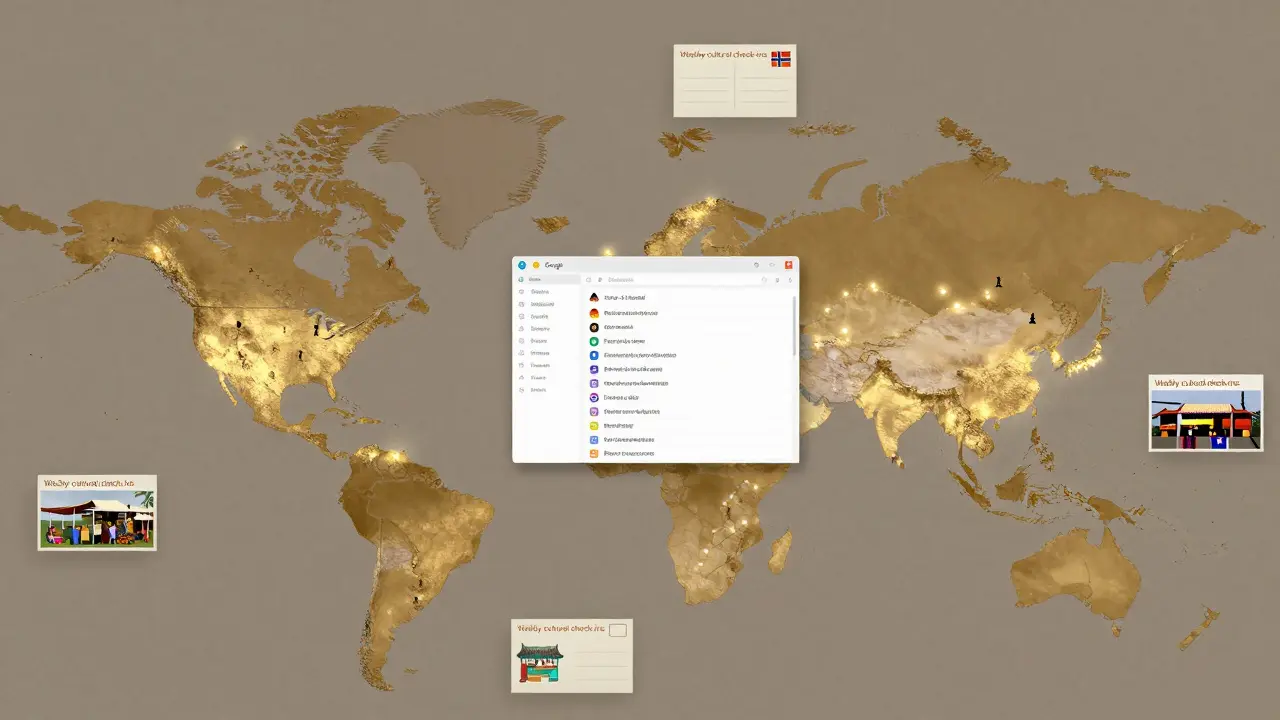
These groups use simple tools: Notion for collaboration, Loom for asynchronous video, and translation plugins like DeepL Write. But the real magic? They’ve built rituals. Weekly "cultural check-ins" where everyone shares one thing from their hometown they’re proud of. A monthly "misunderstanding hour" where people share a time they got it wrong-and what they learned.
Why This Beats Traditional Study Abroad
Study abroad programs used to be the gold standard. Spend a semester in Paris. Learn the language. Eat the food. Meet locals.
But here’s the problem: those programs cost $20,000. They’re exclusive. And they often reinforce stereotypes. A student in Paris might think they’ve "understood" France. But they’ve only seen one slice: the tourist version.
Global learning communities don’t offer one perspective. They offer dozens. A student in rural Kenya, a factory worker in Vietnam, a retired teacher in Finland-all contribute equally. No visa. No flight. No expensive housing. Just access.
And the outcomes? A 2025 study from the University of Edinburgh tracked 3,400 students in global learning groups. Those students were 68% more likely to solve complex problems with non-linear thinking. They were 52% more likely to collaborate across conflicting viewpoints. And 73% said they felt more prepared for international work than peers who studied abroad.
The Hidden Cost: Cultural Fatigue
It’s not all smooth sailing. Global learning is exhausting. Constantly translating your thoughts, adjusting your tone, second-guessing your assumptions-it wears you down.
One student in the Global Health Network described it as "mental juggling." She’d spend hours writing a message in English, only to realize her point got lost because her group didn’t have the same concept of "personal responsibility" in healthcare. She had to rebuild the whole argument using metaphors from her village.
That’s why successful communities don’t just encourage participation-they protect energy. They cap meeting times. They rotate facilitators. They have "quiet weeks" where no new projects start. They train members in cultural humility, not just communication.
Some groups now use a "cultural bandwidth" metric. It’s not a score. It’s a simple daily check-in: "On a scale of 1 to 5, how much mental space did you have today to learn something new?" If the average drops below 3, they pause. No pressure. No guilt. Just space.
Who’s Leading This Change?
It’s not the big universities. It’s not the tech giants. It’s teachers who refused to go back to the old way.
Dr. Amina Ndiaye, a professor at Cheikh Anta Diop University in Senegal, started a global literature circle in 2021. Her students read novels from Iceland, Nigeria, and Korea-and then wrote responses in their native languages, which were translated and shared. One student from Dakar wrote about how the Icelandic novel’s theme of isolation mirrored her experience during the pandemic lockdown. A student in Seoul responded with a poem about urban loneliness in Tokyo. No one had asked them to do that before.
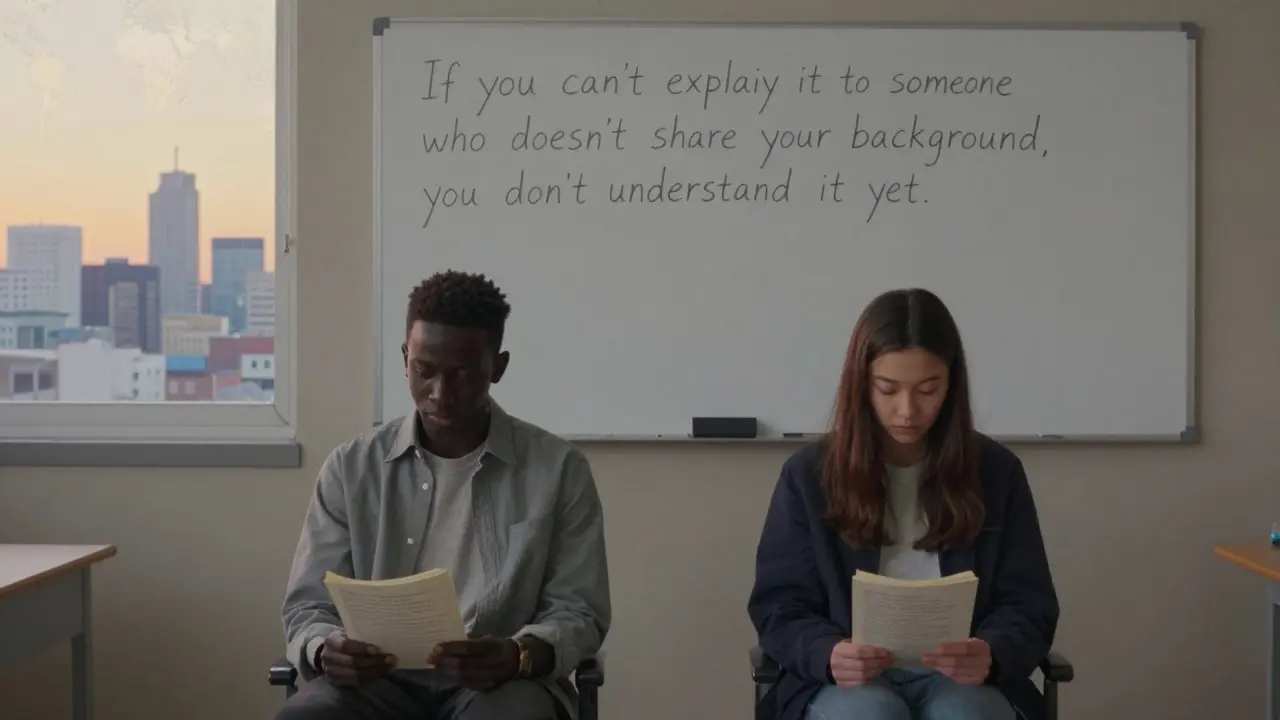
Now, over 800 educators in 64 countries use her open curriculum. No patents. No paywall. Just shared materials and a simple philosophy: "If you can’t explain it to someone who doesn’t share your background, you don’t understand it yet."
What This Means for the Future
By 2030, employers won’t care where you went to school. They’ll care who you’ve learned with.
Resume lines like "studied with peers from 12 countries" are becoming as common as "graduated summa cum laude." Companies like Siemens, Unilever, and the World Bank now ask candidates: "Tell us about a time you had to change your approach because someone from another culture saw the problem differently."
And it’s not just jobs. It’s innovation. The most successful climate solutions today come from teams that include farmers, coders, poets, and engineers from places that don’t usually sit at the same table. The next big idea won’t come from Silicon Valley. It’ll come from a Discord channel where a high schooler in Nairobi, a retiree in Prague, and a software developer in Manila are arguing about how to make clean water accessible.
This isn’t a trend. It’s the new baseline. Learning isn’t something you do in a classroom anymore. It’s something you do with the world.
Can global learning communities replace traditional degrees?
Not entirely-but they’re changing what degrees mean. Employers now value proof of cross-cultural collaboration as much as GPA. Many students combine a traditional degree with active participation in global learning communities to build both credentials and real-world experience. Some programs, like the Global Learning Micro-Credential from the University of Melbourne, now award credit for verified participation in these groups.
Do I need to be fluent in English to join?
No. Most thriving global learning communities use translation tools and encourage multiple languages. Many groups have language partners-two people who help each other communicate across their native tongues. The goal isn’t perfect English. It’s clear understanding. A simple phrase like "Can you say that another way?" is more valuable than perfect grammar.
How do I find a legitimate global learning community?
Start with open platforms like Global Learning Exchange, Open Learning Commons, or university-affiliated networks like MIT’s Global Teaching Labs. Look for communities with clear rules, active moderators, and transparency about how decisions are made. Avoid groups that charge fees to join or promise "certificates" without real engagement. The best ones are free, peer-led, and focused on mutual learning-not performance.
What if I feel like I have nothing to contribute?
That feeling is normal-and it’s usually wrong. Everyone has a perspective shaped by where they live, what they’ve seen, and how they’ve survived. A student in rural Bolivia might not know about quantum computing, but they know how to fix a solar panel with duct tape and a bicycle chain. That’s knowledge. That’s innovation. Global learning doesn’t ask you to be an expert. It asks you to be honest.
Are these communities only for students?
No. Many communities welcome teachers, freelancers, retirees, and self-taught learners. In fact, some of the most valuable insights come from people outside academia. A nurse in Lagos, a mechanic in Manila, and a grandmother in rural Poland have all led major learning projects in global communities. Experience, not credentials, is the currency here.
Comments
Jen Kay
I’ve seen this work firsthand. A student from Lagos and one from Oslo co-led a project on renewable energy access-no common language, just raw patience and a shared Google Doc. They didn’t need to agree on everything. They just needed to listen long enough to learn how the other person thought. That’s the real curriculum.
Michael Thomas
This is just woke globalization dressed up as education. America still leads in innovation. Stop pretending some Discord server in Nairobi is replacing MIT.
Abert Canada
I’ve been in one of these groups for two years. Honestly? It’s the only place I’ve ever felt like my perspective as a Canadian from the North doesn’t get drowned out. We had a guy from Papua New Guinea explain how his village tracks weather using bird calls. I didn’t know that was a thing. Now I use it to teach my nephew. No degree needed.
Xavier Lévesque
They call it 'cultural bandwidth' like it’s some new tech metric. Meanwhile, I’m over here trying to explain to a group in Mumbai why 'quiet weeks' are basically just a fancy way of saying 'we’re all burnt out.' We’re not building a utopia. We’re just trying not to cry into our laptops.
Thabo mangena
I must express my profound appreciation for the paradigm shift represented herein. The erosion of institutional gatekeeping in knowledge dissemination is not merely progressive-it is morally imperative. The dignity afforded to the rural teacher in Finland, the mechanic in Manila, the grandmother in Poland-these are not anecdotes. They are the foundation of a new epistemic order.
Karl Fisher
I started a global learning circle with my yoga instructor from Bali and a guy who tweets about medieval cheese-making in Poland. We’ve had 14 sessions. One of them was just me reading Rilke in French while they listened. I’m pretty sure we just changed the future. My therapist says I’m ‘over-identifying with the movement.’ I say: the movement is me.
Buddy Faith
This is all a distraction. The real global learning is happening in dark web forums where people trade hacked textbooks and translate Marx in real time. The UN app? Probably funded by the same people who made your smart fridge. They want you distracted by feel-good stories while they sell your data to the AI overlords
Scott Perlman
I joined one of these groups last year. I’m a welder. I didn’t know how to write a paragraph. Now I’ve helped design a water filter with someone from Nepal. We used duct tape. It works. I don’t need a degree. I just needed someone to say hey your idea matters.
Sandi Johnson
I love how everyone acts like this is revolutionary. My cousin did this exact thing in 2017 with a group of Syrian refugees and a bunch of German coders. They built an app to map refugee language needs. No one cared. Now it’s a TED Talk. The cycle repeats. The content changes. The attention span stays the same.
Eva Monhaut
I’ve been part of three of these communities. Each one felt like a tiny rebellion. Not loud. Not flashy. Just quiet persistence. A grandmother in Poland taught me how to braid hay to predict rain. A teenager in Nairobi showed me how to turn a broken phone into a radio receiver. We never met. But I carry their knowledge like tattoos. You don’t need a classroom to learn the world. You just need to stop assuming you already know it.