

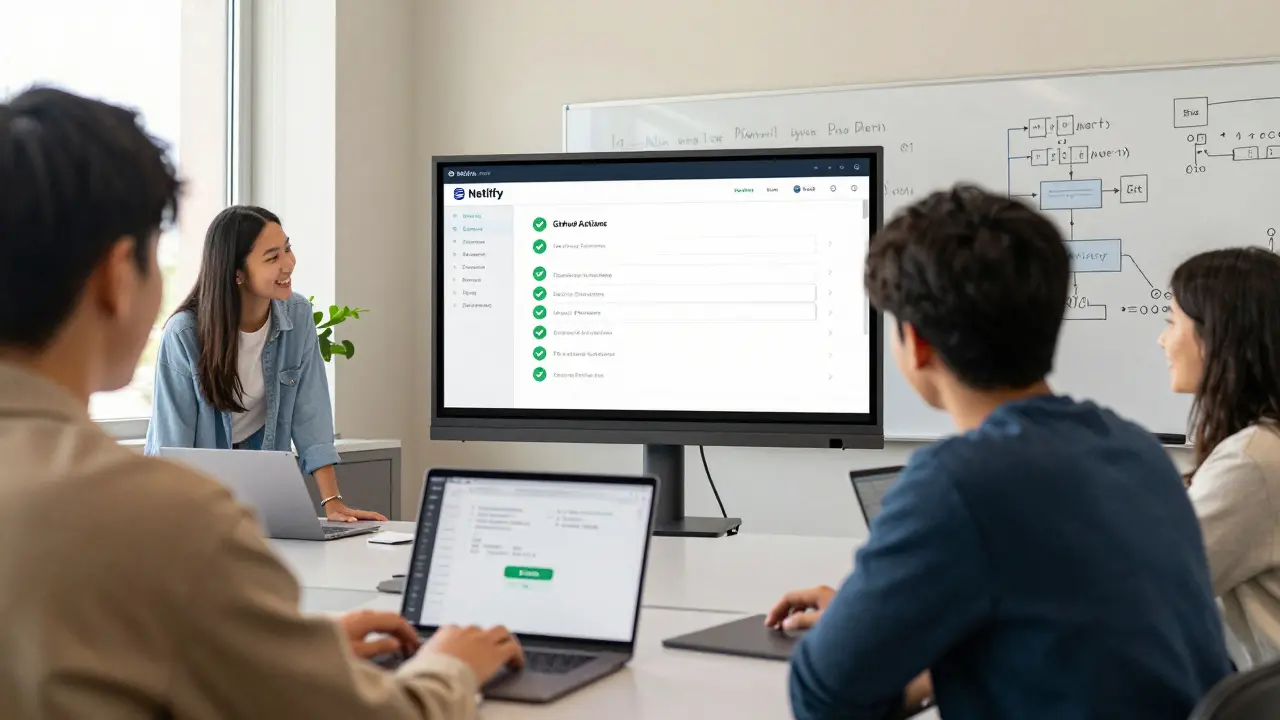
Most coding courses teach you how to write code. But very few teach you how to get that code into the hands of real users. That gap is why so many students graduate feeling confident in Python or JavaScript-but lost when it comes to actually launching a project. DevOps isn’t just for big tech companies. It’s the missing piece in modern coding education.
Why DevOps Belongs in Every Coding Course
Imagine a student builds a web app that works perfectly on their laptop. They show it to their instructor. Everything looks great. Then they try to share it with a friend. The friend can’t open it. No server. No domain. No way to update it without breaking everything. This isn’t rare. It’s the norm.
DevOps changes that. It’s the set of practices that lets teams build, test, and deploy software quickly and reliably. In a classroom, that means students don’t just write code-they ship it. They learn to push changes to a live site, roll back if something breaks, and monitor what’s happening after launch.
Companies don’t hire coders who only write code. They hire people who can take an idea from a sketch to a working product. That’s why top bootcamps and university programs are adding DevOps tools like GitHub Actions, Docker, and Netlify to their curricula. Students who learn these tools don’t just finish projects. They finish them with confidence.
What DevOps Skills Do Students Actually Need?
You don’t need to teach students every DevOps tool out there. Focus on what matters for beginners:
- Version control with Git-not just saving files, but branching, merging, and collaborating on code
- Automated testing-running tests every time code changes, so bugs don’t sneak into production
- Continuous Integration (CI)-automatic builds and tests triggered by commits
- Simple deployment-one-click publishing to platforms like Netlify, Vercel, or Render
- Basic monitoring-seeing if a site is up, checking load times, understanding error logs
These aren’t advanced topics. They’re the baseline for any modern web project. A student who can push a change to GitHub and see it live on a public URL within five minutes has already outpaced 80% of coding bootcamp graduates.
At the University of Auckland, a second-year web development class now requires every student to deploy a final project using Netlify. No more ZIP files emailed to the professor. No more "it works on my machine" excuses. The project goes live. Everyone can see it. The pressure is real-and that’s the point.
How to Teach DevOps Without Overwhelming Students
DevOps sounds intimidating. Terms like "CI/CD pipeline" or "containerization" can make students shut down. But you don’t need to explain Kubernetes on day one.
Start small. Use tools that hide complexity:
- GitHub Actions-automatically run tests when code is pushed. No command line needed.
- Netlify or Vercel-drag and drop a folder, get a live URL. No servers to configure.
- Render or Railway-one-click deployment for Node.js, Python, or React apps.
Use templates. Give students a starter repo with a pre-configured GitHub Actions workflow. They just need to write their code. The rest happens automatically. They see the result: green checkmarks, live URLs, instant feedback.
By week three, they’re already deploying. By week six, they’re fixing broken builds. That’s when learning sticks. They’re not memorizing commands. They’re solving real problems.
Real Projects, Real Results
At a coding bootcamp in Wellington, students built a local food delivery app for community gardens. They didn’t just write the frontend. They set up a backend API, connected a database, and deployed it to Render. Then they invited 50 local residents to use it. One user reported a bug: the app crashed when someone ordered more than 10 items.
The student team fixed it in under an hour. They pushed the fix. Within minutes, the new version was live. No email chain. No waiting for IT. No "I’ll send you the update tomorrow." Just a commit, a push, and a live update.
That’s the power of DevOps in education. It turns classroom projects into real products. Students learn that code isn’t done when it runs on their laptop. It’s done when it works for someone else.
What Happens When Students Skip DevOps?
Students who never deploy their code end up with portfolios full of screenshots. They can describe their projects. But they can’t show them. They can’t explain how they handled errors, scaled traffic, or recovered from a failed update.
In job interviews, they’re asked: "How do you handle deployment?" They answer: "I use Git." That’s not enough.
Employers want to see:
- GitHub repos with commit history
- Live URLs for projects
- Proof of testing and automation
- Understanding of deployment pipelines
Without DevOps, students are at a disadvantage. Even if they write great code, they can’t prove they can ship it.

DevOps Isn’t Just Tools-It’s a Mindset
The biggest shift isn’t learning Docker or Jenkins. It’s changing how students think about code.
Before DevOps: "I finished my project." After DevOps: "My project is live. Here’s how I know it’s working."
Students start asking better questions:
- "What happens if ten people use this at once?"
- "How do I know if my update broke something?"
- "Can I roll back if I mess up?"
These are the questions professionals ask every day. Teaching them early builds confidence, curiosity, and responsibility.
One student from a high school coding club in Christchurch told me: "I used to think coding was just typing. Now I see it’s about making things people can actually use. That’s way cooler."
Where to Start: A Simple DevOps Curriculum for Beginners
If you’re an instructor or curriculum designer, here’s a realistic 6-week plan:
- Week 1: Git basics-commit, push, pull, branch. Use GitHub Classroom.
- Week 2: Build a simple web app (HTML/CSS/JS or React). Host it on GitHub Pages.
- Week 3: Add automated testing with Jest or Cypress. Run tests locally.
- Week 4: Set up GitHub Actions to run tests on every push. Show the green checkmark.
- Week 5: Deploy to Netlify or Vercel. Compare GitHub Pages vs. Netlify.
- Week 6: Break something on purpose. Fix it. Deploy the fix. Watch it go live.
By the end, every student has:
- A live project URL
- A GitHub repo with commit history
- Experience with CI/CD
- Proof they can recover from mistakes
That’s not just a project. That’s a professional portfolio piece.
DevOps in Education Isn’t Optional Anymore
The world doesn’t need more coders who can write code. It needs coders who can ship it. DevOps isn’t a luxury for advanced students. It’s the foundation for any modern coding education.
Students who learn to deploy early don’t just finish courses. They finish them with a working product, a live link, and the confidence to say: "I built this. And I can make it better."
Do students need to learn Linux or command line to do DevOps in coding courses?
No. Most modern tools like Netlify, Vercel, and GitHub Actions hide the command line. Students can deploy apps with just a browser and a GitHub account. Basic terminal use (like git commit and git push) is helpful, but not required. The goal is to get students deploying quickly-not mastering system administration.
Can DevOps be taught in high school coding classes?
Yes. High school students in Auckland and Wellington are already deploying projects using Netlify and GitHub Actions. Tools have become simple enough that even 14-year-olds can set up automated deployments in under an hour. The key is starting with pre-built templates and focusing on outcomes, not technical depth.
What’s the most common mistake when teaching DevOps to students?
Trying to teach everything at once. Instructors often jump into Docker, Kubernetes, or CI/CD pipelines before students can even run a basic web server. Start with one tool-one deployment method-and make it work. Once students see the result, they’ll ask for more.
How do you assess DevOps skills in students?
Don’t grade based on how many tools they used. Grade based on outcomes: Is the project live? Can you see the deployment history? Did they fix a bug and redeploy? Did they write tests that ran automatically? These are real indicators of competence.
Is DevOps too expensive for schools to implement?
No. Platforms like GitHub, Netlify, Vercel, and Render offer free tiers that handle thousands of deployments per month. A single teacher can support 50 students without spending a cent. The cost isn’t financial-it’s time. But the payoff in student confidence and employability is worth it.
Comments
Ian Maggs
DevOps isn't just a set of tools-it's the quiet, relentless discipline of caring about what happens after you hit 'save.' It's the difference between writing a poem and publishing a book. And yet, most courses treat deployment like an afterthought-like a bonus round you only play if you finish early.
But code without users is just noise. A silent scream in a vacuum. DevOps forces you to face reality: your app might crash. Someone might hate your UI. The server might go down at 3 a.m. And that’s beautiful. Because now you’re not just a coder-you’re a steward.
We teach kids to write essays, then never show them how to publish them. Why? Because it’s messy? Because it’s hard? That’s exactly why we should do it.
Learning to deploy isn’t about mastering Kubernetes. It’s about learning to be responsible. To own your work. To care enough to fix it when it breaks. That’s the real skill.
And yes-I’m talking to you, instructors who still accept ZIP files. Please stop.
Chuck Doland
The argument presented herein is both cogent and empirically substantiated. The pedagogical omission of deployment practices in coding curricula constitutes a systemic failure in vocational preparation. Students are being equipped with syntactic proficiency but deprived of operational competence.
It is not sufficient to teach syntax, semantics, or even algorithmic design if the final product remains confined to the local filesystem. The professional ecosystem demands demonstrable, reproducible, and observable outcomes.
Furthermore, the reliance on abstractions such as Netlify and Vercel is not a dilution of rigor-it is a necessary evolution of pedagogy. Complexity should be deferred, not avoided. Mastery emerges from iterative exposure, not initial immersion.
One must also note that the assertion regarding Linux and CLI proficiency is correct: foundational deployment can be achieved via GUI-driven platforms without compromising learning outcomes. The goal is not to produce system administrators, but to cultivate software artisans who understand the lifecycle of their creations.
It is, therefore, imperative that accreditation bodies and curriculum designers integrate these practices as non-negotiable components of entry-level programming education.
Madeline VanHorn
Ugh. Of course you’re saying this. Everyone who’s ever used a computer knows you can’t just ‘write code’ and call it a day. But most students? They’re not ready for this. They can’t even spell ‘JavaScript’ right. Why are we pushing them into CI/CD like it’s a rite of passage?
It’s not about deploying. It’s about having the mental bandwidth to care. Most of them are just trying to pass the class.
Stop romanticizing DevOps. It’s not magic. It’s just more work. And most students don’t want it.
Glenn Celaya
devops is just corporate jargon for 'do more work for free' lol
Wilda Mcgee
Let me tell you something-I taught a 16-year-old girl in a summer program how to deploy a simple React app to Netlify using a template. She cried. Not because it was hard. Because when she saw her URL go live-her name on the banner, her art on the screen-she whispered, 'I made this.' That’s the moment you stop being a student and become a creator.
DevOps isn’t about tools. It’s about identity. It’s about saying, 'I built this, and it matters.' And once you feel that? You never go back.
Start small. Use templates. Celebrate every green checkmark. Let them see the result before they understand the mechanism. The rest follows.
And to the people who say 'they’re not ready'? They’re ready. They’re just waiting for someone to hand them the keys.
Chris Atkins
i just used github actions to auto deploy my portfolio and it felt like i won a game of chess against my own laziness
Jen Becker
I tried to deploy once. My professor said 'it works on my machine' and I cried in the bathroom for 20 minutes. Now I just screenshot everything. At least screenshots don’t crash.
Ryan Toporowski
YES YES YES!!! 🎉
I’ve seen students go from 'I don’t know how to upload this' to 'I fixed the bug and it’s live in 5 minutes'-and their whole face lights up. It’s not about the tech. It’s about that spark.
Start with one button. One URL. One green checkmark. That’s all it takes to change someone’s whole view of what coding can be.
And if you’re an instructor? Don’t overcomplicate it. Just make it work. The rest will follow. 💪
Samuel Bennett
you people are all wrong. devops is just a way for big tech to make you work for free. nobody needs netlify. you should be running your own servers. and git? that’s a microsoft tool. you should be using mercurial. and why are you teaching react? react is a cult. use vanilla js. and why are you even using javascript? python is better. and why are you even using a browser? you should be building cli tools. and why are you even teaching this in school? schools are broken. i dropped out at 14 and now i run a blockchain startup. you’re all doing it wrong.
Rob D
Let me tell you something, America. We don’t need Netlify. We need real infrastructure. Real servers. Real engineers. Not some fancy drag-and-drop crap from Silicon Valley. This is why our country is falling behind-because we’re teaching kids to click buttons instead of building things.
Back in my day, we had to compile our own kernels. We didn’t have GitHub Actions. We had tears. And pride.
Now? Students think 'deploying' means hitting a button. That’s not engineering. That’s babysitting a toy.
If you want to be a real coder? Learn Linux. Learn bash. Learn how to fix a server that’s down at 2 a.m. without crying. Otherwise, you’re just a glorified typist.
Franklin Hooper
It is true that deployment is underemphasized in curricula. However, the suggested solutions-Netlify, Vercel, GitHub Actions-are superficial. They abstract away the underlying architecture. Students will not understand the nature of HTTP requests, DNS resolution, or process management. This leads to fragile competence.
Furthermore, the normalization of free-tier platforms introduces a dependency on corporate infrastructure. What happens when Netlify changes its terms? Or when GitHub deprecates Actions?
True mastery requires understanding the stack. Not the button.
Jess Ciro
they’re all lying. no one is deploying anything. it’s all fake. the 'live projects' are just demo accounts. the teachers are using their own servers. the students are just copying. you think that kid in Wellington actually fixed a bug? nah. the professor did it for him. and the 50 users? they’re all his friends. this whole thing is a scam.
saravana kumar
Why waste time on Netlify? In India, we have real problems. Students can’t even afford internet. You want them to deploy? First, give them a laptop. Then a stable connection. Then maybe, just maybe, we talk about CI/CD. This is first-world pedagogy.
Tamil selvan
I have witnessed, in my own teaching experience, the transformative power of early deployment. A student, initially hesitant and overwhelmed, successfully deployed a simple Flask application using Render after only three weeks of guided practice. The emotional impact was profound: he smiled for the first time in class. He said, 'I didn’t know I could do this.'
It is not about the tools. It is about the experience of creation, not just construction. The confidence gained from seeing one’s work accessible to others cannot be measured in grades.
I urge all educators: begin with a single, well-structured template. Remove the fear. Allow the result to speak. The technical depth will follow, naturally and organically.
Let us not underestimate the dignity of a live URL.
Mark Brantner
Wait, so you’re telling me we’re not supposed to just copy-paste from Stack Overflow and call it a day?!
And we have to… *gasp*… fix bugs after they go live?!?!?!?!?
What is this, a horror movie?
But… I just wanted to make a website that says 'hi' and has a cat GIF…
…wait. I just deployed it. It’s live. It’s working. I think I just became a dev.
…oh no. I have to write a test now. 😭
Chuck Doland
The rebuttal by commenter #395 exemplifies the very antithesis of pedagogical progress. The notion that 'real engineering' requires manual server configuration is not only archaic-it is dangerously exclusionary. Modern software development is not about reinventing the wheel; it is about leveraging abstraction to solve higher-order problems.
One does not learn calculus by first building a mechanical calculator from scratch. Similarly, one does not learn deployment by first compiling a Linux kernel.
The goal of education is not to produce system administrators. It is to produce capable, confident software creators. And that begins with shipping.