

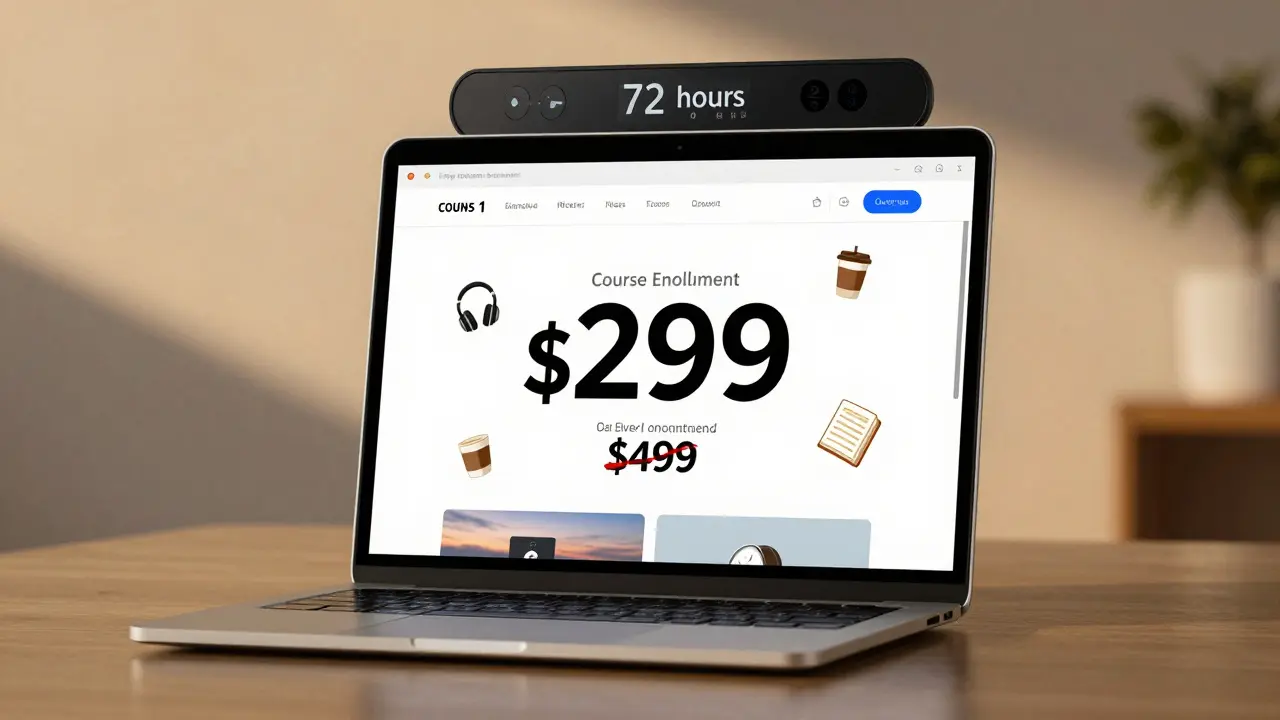
When you see a course labeled early-bird pricing, it’s not just a marketing trick. It’s a real chance to lock in a lower price before the cost goes up - sometimes by hundreds of dollars. And if you wait too long, you might miss out completely. Limited-time offers for courses aren’t about creating urgency for the sake of it. They’re designed to reward people who act fast, make decisions, and commit to their growth.
Think about it: a data analytics course might cost $499 after the early-bird window closes. But if you enroll in the next 72 hours, you pay $299. That’s a $200 saving - enough to cover a month of coffee, a new pair of headphones, or even a small textbook. And you’re not just saving money. You’re getting ahead.
Why Early-Bird Pricing Exists
Course creators don’t offer early-bird pricing because they’re generous. They do it because they need to cover costs before the course even launches. Building a high-quality online course takes time, money, and effort. Instructors pay for video editing, platform fees, curriculum design, and sometimes even hiring assistants. Early sign-ups give them the cash flow to finish everything without cutting corners.
It’s also a way to build momentum. If a course has 50 people signed up before launch, the instructor knows it’s viable. That confidence translates into better content, more support, and sometimes even bonus materials for early enrollees. You’re not just buying a course. You’re helping shape it.
How to Spot a Real Deal
Not every "limited-time offer" is worth it. Some sellers stretch the timeline for weeks. Others raise the price right before the "offer" ends just to make the discount look bigger. Here’s how to tell the difference:
- Check the course’s historical pricing. If it’s always been $499 and suddenly drops to $299 for 48 hours, that’s likely real.
- Look for a countdown timer. If it’s counting down to a specific launch date - not just "end of the week" - it’s more trustworthy.
- Read reviews from past students. If people mention getting early-bird pricing in the past, it’s a pattern.
- Compare with similar courses. If other instructors in the same field offer similar discounts, it’s industry-standard.
For example, a UX design course from a well-known instructor on Skillshare might have offered $199 early-bird pricing last year. This year, they’re offering $229. That’s still $100 cheaper than the standard $329 rate. That’s a real discount - not a fake one.
When to Pull the Trigger
You don’t need to buy on day one. But waiting until the last hour is risky. Most early-bird windows close 7 to 14 days before the course starts. That’s your sweet spot. Here’s a simple rule: if you’ve been thinking about the course for more than a week, you’re probably ready to enroll.
Here’s what to ask yourself before clicking "Buy":
- Do I have the time to complete this course? (Be honest - if you’re already overwhelmed, wait for the next cycle.)
- Will this skill help me get a promotion, switch jobs, or start a side hustle?
- Have I read the syllabus and watched the free preview?
- Is the instructor credible? (Check their LinkedIn, past courses, or student testimonials.)
- Can I afford the regular price if I miss this window?
If you answer yes to at least four of those, go ahead. Don’t overthink it. The savings are real. The opportunity isn’t.

What You Get Beyond the Discount
Early enrollees don’t just pay less. They often get more.
Some instructors offer:
- Exclusive Q&A sessions
- One-on-one feedback on projects
- Access to a private community before the public group opens
- Free bonus modules not available later
- Priority support when the course launches
Take a copywriting course from a former ad agency lead. The early-bird package included a 30-minute live feedback call. That call alone saved one student weeks of guesswork. They revised their portfolio, landed three freelance clients, and made back the course cost in two weeks.
That’s the hidden value. It’s not just the price tag. It’s the head start.
What Happens When the Offer Ends
Once the early-bird window closes, the price jumps. Sometimes dramatically. A marketing course might go from $199 to $599. A coding bootcamp might jump from $799 to $1,899. That’s not inflation. That’s the cost of doing business without early support.
And sometimes, the course doesn’t reopen at all. Some instructors run limited batches - only 100 spots per cohort. Once they’re full, you wait months for the next one. Or worse, the course gets discontinued because not enough people signed up.
There’s also the psychological cost. Delaying means you’re still stuck where you are. Skills don’t improve by wishing. They improve by doing. Every day you wait is a day you’re not building something that could change your career.

How to Plan Ahead
You don’t have to scramble every time an offer pops up. Build a simple tracking system:
- Make a list of 3-5 courses you want to take in the next 6 months.
- Follow the instructors on LinkedIn or Instagram. Most announce early-bird dates there first.
- Sign up for their email list. Early-bird deals often go to subscribers 48 hours before public launch.
- Set a calendar reminder for 10 days before the expected launch date.
- Keep a small savings fund - even $50 a month - just for learning.
One student saved $1,200 over two years by doing this. She took three courses: digital marketing, Excel for business, and project management. Each time, she enrolled during early-bird pricing. She saved over $300 on each. That’s like getting two courses free.
Common Mistakes to Avoid
People mess this up in predictable ways:
- Waiting for "the perfect time" - there isn’t one. The perfect time is now.
- Thinking you’ll find a better deal later - you probably won’t.
- Buying without reading the syllabus - you end up wasting money on something you don’t need.
- Ignoring refunds - most early-bird offers come with a 14-day money-back guarantee. Use it if it’s not right.
- Comparing to free YouTube videos - yes, you can learn basics for free. But structured learning, feedback, and accountability? That’s what you pay for.
One person bought a photography course after the early-bird window closed. They paid $450. Two weeks later, the same course launched again - with early-bird pricing at $299. They were upset. But they didn’t learn anything in the meantime. They just lost time.
Final Thought: Your Growth Is Worth It
Early-bird pricing isn’t about being cheap. It’s about being strategic. It’s about choosing to invest in yourself before you’re forced to. Every course you take adds to your value. The earlier you start, the sooner you see returns.
Don’t wait for permission. Don’t wait for the "right" moment. The moment is now - and it’s closing fast.
Are early-bird course prices always lower than the regular price?
Yes, by definition. Early-bird pricing is always a discounted rate offered for a limited time before the standard price goes into effect. If the "early-bird" price is the same as the regular price, it’s not a real early-bird deal - it’s misleading marketing.
Can I get a discount after the early-bird window closes?
Sometimes, but don’t count on it. Some instructors offer occasional promotions for students who missed the early-bird window, like seasonal sales or loyalty discounts. But these are rare and usually smaller than the original early-bird deal. If you’re serious about taking the course, waiting is risky.
Do early-bird offers include certificates or access to materials?
Yes. Early-bird pricing includes everything the regular price does - access to all course videos, downloadable resources, quizzes, and certificates of completion. You’re not getting less. You’re getting the same value at a lower price.
What if I can’t afford the course even with early-bird pricing?
Many instructors offer payment plans - split the cost into 2 or 3 monthly installments. Others have scholarships or work-exchange programs where you help with social media or editing in exchange for access. Always check the course page for financial options before giving up.
Is it better to wait for a sale or buy early-bird?
Early-bird pricing is almost always the best deal you’ll get. Major sales like Black Friday or New Year’s discounts are rare for courses, and when they happen, they’re usually smaller than early-bird rates. Plus, early-bird buyers often get extra perks like live Q&As or bonus content that aren’t available later.
Comments
Rahul U.
Early-bird pricing saved me $300 on a UX course last year - I didn’t even know I needed it until I saw the syllabus. Now I’m working remotely for a startup in Bangalore. Don’t wait for perfect timing. Just start.
Addison Smart
Look, I’ve bought over 20 online courses in the last 5 years - from Python to Persian calligraphy - and I can tell you this: the real value isn’t the discount. It’s the momentum. When you commit early, you stop fantasizing about learning and start doing it. I’ve seen people delay for months, then ghost the course after Week 2 because they never actually made space for it. Early-bird isn’t a sale - it’s a psychological nudge to stop procrastinating. And honestly? We all need that.
David Smith
Ugh. Another ‘hustle culture’ post pretending scarcity is virtue. My cousin bought a $500 ‘AI for Beginners’ course because of a 72-hour deal. Got it. Never opened it. The instructor didn’t even reply to his email. This whole thing is just predatory capitalism dressed up as self-help.
Lissa Veldhuis
OMG I literally just bought a copywriting course last week because of early bird and I’m already making money from it like wtf 🤯 I used to be broke and now I’m getting DMs from brands asking me to write their captions 😭 I didn’t even know what a CTA was 3 months ago and now I’m charging $800 per project I’m literally living the dream 💸✨
Michael Jones
You know what’s real? The fact that you’re still reading this instead of signing up. That’s the real cost. Not the $200. Not the time. The regret. The ‘what if’ that haunts you at 2am when you’re scrolling through LinkedIn and everyone else is posting about their new roles, their side gigs, their promotions - and you’re just… still here. The discount is just the price. The real price is your future self.
allison berroteran
I love how this post breaks down the psychology behind early-bird pricing without being pushy. I used to be the person who waited until the last minute, then missed out. Now I have a little folder called ‘Future Learning’ where I save links to courses I’m curious about. I set a reminder 10 days before the expected launch. Last month, I got into a data visualization course for $199 instead of $349 - and they threw in a bonus workbook I didn’t even know existed. It’s not about being cheap. It’s about being intentional. And honestly? It feels good to invest in yourself before you’re desperate.
Gabby Love
Just a heads-up - always check if the course has a refund policy. Most early-bird deals include a 14-day window. I once bought a course thinking I’d love it, but the instructor’s teaching style didn’t click. Got my money back in 3 days. No guilt. No drama. Just smart.
Jen Kay
David, I get your frustration - I’ve been burned too. But dismissing every early-bird offer because of one bad experience is like refusing to fly because one plane had turbulence. The difference between a scam and a real deal? Transparency. If the instructor has past student reviews, a clear timeline, and doesn’t hide the regular price - it’s legit. And if you’re still unsure? Email them. Most creators reply. And if they don’t? Walk away.
Michael Thomas
Just sign up. Stop overthinking. America runs on action, not analysis paralysis.