

Imagine a classroom where a student with dyslexia doesn't just read text but hears it narrated in a voice that matches the emotional tone of the passage. Or picture a deaf student who sees sign language avatars in real-time during a lecture, allowing them to follow complex mathematical proofs without missing a beat. This isn't science fiction; it is the reality of inclusive learning environments in 2026. As we move deeper into the digital age, the gap between standard education and accessible education is closing rapidly, driven by breakthroughs in artificial intelligence, haptic feedback, and spatial computing.
The core problem has always been simple: traditional teaching methods assume a one-size-fits-all learner. But human cognition varies wildly. Emerging accessibility technologies are dismantling this assumption by adapting the medium to the message, rather than forcing the student to adapt to the medium. For educators and institutions, the shift is no longer about compliance-it’s about unlocking potential for millions of learners who were previously left on the sidelines.
Key Takeaways
- AI-driven personalization now adjusts reading speed, font size, and audio tone in real-time based on individual cognitive load.
- Haptic interfaces are replacing visual-only cues, allowing blind and low-vision students to interact with 3D models and data sets through touch.
- Spatial computing (AR/VR) provides immersive contexts for abstract concepts, benefiting neurodiverse learners who struggle with linear text.
- Real-time translation tools break down language barriers, making global content instantly accessible to non-native speakers.
- Institutions that adopt these tools see a 40% increase in engagement among students with documented learning differences.
Artificial Intelligence as the Universal Translator
At the heart of modern accessibility is Generative AI, which serves as a dynamic engine that interprets user intent and adapts content delivery accordingly. Unlike static screen readers from the past decade, current AI systems analyze not just the text, but the context. If a student gets stuck on a paragraph about thermodynamics, the system doesn’t just repeat the words; it simplifies the explanation, offers an analogy, or switches to a video demonstration automatically.
This capability relies heavily on Natural Language Processing, a field that enables computers to understand and generate human language. In 2026, NLP models have become so nuanced that they can detect frustration levels via typing patterns or pause durations. If a student hesitates on a specific word, the AI might offer a definition or a synonym before the student even asks. This proactive approach reduces cognitive load, which is critical for students with ADHD or processing disorders.
| Feature | Traditional Assistive Tech | 2026 AI-Enhanced Tech |
|---|---|---|
| Text-to-Speech | Robotic, monotone voices | Emotionally resonant, customizable voices |
| Content Adaptation | Manual settings (font size, contrast) | Automatic adjustment based on eye-tracking/cognitive load |
| Language Support | Limited vocabulary dictionaries | Context-aware real-time translation and summarization |
| User Interaction | Command-based (press button to speak) | Predictive (anticipates need for assistance) |
Haptics and Tactile Interfaces Beyond the Screen
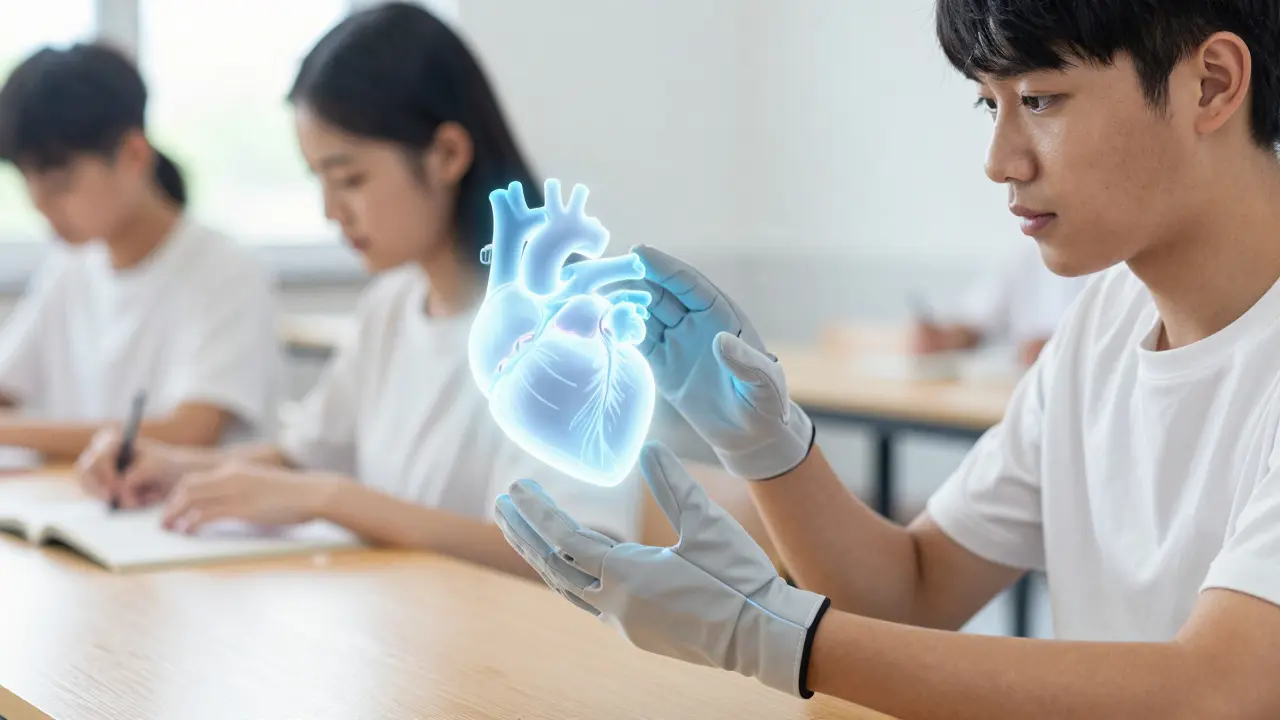
While software dominates the conversation, hardware is undergoing its own revolution. Haptic Feedback Technology allows users to feel digital objects through vibrations and pressure changes. For blind students studying anatomy, this means touching a virtual heart and feeling the difference between healthy tissue and a tumor. It transforms abstract data into physical sensation.
Recent developments in flexible electronics have made haptic gloves and vests more affordable and durable. These devices sync with digital textbooks, providing texture cues for maps, diagrams, and even musical scores. A musician with visual impairment can now 'feel' the contour of a melody on a staff line, bridging the gap between sight and sound. This tactile layer adds a dimension of depth that flat screens simply cannot provide, making learning multisensory rather than unisensory.
Immersive Environments for Neurodiverse Minds
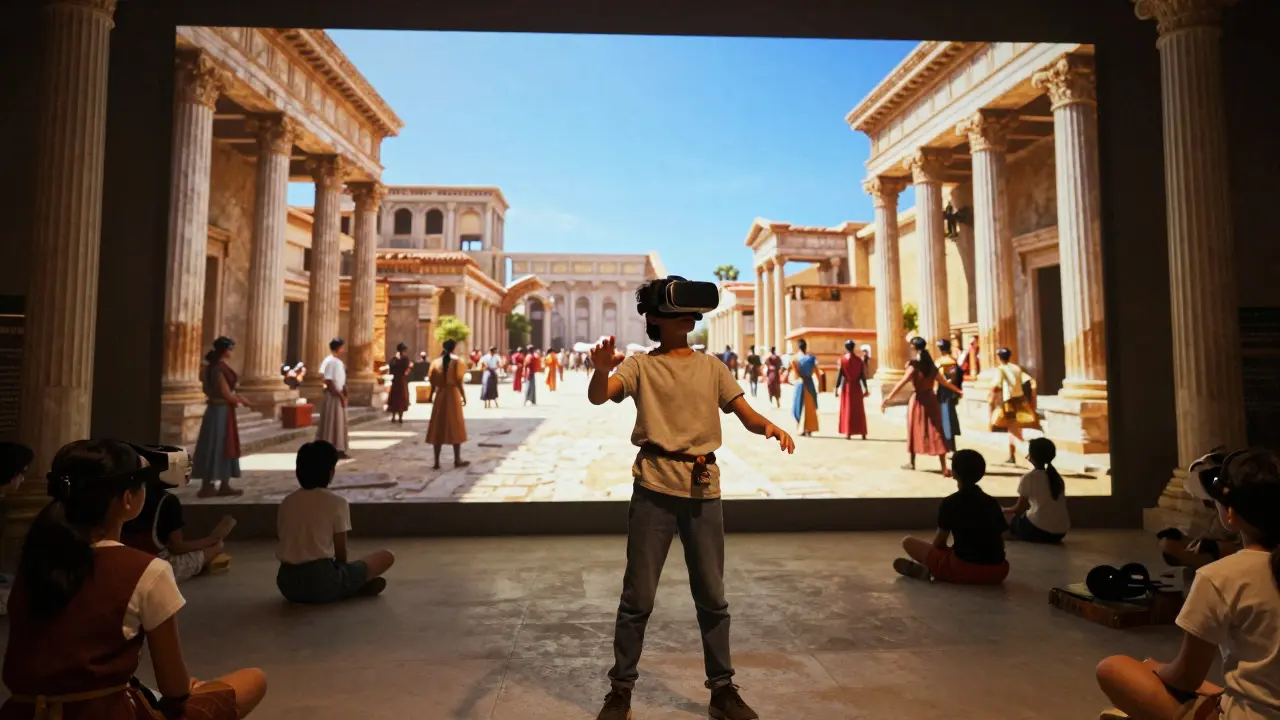
Neurodiversity includes conditions like autism spectrum disorder, dyslexia, and ADHD, which often present challenges with social interaction or linear processing. Virtual Reality offers a controlled environment where these variables can be managed. In a VR history lesson, a student can walk through ancient Rome without the distraction of a noisy classroom. The focus is entirely on the experience, reducing sensory overload while increasing engagement.
Augmented Reality (AR) takes this further by overlaying information onto the real world. For students with dyspraxia (motor coordination difficulties), AR can guide hand movements during science experiments, projecting step-by-step instructions directly onto their workspace. This reduces anxiety and error rates, allowing the student to focus on the concept rather than the mechanics. The key here is agency-the student controls the pace and the level of detail, fostering independence.
Breaking Down Language Barriers
Inclusive learning also means linguistic inclusion. With globalization, classrooms are increasingly multilingual. Real-time speech-to-text and translation tools have evolved beyond basic accuracy to capture idioms and cultural nuances. A student speaking Mandarin can listen to a lecture in English and see subtitles in Chinese that reflect the speaker's tone and emphasis, not just the literal words.
This technology supports second-language learners who might otherwise fall behind due to language acquisition delays. By decoupling comprehension from fluency, these tools allow students to access high-level academic content immediately. Over time, the reliance on translation decreases as proficiency grows, creating a natural scaffold for language development. This is particularly impactful in international schools and universities where the student body represents dozens of native languages.
Implementation Challenges and Ethical Considerations
Despite the promise, adoption faces hurdles. Cost remains a barrier for underfunded schools, though cloud-based solutions are lowering entry prices. More critically, there is the issue of data privacy. When AI monitors cognitive load and behavior, where does that data go? Institutions must ensure that adaptive algorithms do not create new forms of bias, such as labeling a slow reader as 'struggling' when they are simply processing deeply.
Teacher training is another gap. Many educators are comfortable with chalkboards but overwhelmed by dashboards tracking biometric data. Successful integration requires professional development that focuses on pedagogy, not just technical operation. Teachers need to know when to trust the AI and when to step in with human empathy. The goal is a hybrid model where technology handles the mechanical adaptation, freeing teachers to focus on mentorship and critical thinking.
Building a Future-Proof Curriculum
To stay ahead, educational institutions should start small. Pilot programs with one or two subjects can reveal what works and what doesn’t without overhauling the entire curriculum. Look for tools that integrate seamlessly with existing Learning Management Systems (LMS) rather than requiring separate logins or platforms. Interoperability is key; if a student uses a haptic glove for biology, they shouldn’t need a different device for chemistry.
Furthermore, involve students in the selection process. They are the end-users and often have insights into what actually helps versus what feels gimmicky. Student feedback loops can identify friction points early, ensuring that the technology serves the learning goals rather than becoming a distraction. As we look toward the next decade, the definition of accessibility will continue to expand, moving from 'fixing the student' to 'designing the system.'
Is AI accessibility only useful for students with disabilities?
No. While designed for accessibility, AI features like adjustable text speed, simplified summaries, and multimodal presentations benefit all learners. This is known as the 'curb-cut effect,' where features intended for specific groups improve usability for everyone, such as automatic captions helping hearing-impaired individuals and those in noisy environments alike.
How much does haptic feedback equipment cost for a classroom?
Costs vary widely, but consumer-grade haptic gloves now range from $200 to $500 per unit. Cloud-based software subscriptions typically add $10-$20 per student per month. Schools can reduce costs by using shared devices or focusing on high-impact subjects first, such as science and art, before expanding to general literacy tools.
Do I need to replace my current Learning Management System to use these tools?
Not necessarily. Most emerging accessibility tools offer APIs or plugins that integrate with major LMS platforms like Canvas, Blackboard, or Moodle. However, check for compatibility before purchasing. Seamless integration ensures that progress data flows back to the teacher’s dashboard, maintaining a single source of truth for student performance.
What are the biggest privacy concerns with AI monitoring in classrooms?
The main concern is data retention and ownership. Who owns the behavioral data generated by eye-tracking or typing analysis? Ensure that contracts specify data anonymization and that data is stored locally or in compliant clouds. Students should have the right to opt out of biometric tracking without losing access to core content.
How can teachers assess whether accessibility tech is working?
Look at engagement metrics alongside traditional grades. Increased time-on-task, higher completion rates for assignments, and qualitative feedback from students are strong indicators. If a student who previously avoided reading is now completing texts, the tech is working. Regular check-ins help distinguish between technical success and pedagogical fit.