


What an Honor Code Really Means
Most schools and universities don’t just hand out rules about cheating. They ask students to sign a promise - an honor code. This isn’t just a formality. It’s a shared agreement that you won’t lie, cheat, or steal in your academic work. In practice, that means no copying homework, no buying essays, no using hidden notes during an exam. It sounds simple. But in a world where AI tools can write essays in seconds and online exams happen on laptops in dorm rooms, keeping that promise gets harder every year.
Colleges like the University of Virginia and the United States Military Academy have had honor codes since the 1800s. They don’t just punish violations - they rely on students to report each other. That’s not common everywhere, but the core idea stays the same: your word matters. If you break it, you lose trust. And in academia, trust is everything.
Cheating: It’s Not Just Copying Answers
Cheating isn’t just about sneaking a peek at a neighbor’s test. It’s any action that gives you an unfair advantage. That includes:
- Using AI tools like ChatGPT to write your entire paper and calling it your own
- Sharing answers with classmates during a take-home exam
- Having someone else take your online exam for you
- Reusing old assignments from a previous semester
Some students think if they tweak the wording or run it through a paraphraser, it’s fine. It’s not. Professors use tools like Turnitin and Grammarly’s AI detector to spot unnatural writing patterns. A paper that sounds too perfect, too smooth, or too generic raises red flags - even if it’s technically original.
In 2024, a survey by the International Center for Academic Integrity found that 68% of college students admitted to some form of cheating. That number jumped from 54% in 2019. The rise lines up with the spread of AI writing tools. Schools aren’t just catching more cheaters - they’re seeing more people try.
Plagiarism: When Borrowing Becomes Stealing
Plagiarism is when you use someone else’s words, ideas, or work without giving them credit. It doesn’t matter if you meant to or not. If you copy a paragraph from a website and forget to cite it, you’re still guilty. If you paraphrase a study but don’t link it back to the original author, that’s plagiarism too.
Some students think, “I just used it to understand the topic.” That’s fine - as long as you write it in your own words and say where it came from. The problem happens when you treat sources like clip art: copy, paste, and move on.
Real-world consequences are serious. A student at the University of Auckland was suspended for two semesters after submitting a thesis that copied 40% of its content from published articles. He claimed he didn’t know how to cite properly. The school didn’t accept that excuse. In graduate programs, plagiarism can end your degree, your career, or even your visa status if you’re an international student.
Proctoring: Watching You From Afar
Online exams changed how schools catch cheaters. Now, instead of sitting in a quiet room with a proctor walking around, you’re taking the test at home - while a camera watches you.
Remote proctoring tools like ProctorU, Examity, and Respondus LockDown Browser do more than just record your face. They:
- Track eye movement and head position
- Monitor background noise
- Block access to other apps and websites
- Scan your room for phones or notes
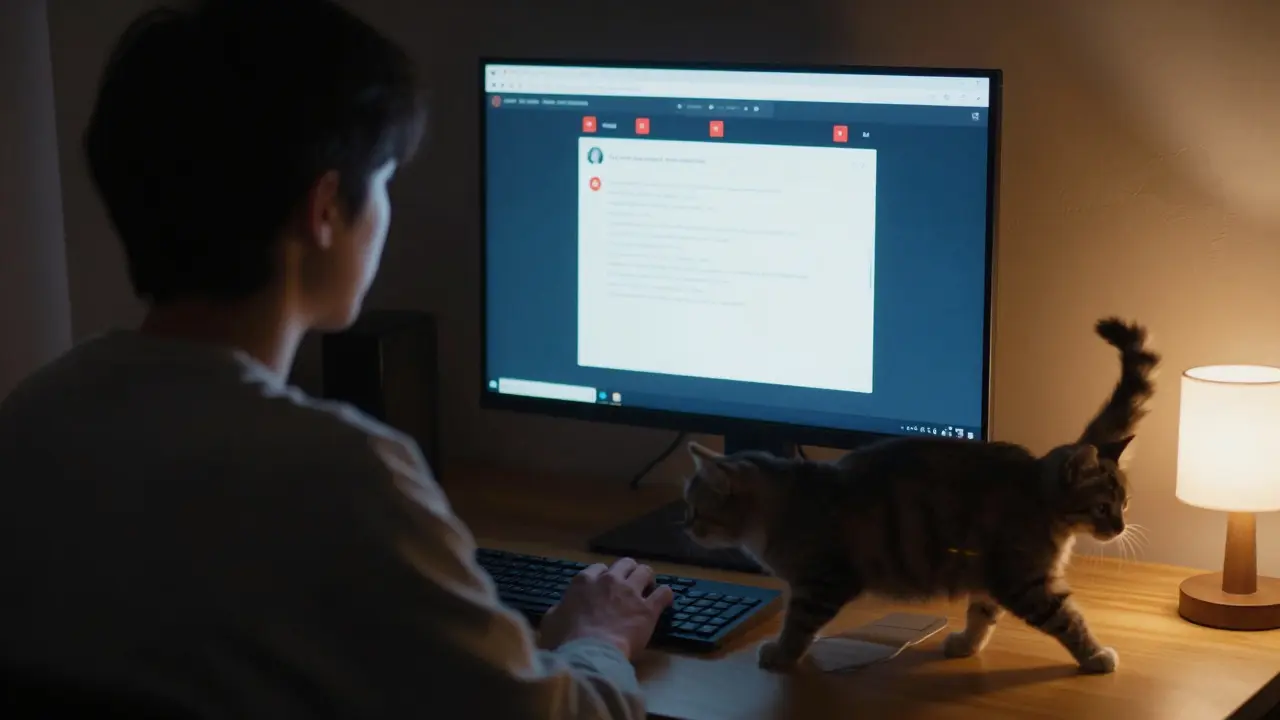
Some students hate it. They say it feels like surveillance. Others say it’s fair - if you’re not cheating, you have nothing to hide. But there’s a catch. Proctoring software isn’t perfect. It flags people for blinking too much, coughing, or walking past the camera. One student in Canada was accused of cheating because her cat walked across the keyboard. She had to prove her innocence with a video log.
And privacy? It’s a real concern. Proctoring companies store hours of video, audio, and screen recordings. Some have had data breaches. Schools are supposed to delete the footage after grading, but not all do.
Why Honor Codes Still Matter - Even With Tech Watching
Technology helps catch cheaters. But it doesn’t stop them from wanting to cheat. That’s where honor codes come in. They shift the focus from fear of getting caught to pride in doing the right thing.
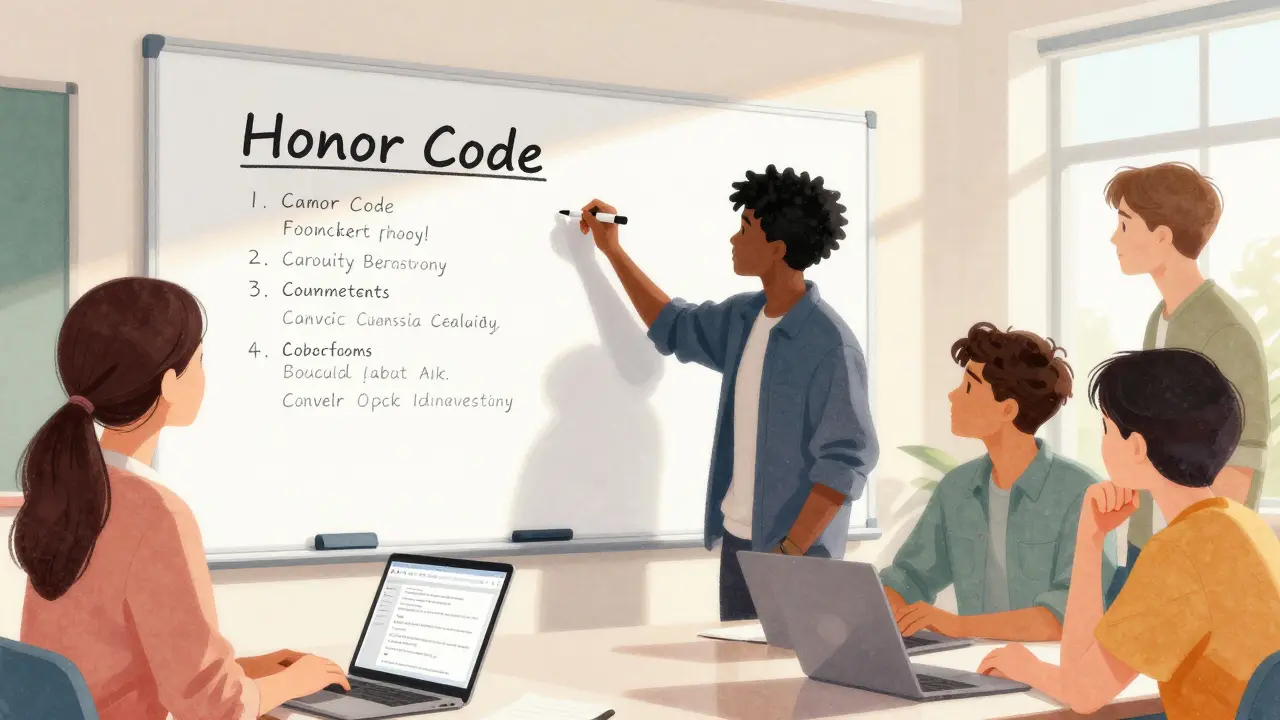
At institutions that take honor codes seriously, students are trained to understand them from day one. First-year orientation includes workshops on academic integrity. Professors don’t just say “don’t cheat” - they explain why it matters. An essay isn’t just a grade. It’s your voice. Your thinking. Your growth.
When students sign an honor code, they’re not just agreeing to rules. They’re joining a community that values honesty. That’s why some schools let students take unproctored exams - because they trust the system. And when trust works, cheating drops.
A 2023 study from Stanford showed that schools with strong honor codes saw 30% fewer plagiarism incidents than those relying only on proctoring software. The difference wasn’t the tech. It was the culture.
What Happens When You Break the Rules
Penalties vary by school, but they’re rarely small. Here’s what you might face:
- First offense: Warning, zero on the assignment, mandatory ethics training
- Second offense: Failing the course, suspension for a semester
- Third offense: Expulsion, permanent record note
Some schools offer a chance to appeal. Others don’t. And once it’s on your record, it can follow you. Graduate schools ask about academic misconduct. Employers running background checks might too - especially in law, medicine, or education.
And here’s the thing: you don’t need to get caught to be punished. If a classmate reports you, the school will investigate. You won’t get a heads-up. You’ll be called in, asked to explain, and given no chance to delete the evidence.
How to Stay on the Right Side of the Line
Here’s how to avoid trouble:
- Always cite your sources - even if you think it’s common knowledge. When in doubt, cite it.
- Use AI tools for brainstorming, not writing. If you use AI to help structure an idea, say so in your footnote.
- Don’t share your work with others. Even helping a friend by sending them your essay is a violation.
- Read your school’s honor code. It’s usually on the student handbook website. Know what’s allowed and what’s not.
- If you’re struggling, ask for help. Professors, tutors, and writing centers exist to support you - not punish you.
There’s no shortcut to learning. And no app can replace your own thinking. The goal of school isn’t to get good grades - it’s to become someone who can think clearly, argue well, and own their ideas.
What Schools Are Doing Differently
Some universities are moving away from strict proctoring. Instead, they’re focusing on design. If an exam feels like a trap, students will try to beat it.
Now, more professors are using open-book, project-based assessments. Instead of memorizing dates, you’re asked to analyze a real-world problem. Instead of a timed multiple-choice test, you write a reflection. These formats are harder to cheat on - because there’s no single right answer.
Other schools are letting students co-create their honor codes. At the University of British Columbia, students helped design their own academic integrity policy. The result? A 40% drop in reported violations in two years.
Change isn’t about locking students down. It’s about giving them reasons to stay honest.
Is using ChatGPT for homework considered cheating?
It depends on your school’s policy. If your professor says you can use AI for brainstorming but not for writing full responses, then using it to generate your essay is cheating. If the assignment asks for your original thinking, and you hand in AI-generated text without disclosure, that’s plagiarism. Some schools now require you to state if and how you used AI. Always check the assignment instructions - and when in doubt, ask.
Can I get in trouble for accidentally plagiarizing?
Yes. Intent doesn’t matter in most honor code systems. If you copy text without citation, even by mistake, you’re still in violation. That’s why learning how to cite properly is part of every college course. Tools like Zotero or Citation Machine can help. But the best defense is reading your sources carefully and writing your own words - then double-checking your references.
Do proctoring tools really catch everyone who cheats?
No. Proctoring software catches obvious violations - like someone reading off a phone or having another person in the room. But it can’t detect everything. A student might have a friend help them during a take-home exam, or use a hidden earpiece. No system is foolproof. That’s why honor codes matter: they create a culture where cheating is socially unacceptable, not just risky.
What if my school doesn’t have an honor code?
Even without a formal honor code, most schools still have academic integrity policies. These are usually buried in the student handbook or course syllabus. Look for terms like “academic misconduct,” “plagiarism,” or “unauthorized collaboration.” If you’re unsure, ask your professor or academic advisor. Don’t assume silence means permission.
Can I be expelled for one incident of cheating?
It’s rare, but possible - especially in graduate programs or for repeated offenses. A single act of plagiarism on a thesis, for example, can lead to expulsion. Schools weigh the severity, intent, and history. If it’s your first offense and you show remorse, you’ll likely get a warning or a failing grade. But if you lied about it, tried to cover it up, or did it again, expulsion becomes likely.
Final Thought: Your Reputation Is Your Currency
In school, your grade is temporary. Your transcript is permanent. What you do today - whether you cite your sources, whether you sit through an exam without looking at your phone, whether you speak up when you see someone else cheat - shapes who people think you are. That reputation follows you into internships, jobs, and graduate programs.
There’s no app that can fake your integrity. No algorithm that can replace your own voice. The only thing that lasts is what you build honestly - one paper, one exam, one decision at a time.
Comments
Teja kumar Baliga
Honestly, this hit different coming from a place where honor isn't just a word on paper. In India, we grow up hearing 'apna kaam khud karo' - do your own work. Simple, but powerful.
AI tools? Sure, they help brainstorm. But if you're outsourcing your thinking, you're not learning - you're just gaming the system.
k arnold
Oh wow, another lecture on 'honor codes.' Next they’ll make us salute the syllabus. I took a 3am exam in my underwear while eating ramen and still got an A. The system’s broken, not me.
kelvin kind
Proctoring software flagged me once because I sneezed. Turned out it was just dust in my nose. Still had to submit a 3-page appeal. No thanks.
Ian Cassidy
The real issue isn't AI or proctoring - it's assessment design. If your exam can be solved by a GPT-4 prompt, then your course is just a glorified autocomplete test. Time to rethink the pedagogy, not just the policing.
Zach Beggs
I get both sides. Proctoring feels invasive, but I’ve seen people cheat hard. Maybe the answer isn’t more tech or more rules - just more trust.
Kenny Stockman
If you're struggling, just ask for help. Seriously. Tutors, professors, writing centers - they’re there for a reason. No one’s gonna judge you for being human. But trying to hack the system? That’s the real trap.
Antonio Hunter
I’ve been teaching for over 15 years, and I’ve seen the shift. Students used to worry about getting caught. Now they worry about whether the AI-generated essay will pass the detector. It’s not about integrity anymore - it’s about algorithmic evasion. We’ve turned education into a cat-and-mouse game with machines, and we’re losing the moral high ground in the process. The honor code isn’t about punishment - it’s about identity. Who do you want to be when no one’s watching? That’s the question we stopped asking.
Paritosh Bhagat
You think cheating is bad? Wait till you see someone submit a paper with ‘they’ instead of ‘he’ when referencing a historical figure. Grammar is the first domino. Then comes plagiarism. Then comes moral decay. I’ve seen it. I’ve reported it. And yes, I’m the guy who sends you a 12-point annotated correction on your APA references. You’re welcome.
Ben De Keersmaecker
The term 'honor code' implies voluntary adherence. But if your school doesn't define what constitutes 'unauthorized collaboration' in the syllabus, how can you honor something you never agreed to? Transparency is the real foundation - not the signature at the bottom of a 20-page PDF.
Aaron Elliott
The philosophical underpinning of academic integrity is predicated upon the Cartesian notion of the autonomous rational agent - a construct increasingly untenable in an age of distributed cognition and algorithmic augmentation. To penalize the use of AI without interrogating the epistemological framework of originality itself is to engage in a form of ideological fetishism. The honor code, as currently constituted, is an anachronism.
Chris Heffron
I once got flagged for using a thesaurus. 😅
Turns out 'utilize' isn't 'use' - who knew? 😅
Anyway, I always cite now. Better safe than sorry!
Adrienne Temple
I used to think AI was cheating... until I used it to help me rewrite a paragraph I was stuck on. It didn't write it for me - it helped me find my own voice. There's a difference.
And if your professor can't tell the difference? Maybe they need to update their teaching game too. 🤔
Sandy Dog
I CRIED when my professor accused me of plagiarism because my essay sounded ‘too professional.’ I spent 14 hours on that paper. I cried again when I found out my best friend had used ChatGPT for her entire thesis and got an A+ because her professor ‘loved the flow.’
It’s not fair. It’s not right. And now I don’t even trust myself. I read my own work and wonder - is this mine? Or did I just absorb someone else’s AI-generated vibe? 😭
I just want to pass. But I don’t know how to be honest anymore.