


Imagine a training module that doesn't just play out the same way for everyone. Instead, it reacts to your choices. You pick an option, and the story changes. You get stuck, and the system offers specific help based on where you went wrong. This isn't science fiction; it's the power of branching scenarios, which are interactive narrative structures in e-learning that adapt content delivery based on user decisions. For organizations trying to scale education without losing the personal touch, this approach is a game-changer.
Traditional linear courses treat all learners the same. They assume everyone needs the same information, at the same time, in the same order. But we know that's not how people learn. Some need more practice with math; others need context for history. Branching scenarios fix this by allowing personalized learning to happen automatically through decision-based pathways rather than manual instructor intervention. The result is higher engagement, better retention, and a system that scales effortlessly.
The Core Mechanics of Adaptive Pathways
To understand why branching works, you have to look at the mechanics. A branching scenario is built on a simple principle: choice leads to consequence. In a linear video, if a viewer falls asleep for ten minutes, they miss critical info. In a branching module, if a learner makes a wrong choice, the system detects the gap in knowledge immediately.
This detection triggers a feedback loop. Instead of a generic "Wrong answer" screen, the learner receives targeted remediation. Maybe they missed a clue about customer empathy. The next scene shows them the impact of that oversight, then loops back to a similar decision point. This is adaptive learning in action, using real-time data from user interactions to modify the subsequent content flow. It mimics the Socratic method but does it digitally, instantly, and for thousands of users simultaneously.
The key here is the logic map behind the scenes. Designers don't just write one story; they write a web of possibilities. Each node represents a decision or a piece of content. The edges represent the transitions. When a learner moves through this web, their path becomes unique. No two journeys are identical unless the learners make identical choices. This uniqueness is what drives the "personalization" part of the equation.
Why Linear Courses Fail at Scale
We've all taken those boring compliance courses. You click "Next" repeatedly until the progress bar hits 100%. You might even be able to do it while watching TV. The problem isn't just boredom; it's inefficiency. If you already know the material, spending three hours on it is a waste of time. If you don't know it, a passive video won't teach you enough.
Linear courses fail because they lack learner agency, which refers to the degree of control and influence a learner has over their own educational journey. When learners feel like passengers, they disengage. Branching scenarios force active participation. You can't progress without making a choice. This cognitive load is good-it means your brain is working. It turns passive consumption into active simulation.
At scale, this difference compounds. Imagine training 10,000 sales reps. With linear content, maybe 60% actually retain the key selling points. With branching scenarios, the system ensures every rep encounters the specific objections they struggle with most. The weak spots get reinforced automatically. You don't need 10,000 trainers to identify these gaps; the software does it for you.
Designing Effective Decision Trees
Building a branching scenario isn't just about writing lots of text. It requires careful architectural planning. If you branch too much, you create "content sprawl." You end up writing 50 different endings for a single module, which is unsustainable. The goal is meaningful variation, not infinite complexity.
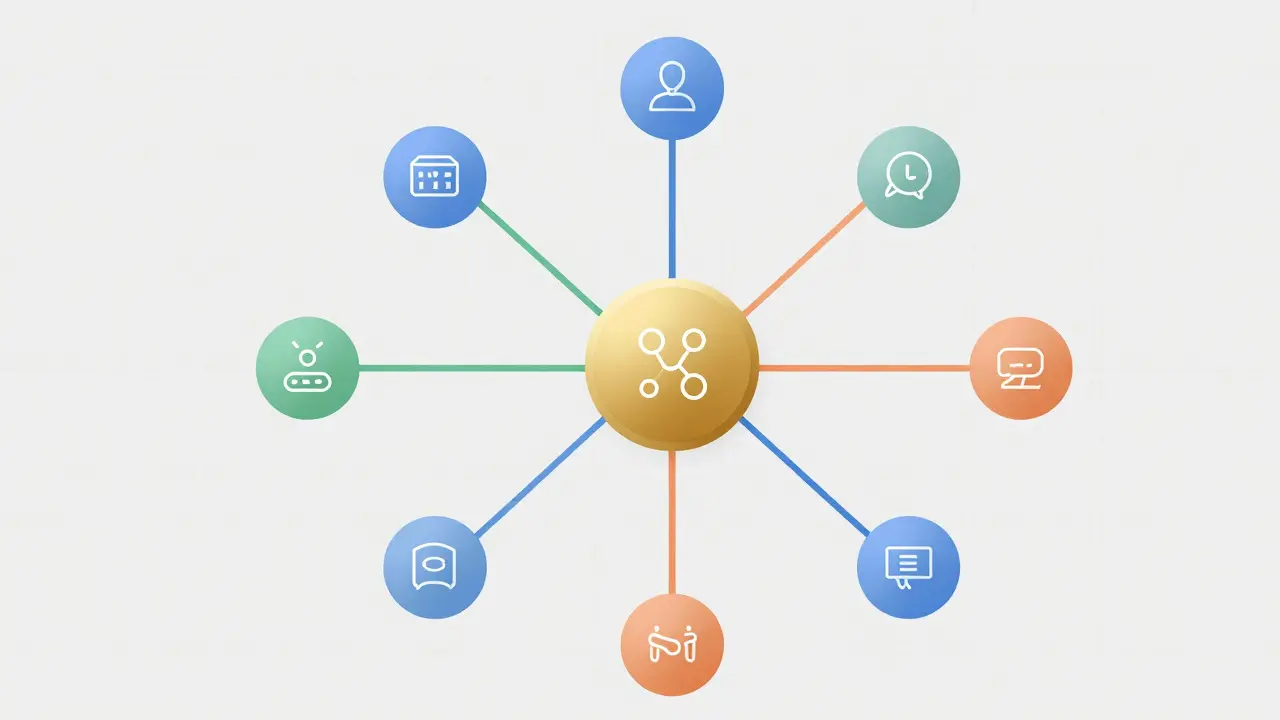
A good design uses a "hub-and-spoke" model. There is a central narrative thread (the hub), and specific decisions lead to short, focused variations (the spokes) before returning to the main path. This keeps development manageable while still offering personalization. For example, in a leadership course, the main story might be managing a team conflict. One branch could focus on emotional intelligence, another on procedural fairness. Both branches teach valuable skills but cater to different leadership styles.
You also need to plan for assessment. How do you know if the branching worked? You embed checkpoints. These aren't just multiple-choice quizzes at the end. They are embedded within the branches. Did the learner choose the empathetic response? If yes, they move to advanced topics. If no, they revisit the core concept. This continuous assessment provides rich data for learning analytics, which involves the measurement, collection, analysis, and reporting of data about learners and their contexts.
| Feature | Linear Course | Branching Scenario |
|---|---|---|
| Learner Control | Low (Passive) | High (Active) |
| Content Adaptation | None | Real-time based on choices |
| Development Cost | Lower initial cost | Higher initial cost, lower marginal cost per learner insight |
| Retention Rates | Average (30-40%) | High (70-90% due to interactivity) |
| Scalability | Easy to deploy, hard to personalize | Hard to build, easy to personalize at scale |
Technology Stack for Implementation
You don't need a computer science degree to build this, but you do need the right tools. Modern e-learning authoring tools like software platforms used to create interactive digital learning experiences. such as Articulate Storyline or Adobe Captivate have built-in branching capabilities. They allow you to set variables and conditions. For instance, if "Customer_Satisfaction" score is below 50, show "Remediation_Slide_A".
For more complex scaling, you might integrate these modules with a Learning Management System (LMS) that supports xAPI or Tin Can API standards for tracking detailed learner interactions. xAPI is crucial here. Traditional SCORM only tracks completion and score. xAPI tracks the granular details: "Learner chose Option B," "Learner failed Assessment C," "Learner watched Video D." This data allows the LMS to recommend future branching paths based on past performance across different courses.
If you're looking at enterprise-scale personalization, you might combine branching scenarios with AI-driven recommendation engines. The AI analyzes the aggregate data from thousands of learners to optimize the branching logic. If 80% of learners who take Branch A fail the final test, the system can automatically nudge future learners toward Branch B. This creates a self-improving curriculum.
Real-World Applications in Corporate Training
Where does this work best? High-stakes decision-making environments. Healthcare, sales, compliance, and leadership development are prime candidates. In healthcare, branching scenarios simulate patient interactions. A nurse trainee must decide whether to administer medication based on symptoms. Wrong choices lead to virtual patient deterioration, providing safe, high-fidelity practice without real-world risk.
In sales training, branching scenarios role-play difficult conversations. A rep might face an angry client. Do they apologize first? Do they offer a discount? Do they escalate to a manager? Each choice reveals something about the rep's strategy. The system then tailors the next coaching session to address their specific weakness-perhaps negotiation tactics or empathy building.
Compliance training benefits immensely too. Instead of reading dry policies, employees navigate ethical dilemmas. They see the consequences of cutting corners. This contextual learning sticks far better than memorizing rulebooks. Companies report higher compliance rates and fewer incidents when using immersive, choice-driven training.

Overcoming Common Pitfalls
It's not all smooth sailing. The biggest pitfall is "branch fatigue." If every single sentence is a choice, the learner gets overwhelmed. You need to balance interactivity with narrative flow. Use branching for critical decision points, not for trivial preferences like "What color is the character's shirt?"
Another issue is maintenance. As regulations change or products update, linear courses are easy to edit. Branching scenarios require checking every possible path to ensure consistency. You need a robust version control system and clear documentation of your logic maps. Treat your course logic like code: document it, test it, and update it systematically.
Finally, don't underestimate the writing challenge. Good branching requires strong storytelling skills. The narrative must remain coherent despite diverging paths. Characters shouldn't act out of character just to fit a plot hole created by a learner's choice. Invest in skilled instructional designers who understand both pedagogy and narrative structure.
The Future of Personalized Learning
We are moving toward a future where learning is entirely fluid. Branching scenarios are just the beginning. Soon, we'll see seamless integration between virtual reality, AI tutors, and adaptive content. Imagine stepping into a VR environment where the scenario branches in real-time based on your biometric stress levels. If you're anxious, the system simplifies the task. If you're confident, it increases the difficulty.
This level of personalization was impossible a decade ago. Now, it's within reach for any organization willing to invest in the right design and technology. The key takeaway is this: personalization isn't a luxury; it's a necessity for effective learning at scale. Branching scenarios provide the framework to deliver it.
What is the difference between branching scenarios and linear e-learning?
Linear e-learning follows a fixed path where every learner sees the same content in the same order. Branching scenarios allow learners to make choices that determine the subsequent content they receive, creating a unique learning path for each individual based on their decisions and knowledge gaps.
Are branching scenarios expensive to develop?
Yes, they generally have a higher upfront development cost than linear courses because you need to write multiple narrative paths and program the logic. However, they offer better return on investment through improved learner retention, reduced training time for competent learners, and deeper insights into learner performance.
Which authoring tools support branching scenarios?
Popular tools include Articulate Storyline, Adobe Captivate, and iSpring Suite. These platforms allow you to set variables, trigger conditions, and create non-linear navigation structures. For more advanced customization, developers may use HTML5/JavaScript frameworks combined with an LMS that supports xAPI.
How do I prevent content sprawl in branching scenarios?
Use a hub-and-spoke design model where branches diverge briefly for specific feedback or remediation and then reconverge on the main narrative path. Focus branching only on critical decision points that significantly impact learning outcomes, rather than creating endless variations for minor choices.
Can branching scenarios track detailed learner data?
Yes, especially when paired with xAPI (Tin Can API). While traditional SCORM tracks completion and scores, xAPI can record specific interactions, such as which choices were made, how long a learner spent on a branch, and repeated attempts at specific decision points, enabling deep learning analytics.