

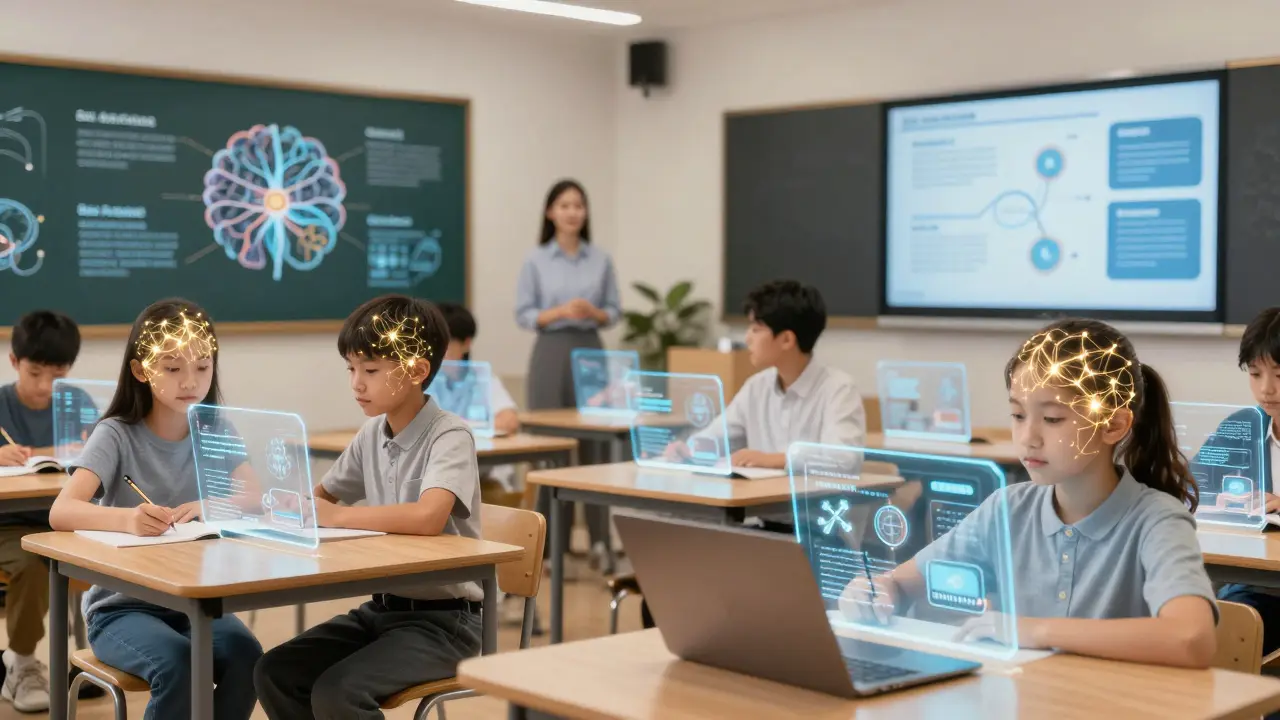
Imagine a classroom where lessons aren't just designed around what students need to memorize for a test, but are built around how their brains actually process information. For decades, education relied on intuition and tradition. If it worked for the teacher, it was assumed to work for the student. Today, that guesswork is disappearing. We are standing at the intersection of Neuroscience and the study of the nervous system, specifically how the brain encodes, stores, and retrieves information. When you combine this hard data with Learning Science and an interdisciplinary field that uses psychology and cognitive science to understand how people learn best, the result is a revolution in how we teach.
This isn't about fads or quick fixes. It's about aligning our educational methods with biological reality. As we move through 2026, schools and online platforms are increasingly adopting evidence-based strategies that respect the limits of human attention and the mechanics of memory. The goal is simple: make learning stickier, less stressful, and more effective for every type of learner.
The Myth of Learning Styles vs. Cognitive Reality
Let’s start by busting a massive myth that has plagued education for years: learning styles. You’ve probably heard that some people are "visual learners" while others are "auditory." It sounds intuitive, right? But neuroscience tells us otherwise. Research consistently shows that tailoring instruction to a specific style (like drawing diagrams for visual learners) does not improve outcomes compared to matching the mode to the content itself.
Instead of focusing on styles, learning science points us toward Dual Coding and a technique that combines verbal explanations with visual representations to create two distinct memory traces. When you explain a concept verbally while showing a relevant diagram, you engage multiple areas of the brain simultaneously. This doesn't matter if the student is a "visual" person; it works because the human brain is wired to process images and language separately but integrate them for deeper understanding. Teachers who drop the "style" label and start using dual coding see immediate improvements in retention across all students.
Managing Cognitive Load: Less Is More
One of the most critical insights from cognitive neuroscience is the concept of Cognitive Load Theory and a framework describing the limited capacity of working memory during learning. Think of your working memory as a small cup and long-term memory as a large tank. If you pour too much water into the cup at once, it spills over. That spillage is lost learning.
In traditional classrooms, teachers often overload this cup. They might present a complex diagram with labels, a dense paragraph of text, and a spoken explanation all at the same time. This creates extraneous cognitive load-mental effort spent processing irrelevant details rather than the core concept. To fix this, educators are now breaking lessons into smaller, manageable chunks. This approach, known as scaffolding, ensures that new information connects smoothly to existing knowledge without overwhelming the brain’s processing power. In 2026, digital learning platforms use algorithms to detect when a user is struggling, automatically simplifying the next step to keep cognitive load optimal.
The Power of Spaced Repetition and Retrieval Practice
If you want to remember something, rereading your notes is one of the least effective ways to do it. It feels productive, but it’s largely an illusion of competence. True learning happens when you force your brain to retrieve information. This is called Retrieval Practice and the act of actively recalling information from memory, which strengthens neural pathways.
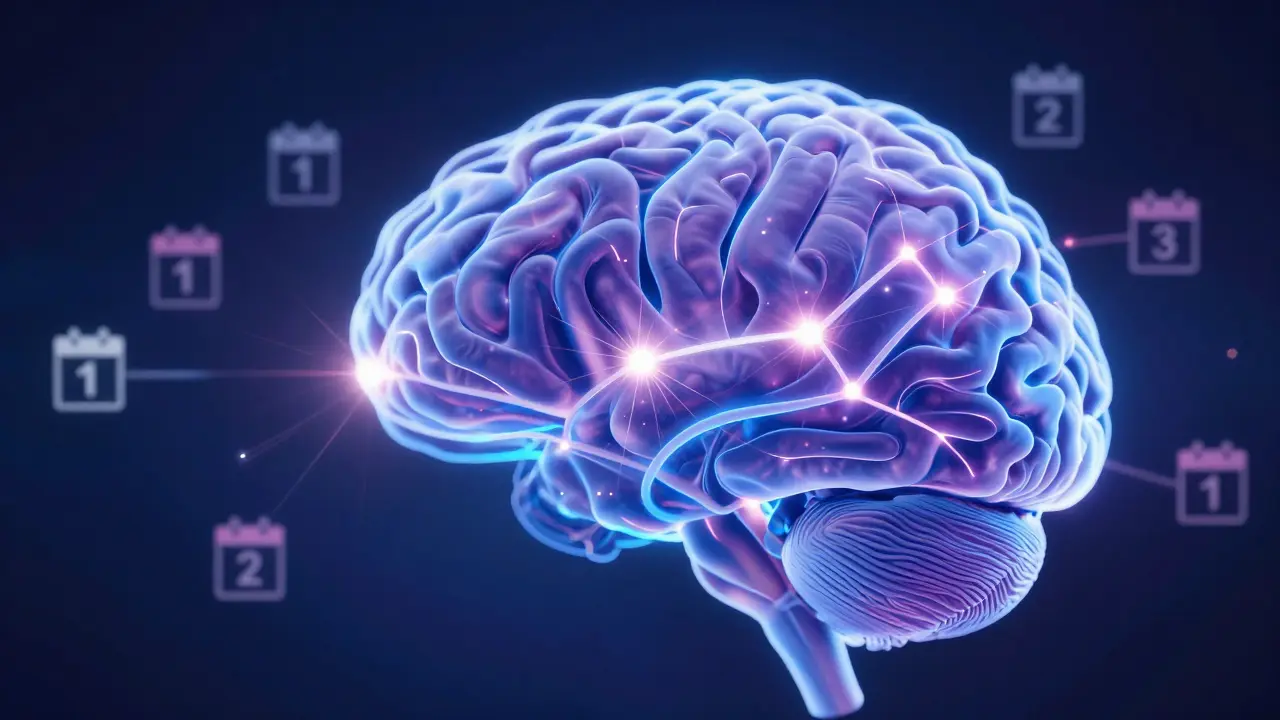
Combine retrieval with Spaced Repetition and a scheduling technique that reviews material at increasing intervals over time, and you have a powerhouse combination. Instead of cramming for a final exam, students review material one day after learning it, then three days later, then a week later. Each time they struggle to recall the answer, the neural connection becomes stronger. Apps like Anki and Quizlet have popularized this, but modern LMS (Learning Management Systems) now embed spaced repetition directly into curriculum flows, prompting students to revisit key concepts just before they are likely to forget them.

Emotional Regulation and the Prefrontal Cortex
You can’t separate learning from emotion. Neuroscience confirms that stress and anxiety directly inhibit the prefrontal cortex-the part of the brain responsible for higher-order thinking, decision-making, and focus. When a student is anxious about failing a test, their brain shifts into survival mode. Literally, the amygdala hijacks the system, making deep learning nearly impossible.
This is why the future of learning emphasizes psychological safety. Schools are integrating mindfulness practices and social-emotional learning (SEL) not as "extras," but as core components of academic success. By teaching students how to regulate their emotions, educators lower cortisol levels and clear the path for cognitive engagement. A calm brain is a learning brain. In 2026, many institutions begin classes with brief breathing exercises or reflection periods to reset the nervous system before diving into complex topics.
Technology as a Cognitive Partner
Artificial intelligence and adaptive learning technologies are no longer just buzzwords; they are practical tools grounded in learning science. These systems analyze student performance in real-time to identify gaps in understanding. Unlike a static textbook, an AI-driven platform can adjust the difficulty of questions based on the learner’s current cognitive state.
For example, if a student consistently struggles with algebraic variables, the system might backtrack to reinforce foundational arithmetic concepts before moving forward. This personalized pacing respects individual differences in processing speed and prior knowledge. However, technology must be used wisely. Over-reliance on AI can erode critical thinking skills if students don’t engage in the struggle necessary for deep learning. The best models use tech to handle rote practice, freeing up human teachers to facilitate discussion, debate, and creative application.
| Aspect | Traditional Approach | Neuroscience-Based Approach |
|---|---|---|
| Content Delivery | Lecture-heavy, continuous flow | Chunked information with breaks |
| Review Strategy | Cramming before exams | Spaced repetition over weeks/months |
| Assessment | High-stakes testing | Low-stakes retrieval practice quizzes |
| Error Handling | Punitive grading | Feedback loops for growth |
| Role of Emotion | Ignores emotional state | Integrates SEL and stress management |
Mitigating Neuroplasticity Myths
We hear a lot about neuroplasticity-the brain’s ability to rewire itself. While true, it’s often oversold. Just thinking about playing piano won’t make you a pianist. Plasticity requires active, focused effort. This is where the concept of "desirable difficulties" comes in. Learning should feel somewhat challenging. If it’s too easy, no new connections are formed. Educators are learning to design tasks that push students just beyond their comfort zone, providing enough support to prevent frustration but enough challenge to stimulate growth.
Implementing These Strategies in Real Classrooms
So, how do you actually apply this tomorrow? Start small. Replace one lecture with a session that includes a five-minute silent reading period followed by peer discussion. Use exit tickets where students write down one thing they learned and one question they still have. This forces retrieval and provides you with instant feedback. Encourage students to teach each other; explaining a concept to someone else is one of the most powerful ways to solidify your own understanding, known as the Protégé Effect.
Professional development for teachers is shifting away from generic pedagogy workshops toward neuroscience-informed training. Teachers are learning to recognize signs of cognitive overload and how to structure lessons that build mental stamina. It’s a cultural shift from "covering content" to "ensuring comprehension."
What is the biggest misconception about neuroscience in education?
The biggest misconception is that neuroscience provides a direct map for teaching. Brain scans show activity, but they don't tell you exactly how to teach math or history. Learning science bridges this gap by translating neural mechanisms into practical classroom strategies. Don't confuse correlation with causation; just because two brain lights up together doesn't mean one causes the other.
Does spacing out study sessions really work better than cramming?
Yes, significantly. Cramming might get you through a test tomorrow, but the information fades quickly. Spaced repetition strengthens long-term memory consolidation. Studies show that students who space their study sessions retain information months later, whereas cramming leads to rapid forgetting. It feels slower initially, but it saves time in the long run.
How can teachers reduce cognitive load without simplifying the curriculum?
Teachers can reduce extraneous load by removing distractions from materials. For example, avoid decorative images in textbooks that don't add meaning. Break complex problems into step-by-step guides. Provide worked examples before asking students to solve problems independently. This allows students to focus their limited working memory on the core concepts rather than figuring out the format.
Is learning science only useful for academic subjects?
No, these principles apply to any skill acquisition, including sports, music, and professional training. Whether you're learning to code or play guitar, spaced practice, retrieval, and managing cognitive load will accelerate your progress. The underlying mechanisms of memory and attention are universal across domains.
How does stress affect learning according to neuroscience?
Chronic stress releases cortisol, which can damage the hippocampus, the area of the brain crucial for memory formation. Acute stress can temporarily shut down the prefrontal cortex, impairing critical thinking. Creating a low-stress environment isn't just about kindness; it's a biological necessity for optimal cognitive function. Students need to feel safe to take risks and make mistakes, which are essential parts of learning.