


Forget the stack of flashcards gathering dust in your drawer. If you are trying to learn a new language, brute force memorization is not just inefficient; it is actively working against you. You study hard for three days, feel confident, and then forget half of what you learned by the weekend. This isn't a failure of intelligence. It is a failure of strategy.
The solution lies in a concept that has been around for over a century but has only recently become accessible through digital tools: Spaced Repetition Systems, or SRS. These systems are algorithms designed to show you information right before you are about to forget it. For language learners, this is the difference between struggling to recall basic words after six months and holding fluent conversations with ease.
Why Your Brain Forgets (And How to Stop It)
To understand why SRS works, you have to look at the Forgetting Curve, a concept introduced by German psychologist Hermann Ebbinghaus in 1885. His research showed that human memory decays exponentially. If you learn a new word today, you will likely remember it tomorrow. But by day three, you might retain only 40% of it. By day seven, that number drops to near zero unless you review it.
Most traditional language courses ignore this curve. They teach you twenty words on Monday, twenty on Tuesday, and expect you to know all forty by Friday. This leads to massive cognitive overload and rapid decay. Spaced repetition flips this model. Instead of reviewing everything equally, an SRS algorithm calculates the optimal interval for each specific piece of information. If you know the word "apple" perfectly, it won't show it to you again for two weeks. If you struggle with "banana," it will pop up again in ten minutes.
This efficiency is crucial for language acquisition because vocabulary size correlates directly with fluency. In English, the top 1,000 most frequent words cover about 75% of everyday speech. The next 1,000 push that coverage to nearly 90%. Memorizing these efficiently frees up mental energy for grammar, pronunciation, and cultural nuance, rather than wasting hours relearning basics.
How Spaced Repetition Algorithms Work
You don't need to be a mathematician to use an SRS, but understanding the logic helps you trust the process. At its core, every major SRS relies on a variation of the SM-2 Algorithm, developed by Piotr Wozniak in 1986 for his SuperMemo program. Modern apps like Anki and Memrise use refined versions of this logic.
Here is the simple workflow:
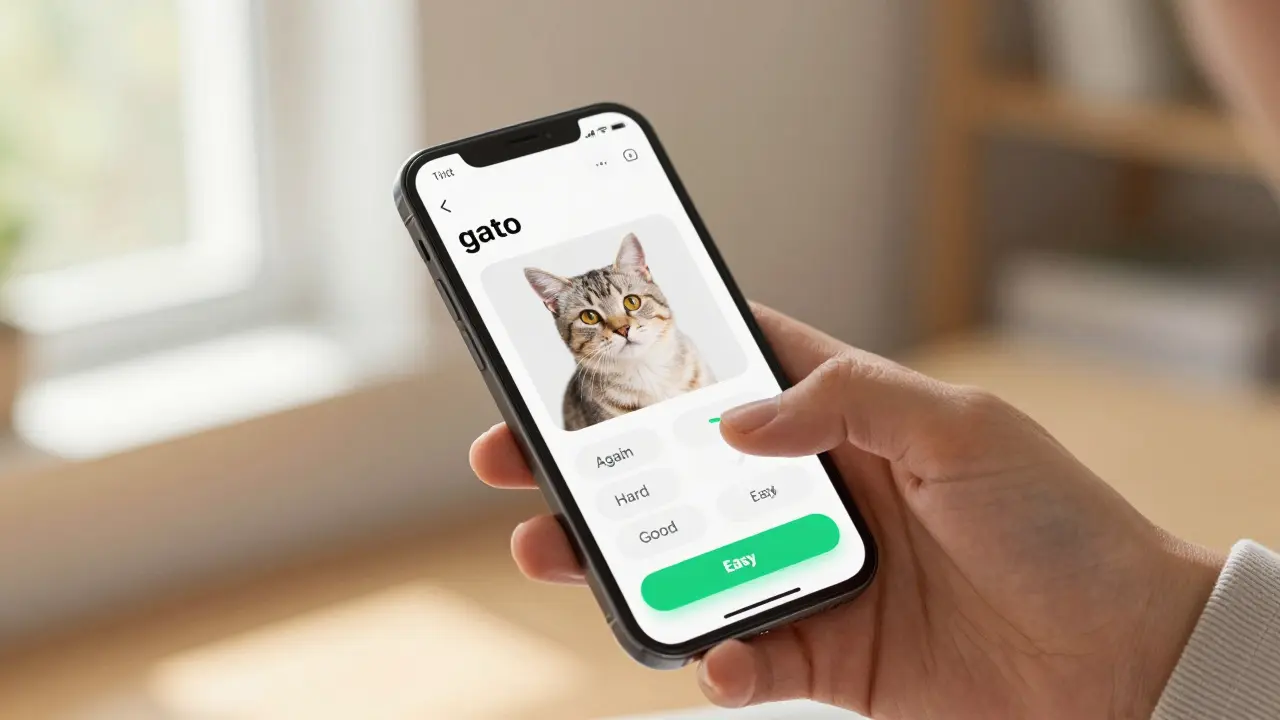
- Initial Presentation: You see a new card (e.g., Spanish "gato" = English "cat").
- Self-Assessment: After seeing the answer, you rate how difficult it was to recall. Options usually range from "Again" (failed) to "Easy" (instant recall).
- Interval Calculation: The algorithm adjusts the next review date based on your rating. A "Hard" response might schedule the card for tomorrow. An "Easy" response might push it out by a month.
- Progressive Spacing: Each successful review extends the interval further-days, then weeks, then months, then years.
The key insight here is that struggle strengthens memory. When you have to work to retrieve a word, neural connections strengthen. If you simply read a list passively, those connections remain weak. SRS forces active recall at the precise moment of maximum benefit.
Top Tools for Language Learners in 2026
Not all spaced repetition tools are created equal. Some are bare-bones databases, while others offer immersive, gamified experiences. Choosing the right one depends on your learning style and technical comfort level.
| Platform | Best For | Customizability | Cost |
|---|---|---|---|
| Anki | Purists & Power Users | High (Add-ons, custom CSS) | Free (iOS paid) |
| Memoize | Beginners & Mobile Users | Low (Pre-built decks) | Freemium |
| Duolingo Max | Casual Learners | None (Fixed curriculum) | Subscription |
| Zanki | Quick Starters | Medium (Import existing decks) | Free |
Anki remains the gold standard for flexibility. It allows you to create cards with audio, images, video, and even cloze deletions (fill-in-the-blank sentences). However, it has a steep learning curve. You need to manage your own deck structure and potentially troubleshoot sync issues across devices.
In contrast, Memrise offers a more polished, user-friendly interface. It uses pre-made courses that integrate native speaker videos, which adds contextual richness that plain text cards lack. While less customizable, it requires zero setup time, making it ideal for people who want to start immediately without fiddling with settings.
Creating Effective Flashcards: Quality Over Quantity
Having the best algorithm means nothing if your input data is poor. A common mistake beginners make is creating vague cards. A card that says "House = Casa" is useless because it doesn't tell you *how* to use the word. Does it require an article? Is it masculine or feminine?
Effective SRS cards should follow these principles:
- Context is King: Use full sentences instead of isolated words. For example, instead of "Run = Correr," use "I run every morning = Yo corro todas las mañanas." This teaches grammar and collocation alongside vocabulary.
- One Idea Per Card: Don't cram multiple facts into one card. If you need to know the gender, plural form, and meaning of a noun, split them into separate cards or use cloze deletion fields.
- Use Mnemonics: If a word is abstract, add a vivid image or story. For the French word "pain" (bread), imagine a man named Pain eating a loaf. Visual associations stick better than rote translation.
- Avoid Ambiguity: Ensure there is only one correct answer. If a word has multiple meanings, create separate cards for each distinct usage context.
Consider the Japanese particle "wa." A card asking "What does 'wa' mean?" is impossible to answer correctly because it depends entirely on the sentence structure. A better card would present a sentence like "Watashi wa gakusei desu" and ask you to identify the function of "wa" (topic marker).

Common Pitfalls and How to Avoid Them
Even with a great system, users often sabotage their progress. Here are the most frequent errors I see among language students.
The Backlog Panic: When you take a break from studying, your SRS accumulates hundreds of overdue reviews. Returning to this mountain feels overwhelming, leading many to quit. To avoid this, set a realistic daily limit. Ten minutes a day is infinitely better than two hours once a week. Consistency beats intensity.
Passive Recognition vs. Active Recall: Many learners glance at the front of the card, guess the answer, and flip it before actually retrieving the information from memory. This creates a false sense of competence. Force yourself to say the answer aloud or write it down before revealing the back. If you hesitate, mark it as "Hard" or "Good," not "Easy."
Ignoring Audio: Language is sound. Text-only cards lead to perfect spelling but terrible pronunciation. Always include audio clips from native speakers. Most modern SRS platforms allow you to embed audio files or use text-to-speech engines, though native recordings are superior for capturing intonation and natural speed.
Integrating SRS Into Your Daily Routine
The biggest advantage of digital SRS is portability. You can turn dead time into learning time. Commuting, waiting in line, or sitting on the toilet are prime opportunities for a quick review session.
Start small. Aim for five minutes a day. As your backlog grows, gradually increase this time. Most serious learners find that 15-20 minutes daily is sustainable. Use notifications to remind you, but treat it like brushing your teeth-a non-negotiable habit, not a chore.
Combine your SRS sessions with other activities. Listen to podcasts in your target language while reviewing cards. Read news articles and pull out new phrases to add to your deck immediately. This keeps the content fresh and relevant to your interests.
Is Anki free to use on all devices?
Anki is completely free on Windows, Mac, Linux, Android, and web browsers. However, the official iOS app costs a one-time fee (usually around $25) to support the developer. There are free alternatives on iOS, such as AnkiMobile clones, but they may lack some features or sync reliability.
How long does it take to see results with spaced repetition?
Most learners notice improved retention within the first two weeks. Significant fluency gains typically appear after 3-6 months of consistent daily practice. The key is consistency; missing several days in a row will reset much of your progress due to the forgetting curve.
Can I import my own flashcards into Anki?
Yes, Anki supports importing CSV or TSV files. You can also download pre-made decks from AnkiWeb shared collections. Just be cautious with shared decks, as quality varies wildly. It is often better to create your own cards to ensure they match your specific learning needs and context.
Does spaced repetition work for grammar rules?
It works best for pattern recognition rather than theoretical explanations. Instead of creating a card that asks "What is the subjunctive mood?", create a card with a sentence in the indicative mood and ask you to convert it to the subjunctive. This tests application, which is far more valuable for speaking and writing.
What if I fall behind on my reviews?
Don't panic. The algorithm will reschedule missed cards, but your daily load will increase. Try to clear the backlog over several days rather than binging. If the backlog becomes unmanageable, consider burying older cards temporarily or reducing the number of new cards you add per day until you catch up.