


Numbers tell you what happened in your course. They show drop-off rates, quiz scores, and completion percentages. But they rarely explain why. Why did students quit halfway through Module 3? Why is the pass rate high but satisfaction low? To answer these questions, you need qualitative data. It captures the human element-the frustration, the 'aha' moments, and the confusion-that spreadsheets simply cannot measure.
Incorporating qualitative data collection into your course analytics strategy transforms raw metrics into actionable insights. This guide breaks down how to gather rich, descriptive feedback and analyze it effectively to improve learner outcomes.
The Gap Between Quantitative Metrics and Learner Reality
Most educators start with quantitative data because it is easy to automate. Learning Management Systems (LMS) like Canvas or Moodle provide dashboards full of graphs. You see that 40% of students failed Assignment 2. That is a fact. But it is not a story.
Qualitative data fills this gap. It consists of non-numerical information: text responses from surveys, transcripts from focus groups, comments on discussion boards, and even open-ended feedback forms. When you combine this with quantitative metrics, you get a complete picture. For instance, if you know 40% failed Assignment 2 (quantitative) and their feedback mentions "unclear instructions" (qualitative), you have a specific problem to solve.
Without qualitative context, you risk optimizing the wrong things. You might make the quiz harder based on score distributions, ignoring the fact that students are struggling with basic concepts due to poor instructional design. Qualitative data grounds your analytics in reality.
Methods for Collecting Rich Qualitative Data
You do not need expensive software to start collecting qualitative data. You need intentional methods that encourage honest, detailed responses. Here are the most effective approaches for course environments:
- Open-Ended Survey Questions: Instead of just asking "Did you like the course? (1-5)", ask "What was the most confusing part of this module and why?" Specific prompts yield specific answers. Avoid yes/no questions if you want depth.
- Discussion Board Analysis: Monitor student forums not just for participation points, but for sentiment. Are students helping each other? Are they expressing frustration about deadlines? These organic conversations are goldmines for understanding the learning climate.
- Focus Groups: Gather 5-8 students for a 30-minute video call. Ask them to walk you through their experience with a recent assignment. Listen for patterns in their language. Do they use words like "overwhelming," "clear," or "repetitive"?
- Learning Journals: Encourage students to keep brief weekly reflections. Ask them to note one thing they learned and one thing that confused them. Over time, this longitudinal data reveals how understanding evolves-or stalls.
A key tip: Timing matters. Collect feedback immediately after a learning event, not at the end of the semester when memories fade. If a lecture was confusing, ask about it within 24 hours.
Choosing the Right Tools for the Job
Your tools should match the volume and type of data you expect. For small courses, simple tools work best. For large-scale programs, you may need specialized platforms.
| Tool Type | Best For | Pros | Cons |
|---|---|---|---|
| Survey Platforms (e.g., Qualtrics, Google Forms) | Structured open-ended feedback | Easy to distribute; automated export | Limited depth; response fatigue |
| LMS Discussion Forums | Organic peer interaction | Real-time data; no extra setup | Noisy data; hard to extract themes |
| Video Conferencing (Zoom, Teams) | Focus groups and interviews | Rich contextual cues; follow-up questions | Time-intensive to schedule and transcribe |
| Social Listening Tools | Brand sentiment and informal feedback | Captures unfiltered opinions | Privacy concerns; data noise |
If you are using an LMS, check its built-in analytics first. Many modern platforms now include sentiment analysis features that scan discussion posts for positive or negative tones. However, always verify automated sentiment scores by reading the actual text. AI can misinterpret sarcasm or complex nuance.
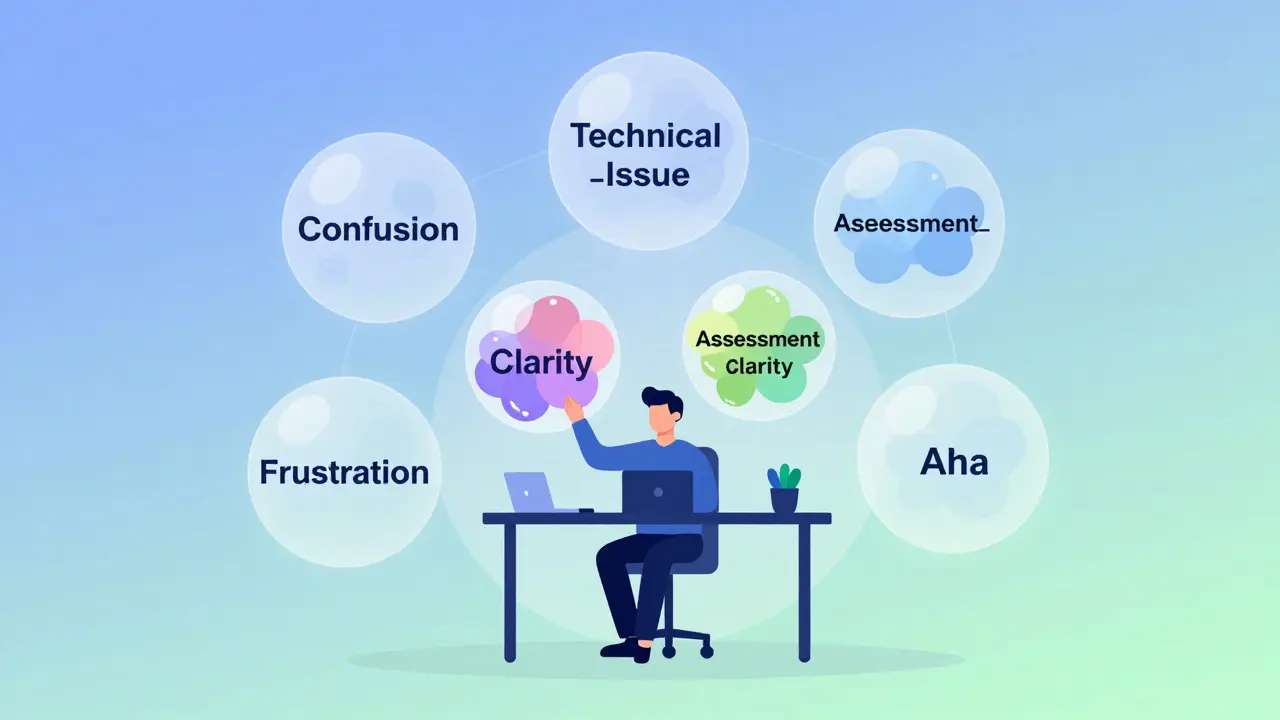
Analyzing Qualitative Data: From Chaos to Clarity
Collecting data is only half the battle. The real value comes from analysis. You will likely end up with hundreds of paragraphs of text. How do you make sense of it? The standard method is thematic analysis.
- Familiarization: Read through all the responses multiple times. Get a feel for the overall tone. Note any recurring words or phrases.
- Coding: Assign labels (codes) to segments of text that relate to a specific idea. For example, if three students mention "video quality," code that segment as "Technical_Issue." If two mention "unclear rubric," code that as "Assessment_Clarity."
- Theme Development: Group similar codes together. "Technical_Issue" and "Audio_Problems" might merge into a broader theme called "Accessibility_Barriers."
- Interpretation: Look for relationships between themes. Does "High_Stress" correlate with "Unclear_Deadlines"? This step moves you from description to insight.
You do not need to be a statistician to do this. Tools like Microsoft Excel or even sticky notes on a wall can help you organize codes. For larger datasets, consider qualitative data analysis software (QDAS) like NVivo or Dedoose, which help manage and visualize connections between codes.
A common pitfall is confirmation bias-only looking for data that supports what you already believe. To avoid this, invite a colleague to review your codes independently. If you both arrive at similar themes, your analysis is more robust.
Integrating Qualitative Insights into Course Design
Data without action is just noise. Once you have identified key themes, map them to specific changes in your course. Create a feedback loop where students see their input leading to tangible improvements. This builds trust and encourages future participation.
For example, if thematic analysis reveals that students feel isolated during asynchronous modules, introduce weekly live Q&A sessions or peer-matching activities. If the data shows confusion around grading criteria, revise the rubrics to include examples of high-scoring work.
Track the impact of these changes. In the next iteration of the course, collect qualitative data again on the same topics. Did the new Q&A sessions reduce feelings of isolation? Compare the sentiment scores or frequency of related complaints. This continuous improvement cycle is the heart of effective course analytics.

Ethical Considerations in Student Feedback
When collecting personal opinions, ethics are paramount. Students must feel safe to share honest criticism without fear of retaliation or grade penalties. Always ensure anonymity where possible. If conducting focus groups, clarify that participation is voluntary and does not affect their academic standing.
Be transparent about how you will use the data. Tell students, "We are analyzing your feedback to improve the course structure." Avoid vague promises. If you cannot act on certain types of feedback (e.g., requests for lower workload due to institutional constraints), acknowledge those limitations upfront.
Respect privacy laws like FERPA (in the US) or GDPR (in Europe). Never publish identifiable student quotes without explicit permission. Even anonymized quotes can sometimes be traced back to individuals in small classes, so exercise caution.
Common Pitfalls to Avoid
New practitioners often stumble over a few predictable hurdles. Awareness helps you sidestep them:
- Survey Fatigue: Asking too many open-ended questions leads to short, unhelpful answers. Limit surveys to 3-5 critical questions.
- Ignoring Silence: Students who don't respond are also providing data. Low response rates may indicate disengagement or distrust. Investigate why.
- Over-Reliance on Outliers: One passionate complaint shouldn't dictate major changes. Look for patterns across multiple respondents.
- Mixing Methods Poorly: Don't just tack on a comment box to a numeric survey. Integrate qualitative and quantitative sections logically so the flow makes sense to the respondent.
Remember, the goal is not to please every student. It is to identify systemic issues that hinder learning for the majority. Use qualitative data to prioritize changes that have the highest impact on educational outcomes.
How much qualitative data is enough for course analysis?
There is no fixed number, but saturation is the key metric. Saturation occurs when new data stops revealing new themes or insights. Typically, interviewing 10-15 students or analyzing 50-100 open-ended survey responses provides sufficient depth for most course-level adjustments. If you read ten responses and find the same three complaints repeatedly, you likely have enough data to act.
Can I automate qualitative data analysis?
Partially. Natural Language Processing (NLP) tools can perform sentiment analysis and topic modeling at scale, identifying broad trends quickly. However, automation lacks nuance. It may miss sarcasm, cultural context, or subtle pedagogical issues. Use AI as a first-pass filter to highlight potential areas of concern, then apply human judgment to interpret the deeper meaning behind the words.
What is the difference between formative and summative qualitative feedback?
Formative feedback is collected during the course to make immediate adjustments (e.g., mid-module check-ins). Summative feedback is gathered at the end to evaluate overall effectiveness and inform future iterations. Both are valuable: formative helps current students, while summative improves the course for future cohorts.
How do I handle conflicting qualitative feedback?
Conflict is normal. Some students prefer detailed lectures; others want concise summaries. Look for the underlying need. Often, the solution is flexibility-providing both options. If conflicts persist, weigh the feedback against your learning objectives. Does the requested change support the core goals of the course? If not, explain your rationale to students to maintain transparency.
Is qualitative data reliable compared to quantitative data?
Reliability depends on methodology. Qualitative data is subjective by nature, but it can be highly valid if collected systematically and analyzed rigorously. Triangulation-using multiple sources (surveys, interviews, observations)-increases reliability. While quantitative data tells you the magnitude of a problem, qualitative data confirms its existence and nature. Both are essential for a balanced view.