

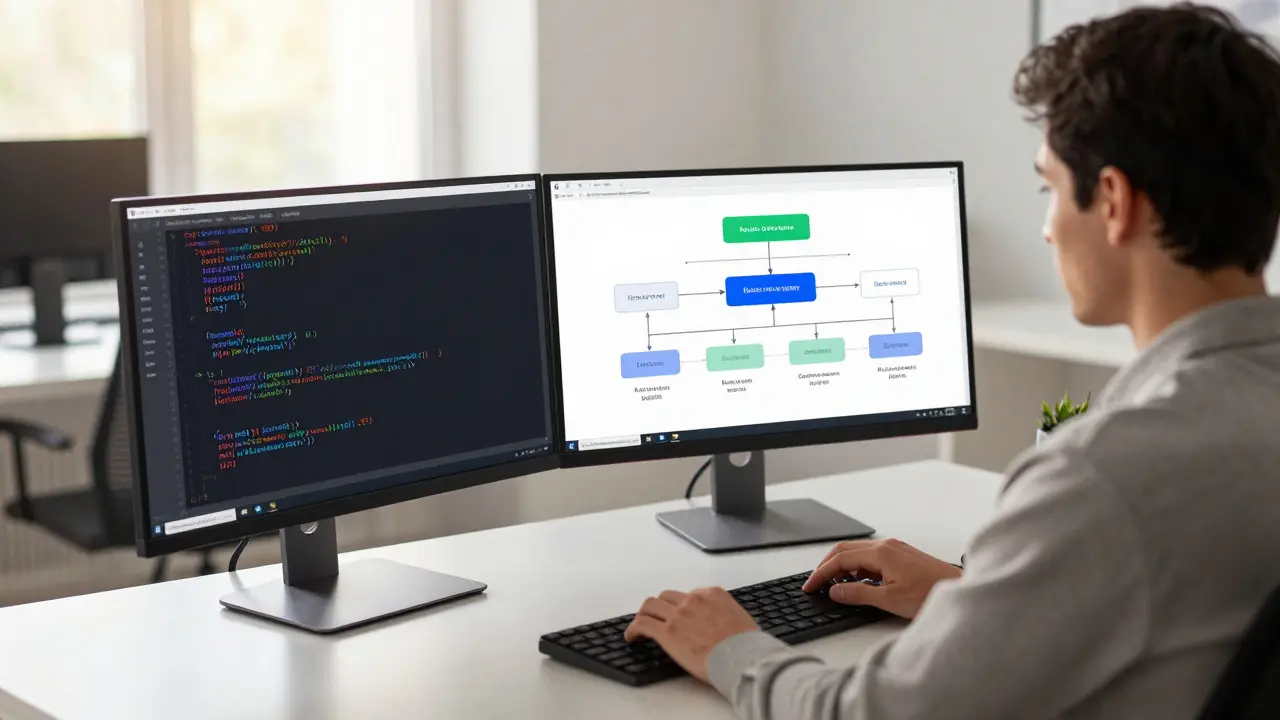
Most developers know how to code. They can build APIs, manage databases, and deploy containers without breaking a sweat. But when it comes to AI and Machine Learning Course Design, many struggle because they try to teach math before mechanics. The result? Frustrated students who quit before they ever see their model predict anything useful.
You don't need to turn your learners into data scientists overnight. You need to bridge the gap between traditional software engineering and probabilistic thinking. If you're building a curriculum for engineers, the goal isn't just theory-it's integration. How do you take a random forest algorithm and make it work inside a production-grade microservice?
Why do most ML courses fail for experienced developers?
They focus too heavily on statistical theory and calculus early on, ignoring the practical workflow of data ingestion, feature engineering, and deployment that developers care about.
Start with the Developer Mindset
Developers think in terms of inputs, outputs, and edge cases. Data scientists often think in terms of distributions, variances, and confidence intervals. Your course needs to speak the first language while teaching the second. When you introduce Machine Learning is a subset of artificial intelligence focused on systems that learn from data rather than following explicit instructions, frame it as a different way to write functions. Instead of hard-coding rules like `if user_age > 18 then approve`, you train a model to infer that rule from thousands of examples.
This mental shift is crucial. In your first module, avoid heavy mathematics. Start with a simple problem: predicting house prices or classifying spam emails. Use tools they already know. If your audience uses Python, stick to Pandas is a data manipulation library used for cleaning and analyzing structured data and Scikit-learn is a library providing simple and efficient tools for predictive data analysis. These libraries abstract away the complex linear algebra, allowing developers to focus on the logic of the pipeline.
- Input: Raw data (CSV files, API responses).
- Process: Training a model (the "black box").
- Output: Predictions or classifications.
By framing ML this way, you reduce anxiety. You’re not asking them to become mathematicians; you’re asking them to become better integrators of intelligent components.
The Curriculum Arc: From Data to Deployment
A solid AI course design follows a logical progression that mirrors the software development lifecycle. Don’t jump straight into neural networks. Build the foundation first. Here is a proven structure for a 10-week intensive course:
- Weeks 1-2: Data Literacy. Teach them how to clean data. Real-world data is messy. Show them how to handle missing values, outliers, and inconsistent formats using Pandas. This is where 80% of the actual work happens.
- Weeks 3-4: Classical Algorithms. Introduce linear regression, decision trees, and k-nearest neighbors. Focus on *when* to use each one, not just how to code them. Explain overfitting using the analogy of memorizing answers vs. understanding concepts.
- Weeks 5-6: Evaluation Metrics. Accuracy is misleading. Teach precision, recall, F1-score, and ROC curves. Use real scenarios: why does a high accuracy rate fail in fraud detection?
- Weeks 7-8: Deep Learning Basics. Introduce Neural Networks are computing systems inspired by biological neural networks that enable computers to learn from experience. Use TensorFlow is an open-source machine learning framework developed by Google or PyTorch. Keep it simple-image classification or text sentiment analysis.
- Weeks 9-10: MLOps and Deployment. This is the differentiator. Show them how to wrap their model in a FastAPI endpoint, containerize it with Docker, and deploy it to AWS or Azure.
This arc respects the developer’s existing skills while gradually introducing new complexity. It ensures that by the end, they haven’t just built a model in a Jupyter Notebook-they’ve built a product component.
Practical Projects Over Theory Lectures
No one learns to drive by watching videos of cars. They learn by getting behind the wheel. Your course must be project-heavy. Replace long lectures with hands-on labs. For example, instead of explaining gradient descent with equations, have students visualize it by tweaking learning rates in a simple optimization problem and seeing how the loss function changes.
Create projects that solve real business problems. A generic "Titanic Survival Prediction" dataset is boring. Try these instead:
- E-commerce Recommendation Engine: Build a system that suggests products based on past purchases using collaborative filtering.
- Churn Prediction for SaaS: Analyze user activity logs to predict which customers are likely to cancel their subscription.
- NLP Chatbot Triage: Create a classifier that routes customer support tickets to the right department based on email content.
These projects force students to deal with unstructured data, imbalanced classes, and real-time inference constraints. They also produce portfolio pieces that hiring managers actually want to see.
Bridging the Gap: MLOps Essentials
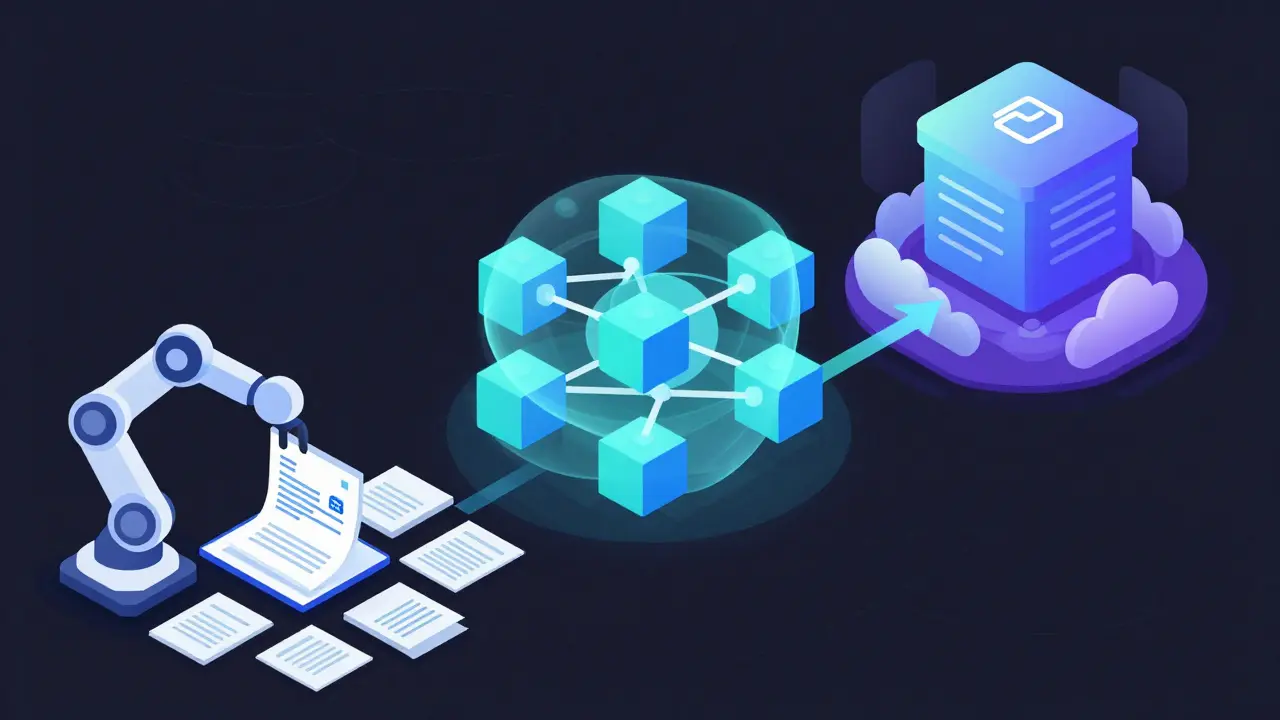
Many courses stop at model accuracy. That’s a mistake. In the industry, a model that sits in a notebook is useless. You must teach MLOps is a set of practices that aims to deploy and maintain machine learning models in production reliably and efficiently. This includes version control for data (not just code), model monitoring, and retraining pipelines.
Introduce tools like DVC (Data Version Control) is an open-source tool for managing data and machine learning models alongside Git. Show them how to track experiments using MLflow is an open-source platform to manage the ML lifecycle, including experimentation and reproducibility. These tools make the chaotic process of model development feel familiar to developers who are used to CI/CD pipelines.
| Aspect | Traditional Dev | ML Development |
|---|---|---|
| Determinism | Code produces same output every time | Model output varies based on data distribution |
| Versioning | Git for code | Git for code + DVC for data/models |
| Testing | Unit tests for logic | Data validation + performance metrics |
| Deployment | Static binaries or containers | Dynamic models requiring GPU/CPU resources |
Highlighting these differences helps developers adjust their expectations. They need to accept that uncertainty is part of the job. A model isn’t "broken" if it makes a mistake; it’s statistically probable. Teaching them to monitor drift-where data patterns change over time-is essential for long-term success.
Teaching Ethics and Bias
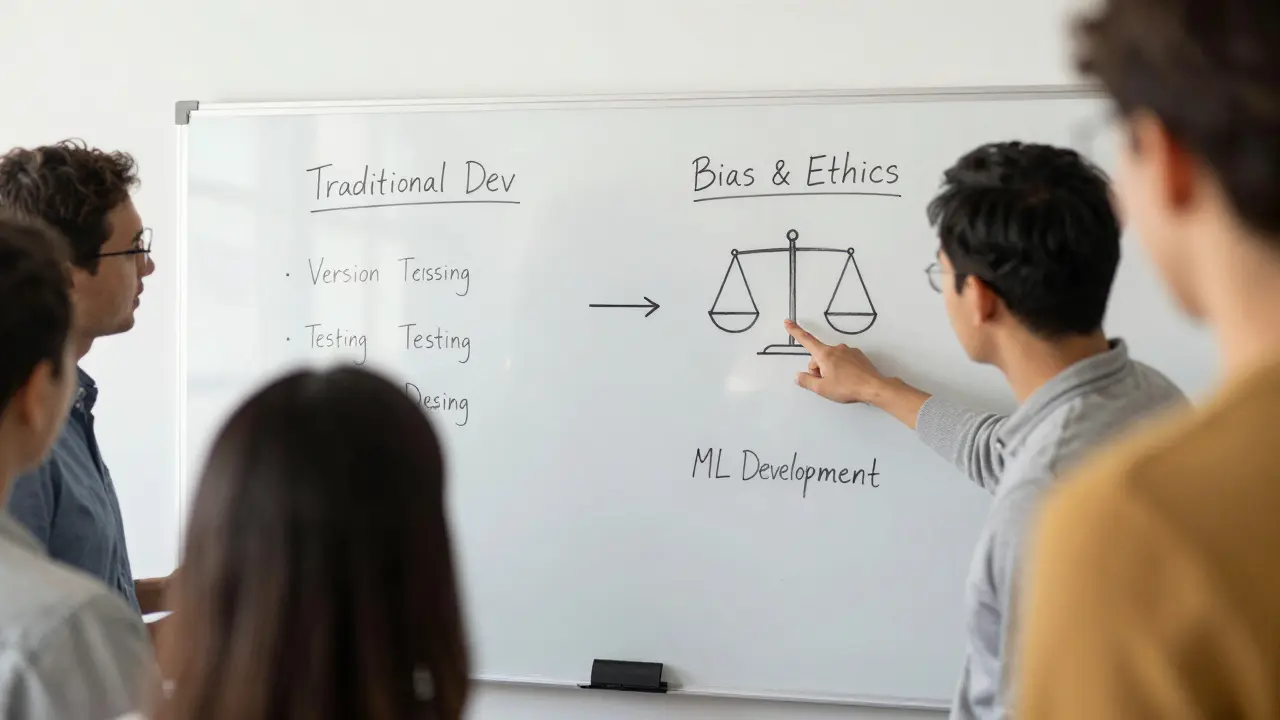
You cannot ignore ethics in modern AI education. Algorithms amplify biases present in training data. If you train a hiring bot on historical data from a male-dominated industry, it will penalize female candidates. This isn’t just a moral issue; it’s a legal and reputational risk.
Dedicate a module to ethical AI. Have students audit datasets for representation gaps. Use tools like Fairness Indicators are tools provided by TensorFlow to evaluate fairness metrics across different subgroups to measure disparate impact. Discuss case studies like COMPAS recidivism algorithms or biased facial recognition systems. Make them understand that responsible AI is a core competency, not an afterthought.
Assessment Strategies That Work
Don’t grade on multiple-choice quizzes about backpropagation. Grade on outcomes. Can they reproduce their results? Can they explain why their model failed? Use peer reviews for code quality and documentation. Require a final capstone project that includes:
- A clear problem statement.
- Data exploration and preprocessing steps.
- Model selection justification.
- Performance evaluation against baseline metrics.
- A deployed demo link.
This mimics real-world deliverables. It forces students to communicate their technical decisions clearly, a skill often overlooked in coding bootcamps but critical for senior roles.
Tools and Technologies to Include
Keep the tech stack current but stable. Avoid niche libraries that might vanish next year. Stick to industry standards:
- Languages: Python (primary), SQL (for data retrieval).
- Libraries: NumPy, Pandas, Scikit-learn, TensorFlow/PyTorch.
- Visualization: Matplotlib, Seaborn, Plotly.
- Cloud Platforms: AWS SageMaker, Google Vertex AI, or Azure ML.
- DevOps: Docker, Kubernetes, GitHub Actions.
Provide cloud credits if possible. Letting students deploy to the cloud removes friction and gives them tangible experience with infrastructure costs and scaling issues.
Common Pitfalls to Avoid
Even well-intentioned courses stumble. Watch out for these traps:
- Overloading Math: Calculus scares off practitioners. Teach intuition first, formulas later.
- Clean Data Only: Using perfectly cleaned datasets creates false confidence. Inject noise and missing values early.
- Ignoring Latency: Developers care about speed. Show them how model size affects inference time.
- No Business Context: Always tie technical choices to business value. Why use a complex deep learning model if a simple logistic regression achieves 95% accuracy with less compute?
By avoiding these pitfalls, you create a learning environment that feels relevant and respectful of the student’s time.
Next Steps for Educators
Designing an AI course for developers is about translation. You are translating the probabilistic world of data science into the deterministic world of software engineering. Start small. Pilot your modules with a small group. Gather feedback on what confused them and what clicked. Iterate quickly.
Remember, your goal isn’t to create pure researchers. It’s to create hybrid engineers who can build, deploy, and maintain intelligent systems. That’s the skill set the market desperately needs in 2026 and beyond.
What prerequisites should students have before starting an AI course?
Students should have solid proficiency in Python, including familiarity with object-oriented programming, list comprehensions, and basic data structures. Understanding of SQL is highly recommended for data extraction tasks.
Is TensorFlow or PyTorch better for beginners?
PyTorch is often preferred for its intuitive, Pythonic syntax and dynamic computation graph, which makes debugging easier. TensorFlow has stronger production deployment tools, but PyTorch is generally more approachable for learning concepts.
How much math is really needed for applied machine learning?
For applied roles, you need conceptual understanding of linear algebra (vectors, matrices) and statistics (mean, variance, probability distributions). You rarely need to derive gradients by hand, but you must understand what they represent.
Should I include Large Language Models (LLMs) in the curriculum?
Yes, but focus on application rather than training. Teach prompt engineering, fine-tuning techniques like LoRA, and RAG (Retrieval-Augmented Generation) architectures. Training LLMs from scratch is computationally prohibitive for most courses.
How do I assess if a student truly understands model bias?
Ask them to identify potential bias sources in a given dataset and propose mitigation strategies. Have them calculate fairness metrics across different demographic groups and explain trade-offs between accuracy and fairness.
Comments
kimberly de Bruin
the whole idea of teaching math before mechanics is like trying to explain the physics of combustion before letting someone drive a car. we learn by doing not by memorizing equations that will never be used in production again
Edward Nigma
You are completely wrong about this approach. In my experience, skipping the mathematical foundations leads to engineers who cannot debug models when they fail. It is essential to understand gradient descent calculus before touching PyTorch otherwise you are just copying code snippets without comprehension. The industry needs rigorous academics not hacky practitioners who rely on black boxes.
Francis Laquerre
I must say that the cultural shift in how we perceive AI education is profound. We are moving from an era of pure theoretical purity to one of pragmatic integration. This article beautifully captures the essence of bridging two distinct worlds: the deterministic logic of software engineering and the probabilistic nature of machine learning. It is a dramatic change indeed.
michael rome
This is an exceptionally well-reasoned argument for restructuring our educational paradigms. I appreciate the emphasis on MLOps as it addresses the critical gap between academic exercises and industrial reality. The suggestion to use FastAPI and Docker aligns perfectly with modern deployment standards. Thank you for sharing these insights which are both respectful of the developer's existing skillset and ambitious in their scope.
Andrea Alonzo
I really resonate with the point about starting with data literacy because so many developers underestimate how much time they will spend cleaning messy datasets rather than building complex neural networks. When I first started learning ML, I was frustrated by the lack of focus on preprocessing, but once I realized that 80% of the work happens there, everything clicked into place for me. It is so important to validate students' feelings of confusion early on and reassure them that struggling with Pandas is a normal part of the journey toward becoming a competent ML engineer.
Saranya M.L.
Your curriculum lacks depth in advanced statistical inference and Bayesian methods which are crucial for robust model interpretation. In India, we prioritize strong mathematical foundations in our top-tier institutions because superficial knowledge leads to catastrophic failures in production environments. You should include rigorous derivations of loss functions and optimization landscapes to ensure students truly understand the underlying mechanics rather than just calling library functions.
om gman
oh please spare me the humblebrag about 'bridging gaps' as if deploying a simple random forest via fastapi is some kind of revolutionary achievement. most of you have no idea what real scale looks like or how distributed training actually works without relying on managed services that hide all the complexity. stop pretending that wrapping a model in docker makes you an mlops engineer
Jeanne Abrahams
How quaint. You think South African developers need a hand-holding tutorial on how to use Scikit-learn? We have been deploying predictive models in high-latency environments for years while dealing with infrastructure constraints that would make your AWS credits look like child's play. Save the basic advice for the beginners who haven't yet learned to read documentation.
Bineesh Mathew
The ethical dimension is not merely a checkbox but a profound moral imperative that defines the soul of our technological creations. To ignore bias is to participate in the systemic oppression of marginalized communities through algorithmic determinism. We must confront the dark underbelly of data collection and the violent histories embedded within our training sets before we dare to claim mastery over artificial intelligence.