


You’ve built the curriculum. You’ve recorded the videos. You’ve polished the slides until they shine. But when you check your analytics six weeks later, the drop-off rate is brutal. Maybe only 15% of students made it past Module 3. The rest? Ghosted. They started with enthusiasm, clicked ‘enroll,’ and then vanished into the digital void.
This isn’t a failure of content quality. It’s a failure of structure. In self-paced online learning, where there is no teacher hovering over their shoulder and no fixed class time, motivation is entirely internal. If you don’t design for that reality, your course becomes just another abandoned cart in a student’s digital life.
The difference between a course people finish and one they ignore comes down to psychology, not pedagogy. You have to build systems that keep learners moving forward even when their initial excitement fades. Here is how you design for retention from day one.
Cut the Fat: Respect the Cognitive Load
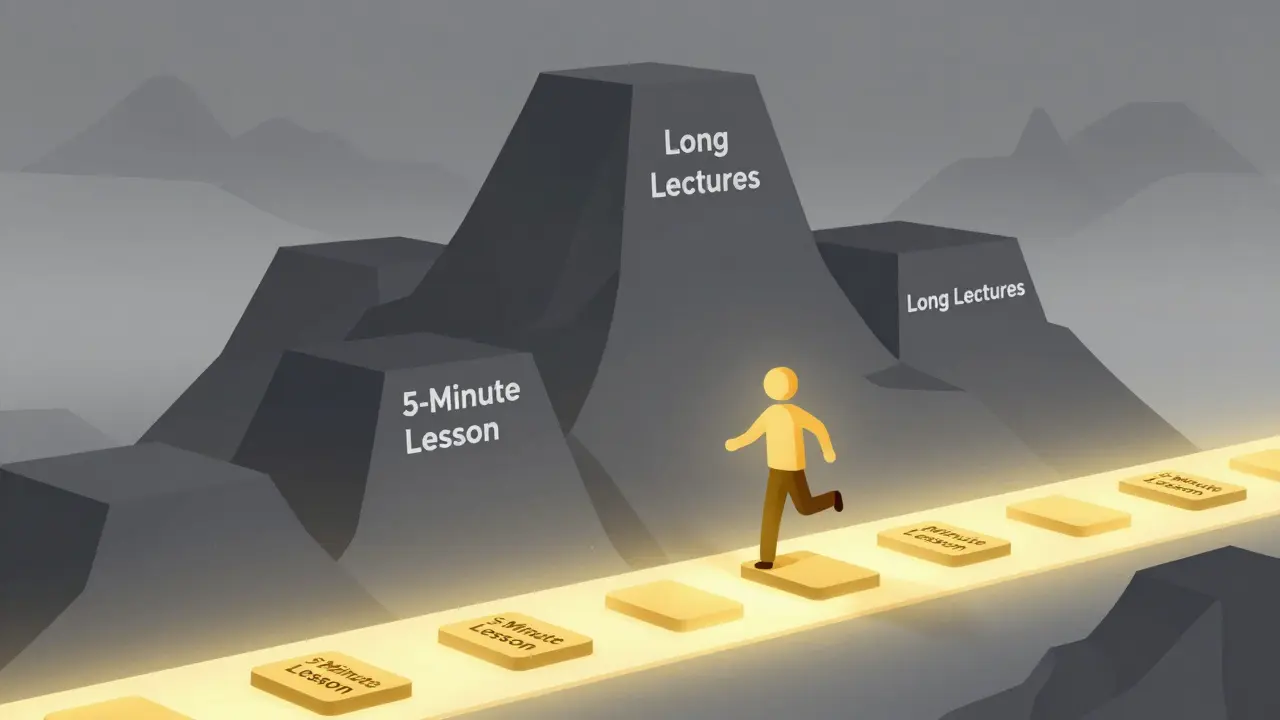
The biggest mistake course creators make is assuming more content equals more value. It doesn’t. It equals fatigue. When a student sees a module titled "Advanced Marketing Strategies" with twelve 45-minute lectures, they don’t see an opportunity. They see a mountain. They procrastinate. And procrastination leads to abandonment.
Cognitive load theory tells us that working memory has limited capacity. If you overwhelm it, learning stops. To fix this, you need to break your content into micro-lessons. Aim for 5 to 7 minutes per video. Keep text-heavy slides to a minimum. One idea per lesson. One action per assignment.
Think about your own behavior. Would you rather watch a 60-minute lecture or three 10-minute clips? Most people choose the latter because it feels manageable. By chunking your content, you create small wins. Finishing a short lesson gives the brain a hit of dopamine, which encourages them to click 'next.' This momentum is critical in self-paced environments where external accountability is zero.
- Keep videos under 10 minutes.
- Use bullet points instead of paragraphs in transcripts.
- Include a single, clear takeaway at the end of every lesson.
Build in Artificial Urgency
Self-paced means flexible, but flexibility can also mean "never." Without deadlines, Parkinson’s Law takes over: work expands to fill the time available. A student might tell themselves they’ll start next week, then next month, then never.
You need to introduce gentle friction. Not the kind that frustrates users, but the kind that prompts action. Use cohort-based elements even within a self-paced framework. For example, create weekly live Q&A sessions that are optional but highly valuable. Or use gamified badges that expire if not earned within a certain timeframe.
Another powerful tactic is the "start date" ritual. Instead of giving immediate access upon purchase, set a future start date (e.g., "Course begins Monday"). This creates a psychological commitment. People are less likely to bail on something they’ve scheduled. Once the course starts, send automated email reminders that mimic a syllabus schedule. "Module 2 unlocks today" works better than "You still have Module 2 pending."
Design for Interaction, Not Just Consumption
Passive watching is the enemy of retention. If your course is just a series of videos, students will binge-watch two lessons and then lose interest. You need to force them to engage with the material actively.
Active recall is one of the most effective learning techniques. Build quizzes, reflection prompts, and practical exercises directly into the flow. Don’t put all the assessments at the end of a module. Sprinkle them throughout. After a 5-minute video, ask a multiple-choice question. After a reading, ask them to type out one key insight in a comment box.
Consider using interactive video platforms like EdCast or H5P. These tools allow you to embed questions directly into the video player. The student cannot proceed without answering. This breaks the passive consumption loop and keeps their brain engaged. Even simple things like asking them to pause and apply what they learned to their current project can significantly boost retention.
| Element | Passive Approach | Active Approach | Impact on Retention |
|---|---|---|---|
| Video Content | Long lectures (30+ mins) | Micro-lessons (5-7 mins) with embedded quizzes | High |
| Assessment | Final exam only | Continuous low-stakes checks | Medium-High |
| Feedback | Automated grade only | Personalized comments or peer review | Very High |
| Social Proof | None | Community forums or group challenges | High |
Create a Sense of Community
Isolation kills completion rates. When a student struggles alone, they quit. When they struggle alongside peers, they persist. Even in a self-paced course, you must foster connection.
You don’t need to be a full-time community manager. Start small. Create a private Discord server or a Slack channel specifically for your course students. Encourage them to share their progress, ask questions, and celebrate wins. Pin a "Weekly Wins" thread where students post what they accomplished that week.
If you’re worried about scaling, use asynchronous discussion boards integrated into your Learning Management System (LMS). Tools like Kajabi or Teachable have built-in community features. The key is to model the behavior. As the creator, you should post regularly, answer questions promptly, and highlight student contributions. When students feel seen, they stay.
Optimize the User Experience
Frustration is a silent dropout driver. If your course platform is clunky, slow, or confusing, students will blame the content, not the interface. Ensure your Learning Management System (LMS) is intuitive. Navigation should be obvious. Progress bars should be visible and motivating.
Mobile optimization is non-negotiable. Many learners study on their phones during commutes or breaks. If your videos don’t play smoothly on mobile, or if your quizzes require complex mouse interactions, you’re losing a huge segment of your audience. Test your course on various devices before launching.
Also, consider the aesthetic. Clean, uncluttered design reduces cognitive load. Use consistent branding, readable fonts, and high-quality audio. Poor audio is the number one reason students abandon video courses. Invest in a decent microphone. It’s cheaper than losing half your customers.

Provide Clear Outcomes and Relevance
Students need to know *why* they are doing each task. Abstract learning is hard to sustain. Connect every lesson to a tangible outcome. Instead of saying "Learn about SEO," say "By the end of this lesson, you will have optimized your homepage meta tags."
Use case studies and real-world examples. Show how previous students applied the concepts. This builds relevance and proves the value of continuing. When a student sees that Lesson 3 directly solves a problem they have right now, they are motivated to finish Lesson 4 to get the next solution.
Regularly remind them of the end goal. In your email sequences and course introductions, reiterate the transformation they signed up for. "Imagine being able to [desired outcome] by the end of this month." This keeps the vision alive and combats the mid-course slump.
Iterate Based on Data
You won’t get it perfect on the first try. That’s okay. Use your analytics to identify where students drop off. Most LMS platforms provide heatmaps or drop-off reports. If 80% of students quit after Lesson 5, look at that lesson critically. Is it too long? Is the content unclear? Is the quiz too difficult?
A/B test different approaches. Try changing the thumbnail, shortening the video, or adding a bonus resource. Small tweaks can lead to significant improvements in completion rates. Treat your course as a living product, not a static archive.
What is the average completion rate for self-paced online courses?
The average completion rate for massive open online courses (MOOCs) is notoriously low, often cited around 5-15%. However, paid, niche self-paced courses can achieve higher rates, typically between 20-40%, depending on the level of support and community integration provided.
How do I keep students motivated without live classes?
Motivation in self-paced courses relies on structure and community. Use artificial deadlines, gamification (badges, points), and regular email nudges. Building a sense of belonging through discussion forums or social media groups also helps students feel accountable to their peers.
Is it better to release all content at once or drip-feed it?
Drip-feeding content (releasing modules over time) generally leads to higher completion rates because it prevents overwhelm and creates a structured learning path. However, some professional audiences prefer lifetime access to all content immediately. Consider offering both options or allowing students to choose their preferred pace.
What are the best tools for creating interactive self-paced courses?
Popular platforms include Teachable, Kajabi, Thinkific, and LearnWorlds for hosting. For interactivity, tools like H5P, EdCast, or Articulate Storyline allow you to embed quizzes, simulations, and branching scenarios directly into your lessons.
How important is mobile optimization for online courses?
Extremely important. A significant portion of learners access content on smartphones or tablets. If your course isn't mobile-friendly, you risk alienating nearly half of your potential audience. Ensure videos stream well on mobile data and that navigation is touch-friendly.
Comments
michael T
Look, I don't care about your fancy psychology talk or whatever dopamine hit you're trying to sell me. You're just another guru trying to squeeze every last drop of attention out of us before we bounce. It's disgusting how you treat human beings like lab rats in a maze.
I've been burned by these 'micro-lessons' before. They're just a way to make you feel productive while you learn absolutely nothing of substance. Real knowledge takes grit, not five-minute clips that fit into my lunch break so I can go back to scrolling TikTok. You're creating a generation of shallow thinkers who can't handle depth.
And don't get me started on the community aspect. Forced connection is the worst kind of isolation. I want to learn alone, thank you very much. Stop trying to herd cats.
Seraphina Nero
Hey Michael, I hear you. It can feel overwhelming when things are pushed too hard. But maybe there's a middle ground? Some people really do struggle with long lectures and need those small wins to keep going. It's not about forcing anyone, just offering a different path for those who might benefit from it. No judgment here, just sharing a perspective. 😊
Megan Ellaby
hi guys! i totally get what michael is saying about the pressure, but honestly? i love the short videos. my brain gets fried if i have to sit through an hour of someone talking without a break. also, spelling matters less than the vibe right? lol. does anyone else find the gamification part kinda cringe or is it just me? i mean badges are fun but dont make it too childish pls.
Rahul U.
That is a very interesting point regarding cognitive load 🧠. In my experience working with corporate training modules, breaking content down significantly improves retention rates. However, one must ensure that the fragmentation does not lead to a loss of context. The 'start date' ritual mentioned in the post is particularly effective for creating psychological commitment. Have you tried using H5P for interactive elements? It works wonders for engagement 👍.
E Jones
You think this is about pedagogy? Please. This is all part of the great simulation they are running on our minds. They want us fragmented, distracted, and unable to focus on anything longer than seven minutes because then we cannot see the patterns. The 'dopamine hit' is literally engineered to keep us docile and consuming their content rather than questioning the reality around us. Who benefits from your completion rates? The advertisers. The data brokers. They are mapping your neural pathways through these micro-interactions. Wake up. The course is not the product; you are. And they are selling your attention span to the highest bidder while you think you are learning SEO. It is a prison of convenience. Do not let them chain you to their platform with their artificial urgency. Break free from the algorithmic leash before it is too late. They are watching your drop-off rates to refine their control mechanisms. Every click is a surrender. Every pause is a betrayal of your own potential for true, unstructured freedom. Resist the urge to engage. Starve the beast.
Barbara & Greg
The moral decay of modern education is evident in this reliance on superficial engagement tactics. True learning requires discipline, sacrifice, and a willingness to endure discomfort for the sake of intellectual growth. To suggest that we must cater to the diminishing attention spans of the masses is to lower the bar for humanity itself. We must uphold the sanctity of deep work and reject these gamified distractions that trivialize the pursuit of knowledge. One should ask not what the course can do for the student's entertainment, but what the student owes to the rigorous tradition of scholarship.
selma souza
Your article is riddled with grammatical inconsistencies and poor structural choices. For instance, the use of colloquialisms such as 'ghosted' undermines the professional tone required for educational discourse. Furthermore, the assertion that 'more content equals fatigue' is a gross oversimplification that ignores the nuances of subject matter complexity. One must adhere to strict editorial standards if one wishes to be taken seriously. The lack of proper citation for 'cognitive load theory' is also quite glaring. Please proofread your work before publishing such subpar material.
Frank Piccolo
Typical American laziness. You can't even finish a book without needing a badge and a pat on the head. In other countries, we respect the teacher and the material enough to just sit there and listen. This whole 'self-paced' nonsense is just an excuse for incompetence. If you can't handle a 45-minute lecture, you're useless. Fix your culture first, then worry about your drop-off rates. Pathetic.
James Boggs
Thank you for sharing this insightful analysis. The emphasis on mobile optimization is particularly relevant given current trends. I agree that clear outcomes are essential for learner motivation. Would you recommend any specific tools for A/B testing video thumbnails?
Addison Smart
I appreciate the diverse perspectives here, though some comments seem unnecessarily harsh. Let us remember that everyone learns differently, and what works for one person may not work for another. The goal should be inclusivity and accessibility, ensuring that no one is left behind due to rigid structures. By fostering a respectful dialogue, we can collectively improve our educational experiences. It is important to recognize the value of both structured and self-directed learning paths, as they serve different needs within our global community. Let us strive for understanding rather than division.