


Most online learning platforms focus on getting new students. But the real money? It’s in keeping them. A student who sticks around for three courses is worth five times more than one who signs up, drops out, and never comes back. That’s the power of Lifetime Value - or LTV - in online education. If you’re running a course platform, tutoring service, or subscription-based learning brand, growing LTV isn’t optional. It’s the difference between barely surviving and building something lasting.
What Lifetime Value Really Means for Online Learning
Lifetime Value (LTV) isn’t just a fancy metric. It’s the total amount a student spends with you from the moment they sign up until they leave - for good. For online learning, that includes course purchases, subscription fees, add-ons like coaching or certificates, and even referral bonuses. The average LTV for a paid online course platform in 2026 is around $210, according to data from EdTech Analytics Group. But top performers? They hit $600+. The gap? It comes down to retention, not acquisition.
Think about it: acquiring a new student costs 5 to 7 times more than keeping an existing one. And yet, most platforms pour 80% of their budget into ads and sign-up incentives. Meanwhile, students who complete their first course and come back for a second are 73% more likely to upgrade to premium tiers. That’s not luck. It’s design.
Why Students Leave - And How to Stop It
Let’s be honest: online learning is full of abandoned accounts. People start a course, get busy, lose motivation, or feel like they’re not making progress. A 2025 study from the Global Online Learning Survey found that 68% of students who enrolled in a paid course never finished it. The biggest reasons? No clear next step, no personal connection, and feeling like they’re just another number.
Here’s what actually works to keep them:
- Progress tracking with real feedback - Not just "You’re 40% done." Show them how far they’ve come compared to others. "You’ve completed more modules than 82% of learners in your cohort."
- Personalized nudges - If a student hasn’t logged in for 10 days, send a message like: "Hey, we noticed you paused Module 3. Want to jump back in? Here’s a 5-minute recap video just for you."
- Community access - Students who join a study group or forum are 3x more likely to complete their next course. Don’t just build a platform. Build a tribe.
Platforms that use these tactics see retention rates jump from 22% to 58% in under six months. That’s not magic. It’s psychology.
Turn One-Time Buyers into Subscribers
One-time course sales are easy. Recurring revenue? That’s the goldmine. But you can’t just slap a subscription button on your site and call it a day. You need to earn it.
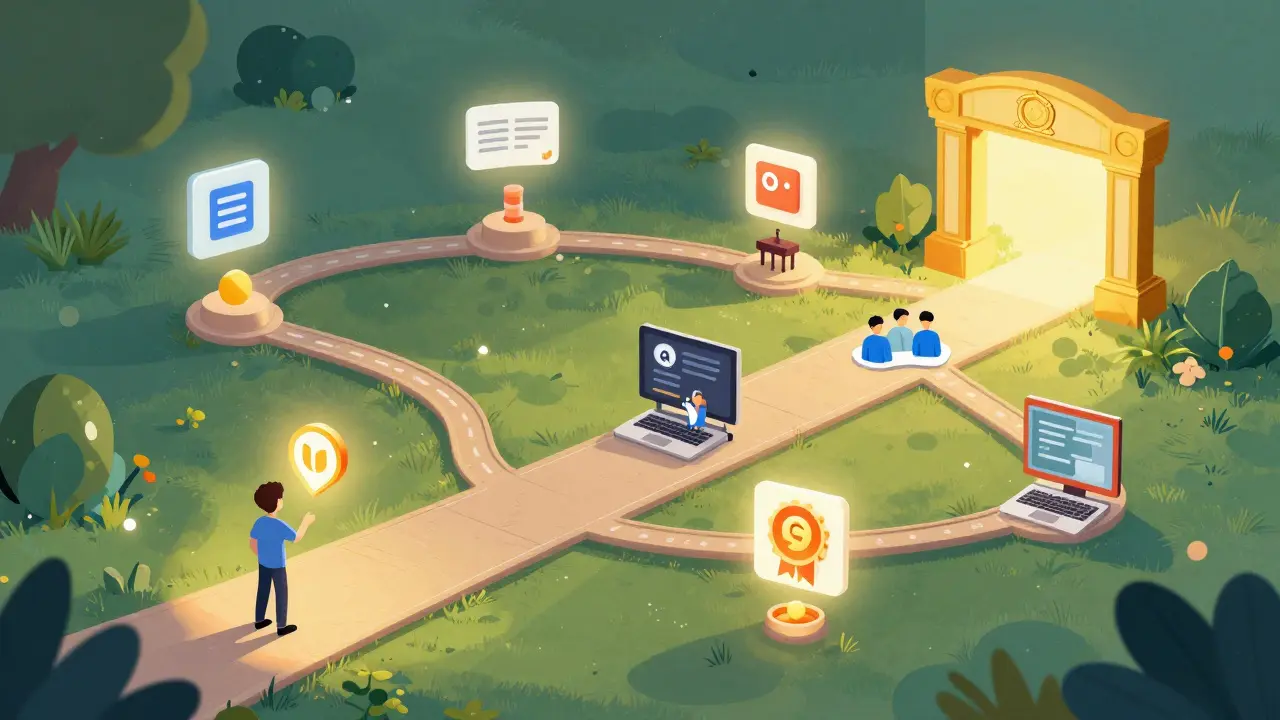
Start by mapping out a natural progression. A student buys a $49 beginner course. After they finish, offer them:
- A $29 "Next Step" micro-course (e.g., "Apply What You Learned")
- Access to a live Q&A session with the instructor
- A 30% discount on the $99 premium certification track
That’s not a hard sell. That’s a journey. And it works. Platforms using this "escalation path" see 41% of one-time buyers convert to monthly subscribers within 90 days. The key? Make each step feel like a natural upgrade - not a pitch.
Also, don’t underestimate the power of bundling. A "Learning Passport" that includes 3 courses, monthly coaching, and a digital badge sells 2.3x better than individual courses. People don’t buy courses. They buy identity. "I’m a certified data analyst." "I’m a published writer." "I’m a confident public speaker."
Use Data to Predict Who’s About to Leave
You don’t need AI to spot a churn risk. You just need to look at the patterns.
Here’s what high-LTV platforms track:
- Time between logins - If it’s more than 14 days, flag them.
- Completion rate of core modules - If they skip the first 3 lessons, they’re unlikely to finish.
- Engagement with support - Students who ask questions are more invested. Those who never reach out? They’re fading.
- Device usage - If they only use mobile, not desktop, they might be on the go and not deeply engaged.
One platform in New Zealand used this data to build a simple "churn score". When a student’s score hit 7/10, an automated email went out: "Hey, we miss you. Here’s what you missed - and a free 1-on-1 call to catch up." Response rate? 37%. Of those who replied, 68% re-enrolled in a new course.
Make Them Feel Seen - Not Sold To
Students don’t want more content. They want to feel understood.
That means:
- Using their name - not "Dear Learner"
- Referencing their past work - "Your essay on climate policy was one of the most thoughtful this month. Here’s what we’re covering next."
- Sharing their progress with peers - "Maria from Auckland just completed her certification. You’re next."
One language learning app started sending weekly "You Did This" emails. Not "You completed Module 5." But: "You just spoke Spanish for 12 minutes straight - the longest streak anyone in your group has had this month."
Engagement jumped 44%. And LTV? Up 82% in 6 months.

Don’t Just Sell Courses - Sell Outcomes
People don’t buy a course because they want to "learn Python." They buy it because they want to get a promotion, switch careers, or build something they’re proud of.
So stop talking about features. Start talking about transformation.
Instead of: "Our AI course covers neural networks, data preprocessing, and model evaluation."
Say: "You’ll go from feeling stuck in your job to confidently applying for data roles - with a portfolio that proves you can do the work."
That’s the difference between a transaction and a commitment. And it’s why customers who feel a clear outcome are 5x more likely to come back for the next course.
What You Should Do Next
You don’t need a big budget. You need focus.
- Find your top 3 courses with the highest completion rates. These are your "anchor" offerings.
- Map out the next logical step for students who finish them. Is it a certification? A cohort? A mentor session?
- Build one personalized retention trigger: a follow-up email, a challenge, a community invite.
- Track the LTV of students who go through that trigger vs. those who don’t.
- Repeat. Every 30 days, test one new way to deepen engagement.
LTV isn’t a number you chase. It’s a habit you build - one thoughtful interaction at a time.
Comments
Samuel Bennett
This whole post is just corporate fluff wrapped in buzzwords. LTV? Please. Most platforms don't even track if students are alive or dead. I've seen platforms that delete accounts after 30 days of inactivity and call it 'cleaning the database.' Meanwhile, they're still charging people who forgot they signed up. It's not retention - it's predatory billing disguised as community.
Rob D
You call that psychology? That's just basic human behavior. People stick around when they feel like they belong - not when you send them a 'Hey we miss you' email. You think this is new? My uncle ran a dojo in '98 and he kept students by making them call him 'Sensei' and forcing them to clean the mats. Same damn thing. You're just putting it in SaaS terms now. Also, 82% of learners? Where's your data? I bet it's from some shady EdTech firm owned by a VC who also owns the ad network pushing this garbage.
Franklin Hooper
The assertion that LTV is 'the difference between barely surviving and building something lasting' is statistically unsupported. Without a confidence interval or sample size, this claim collapses under its own weight. Furthermore, the use of 'tribe' as a metaphor is both sociologically inaccurate and commercially exploitative. One might argue that the entire framework is a neoliberal rebranding of social belonging into monetizable engagement loops.
Jess Ciro
They’re not keeping students. They’re trapping them. Ever notice how every 'personalized nudge' leads to another $20 upsell? It’s not psychology - it’s behavioral manipulation. And the 'Learning Passport'? That’s just a subscription trap with a fancy name. I know a guy who got locked into three years of monthly payments because he completed one course. He’s still paying. He doesn’t even remember what he was learning. They’re not building communities. They’re building debt.
saravana kumar
This entire article reads like a LinkedIn post written by someone who attended a webinar on 'Digital Transformation in EdTech' last Tuesday. The data points are cherry-picked. The solutions are generic. And the idea that 'I’m a certified data analyst' is an identity? Please. In India, we have 2 million people who bought certificates from Udemy and still can't write a for-loop. This isn't about outcomes. It's about selling hope to the desperate.
Mark Brantner
Okay but what if you’re just trying to learn Python for fun? Not to get a job? Not to be 'certified'? What if you’re 62 and just want to understand how your kid’s app works? Do you still need a 3-course passport and a 1-on-1 call? I’m not saying this is bad - I’m saying it’s wildly over-engineered for normal humans. Also typo: 'reciept' not 'receipt' lol
Kate Tran
I actually tried one of these platforms last year. The 'progress tracking' was so aggressive it felt like a fitness app for your brain. I paused for a week because I was sick, and I got a notification that said 'Your streak is broken.' I uninstalled. That’s not community. That’s guilt-tripping with a UI.
amber hopman
I’ve seen this work - but only when done with real empathy. One platform I worked with started letting students name their own learning goals. Not 'Become a Data Analyst' - but 'I want to explain my work to my parents.' That shifted everything. The metrics improved because people weren’t trying to impress the algorithm. They were trying to connect. And that’s the secret: stop selling transformation. Start listening to what people actually need.
Jim Sonntag
I’m from the Midwest. We don’t have 'learning passports.' We have people who show up, do the work, and move on. The idea that you need to 'build a tribe' to keep someone from leaving a course? That’s not innovation. That’s anxiety marketing. I’ve taken 12 online courses. I’ve never once felt like I needed to belong to a group. I just wanted to learn. And yeah - sometimes I quit. Because life happens. Not because I wasn’t 'nudged' enough.
Deepak Sungra
You know what’s funny? The exact same tactics are used by dating apps. 'You’ve matched with 3 people this week!' 'Your profile is 87% complete!' 'We miss you!' It’s the same script. And it works - because humans are wired to respond to attention, even if it’s fake. But here’s the truth: no amount of personalization fixes a bad course. If the content is garbage, the 'tribe' is just a mob yelling into a void. Stop treating symptoms. Fix the disease.
Samar Omar
I find it deeply troubling how casually this piece dismisses the cultural and economic disparities inherent in online learning. The notion that a 'Learning Passport' is a universal solution ignores the fact that in many parts of the world, access to stable internet, time, or even a quiet space to learn is a luxury. To suggest that personalization and nudges are the panacea for retention is not just naive - it is colonial in its assumption that every learner operates within the same privileged framework of autonomy, time, and digital literacy. The real LTV metric should be: How many students are you excluding before they even begin?