


Why employers care about certifications - and how to make them care about yours
If your certification program isn’t getting noticed by employers, it doesn’t matter how good the curriculum is. Employers don’t buy certificates - they buy outcomes. They want to know: Will this person be more productive, safer, or more reliable on day one? Your job isn’t to sell the course. It’s to prove the result.
Take the example of a plumbing certification in Auckland. A local trade school started tracking where their certified graduates landed jobs. They found that 92% of employers who hired their graduates reported fewer callbacks for faulty work in the first six months. That’s not a credential. That’s a cost-saving metric. And that’s what gets attention.
Start with the employers you already know
Don’t blast emails to HR departments you’ve never contacted. Go straight to the companies that already hire people like your graduates. Look at your alumni database. Who hired them? Which ones gave you positive feedback? Reach out to those managers directly.
Call them. Say: “We noticed your team hired three of our graduates last year. Can we send you a quick one-pager showing how their performance compared to non-certified hires?” That’s not marketing. That’s offering useful data.
One health tech certification program in Wellington did this. They reached out to five clinics that had hired their students. Within three months, three of those clinics started referring new applicants directly to the program. Why? Because the clinic managers saw fewer training hours needed and lower error rates.
Turn your graduates into proof points
Employers trust people more than brochures. Find three or four recent graduates who landed good jobs because of your certification. Ask them for a short video or written quote explaining how the certification helped them get hired or promoted.
Don’t ask for generic praise like “This program changed my life.” Ask: “What did your employer say when they saw your certification on your resume?” or “What task did you handle better after getting certified?”
One IT certification provider in Christchurch started sharing these stories in LinkedIn posts tagged with local company names. Within six months, three of those companies reached out asking to partner. One even offered to co-design a module on their internal tools.

Map your certification to real job descriptions
Most employers don’t care about “certified in Python.” They care about “can automate reporting tasks in Excel using Python.” Your certification needs to speak their language.
Take ten job postings from companies you want to target. Highlight the skills they ask for. Then map each one to a module or assessment in your program. Create a simple table: “Job Skill” → “How Our Program Teaches It” → “Assessment Method.”
For example:
- Job Skill: “Manage patient data in compliance with HIPAA” → Your Program: “Module 4: Data Privacy Protocols with simulated audits” → Assessment: “Pass a live mock audit with a compliance officer”
- Job Skill: “Troubleshoot network latency in remote offices” → Your Program: “Lab 7: Simulated WAN environments with real packet captures” → Assessment: “Reduce latency by 40% in a timed scenario”
Print this table. Email it to hiring managers. Put it on your website. Make it impossible for them to ignore the connection.
Offer free skills validation - not free courses
Employers are tired of free trials that don’t lead to results. Instead of offering free access to your course, offer free skills validation.
Set up a one-hour, no-cost assessment for their employees. It’s not a test. It’s a diagnostic. You give them a report: “Here’s what your team knows. Here’s what they’re missing. Here’s how our certification fills those gaps.”
A construction safety certification program in Tauranga did this. They offered free safety competency checks for site supervisors. Out of 40 companies that took the offer, 27 signed up for bulk certification. Why? Because the report showed that 68% of supervisors had gaps in hazard identification - something the company’s insurance provider was already worried about.
Partner with industry associations
Don’t try to reach every employer alone. Find the trade groups, chambers of commerce, or professional bodies that already have their trust.
Offer to co-host a webinar: “How Certification Reduces Workplace Risk in [Industry].” Sponsor their newsletter. Submit a guest article titled “Why 7 Out of 10 Hiring Managers Prefer Certified Candidates in [Field].”
One electrical certification body in Dunedin partnered with the New Zealand Electrical Contractors Association. They got listed in the association’s “Recommended Training Providers” directory. Within a year, their enrollment from member companies jumped by 210%.
Track and share what matters
Employers don’t care about completion rates. They care about retention, promotion, and error reduction.
Start collecting these three metrics for every cohort:
- Job placement rate within 90 days
- Average salary increase after certification
- Reduction in workplace incidents or customer complaints (if applicable)
Then publish them. Not in a fancy PDF. On a simple webpage. With real names (with permission) and real numbers.
A logistics certification program in Hamilton started doing this. They showed that certified warehouse supervisors reduced inventory shrinkage by 18% in their first year. A local logistics firm saw that and asked to bring the certification to their entire network. No sales pitch needed.
Stop selling. Start serving.
The biggest mistake certification programs make is acting like they’re selling a product. They’re not. They’re solving a problem: employers need workers who can hit the ground running.
Every email, every flyer, every website page should answer one question: “How will this make my team better, faster, or cheaper?”
If you can’t answer that in five seconds, rewrite it.
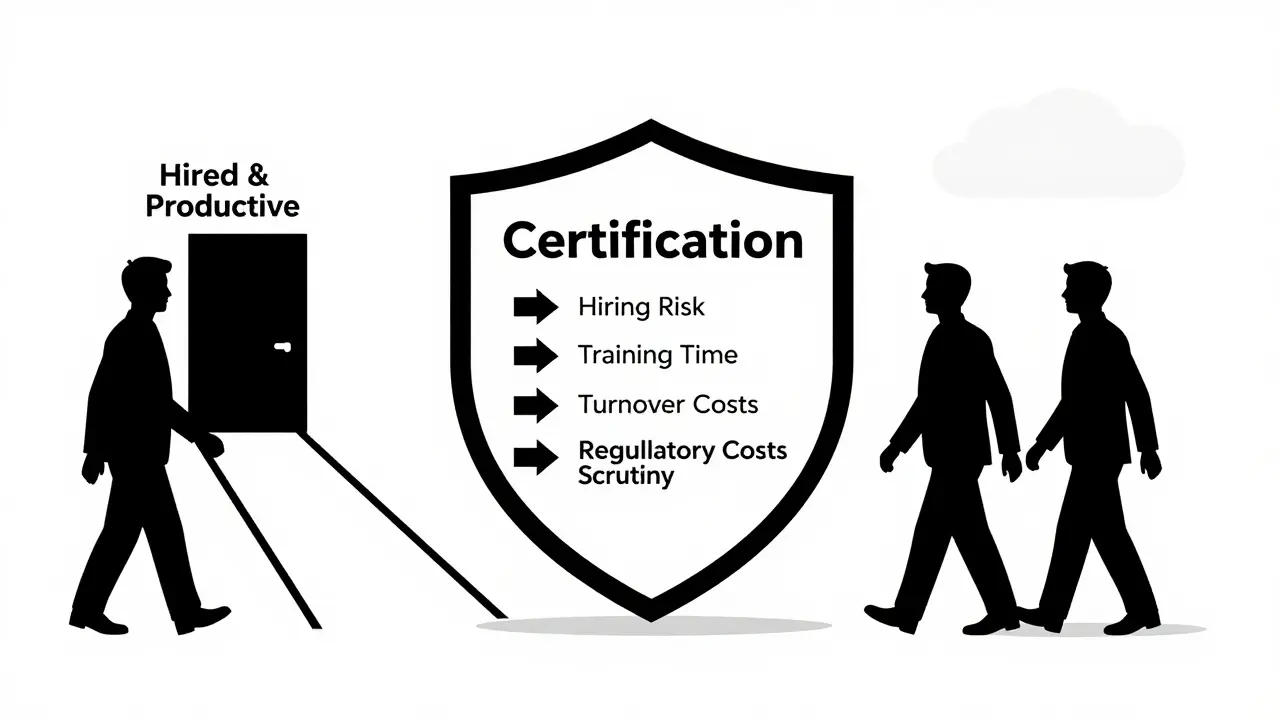
What employers really want
They want to reduce hiring risk.
They want to cut training time.
They want to lower turnover.
They want to meet compliance standards without hiring consultants.
They want to look good to their own clients or regulators.
Your certification isn’t a badge. It’s a risk-reduction tool. Frame it that way - and the right employers will find you.
How do I prove my certification program is worth it to employers?
Track real outcomes: job placement rates, salary increases, and reductions in errors or incidents. Share these numbers with employers using real examples from your graduates. Don’t just say “our program is great” - show how it saved a company money or time.
Should I offer free access to my certification program?
No. Free access doesn’t build trust. Free skills assessments do. Offer employers a no-cost evaluation of their team’s current skills. Then show them exactly where your certification fills the gaps. This turns them from prospects into partners.
What’s the best way to get employers to notice my program?
Start with the employers who already hired your graduates. Ask them for a short testimonial or data point. Then reach out directly with that proof. Employers trust peer validation more than advertising.
Do I need to partner with industry groups to succeed?
You don’t need to, but it helps. Industry associations already have trust with employers. Co-hosting events, getting listed in their directories, or contributing to their publications puts your program in front of decision-makers without cold outreach.
How do I make my certification relevant to job postings?
Take ten job ads from target companies. List the skills they’re asking for. Then match each skill to a module or assessment in your program. Create a simple one-page map showing this connection. Send it to hiring managers - it makes your value obvious.
What if my certification is for a niche field?
Niche fields often have fewer employers, but they’re also more desperate for qualified people. Focus on the top 5-10 companies in your space. Build deep relationships with them. Offer custom training modules based on their tools or processes. They’ll pay for it because they can’t find the talent anywhere else.
Comments
Soham Dhruv
This is actually way smarter than most certification programs i've seen
most just throw a logo on a certificate and call it a day
you're talking about real outcomes like job placement and error reduction
that's the stuff that gets hiring managers to sit up and pay attention
no fluff just facts
love it
Cait Sporleder
The paradigm shift articulated herein is nothing short of revolutionary; whereas traditional certification models have perpetuated a myopic preoccupation with credential issuance as an end in itself, this framework compellingly reorients the discourse toward quantifiable, employer-centric value propositions-specifically, the reduction of hiring risk, the diminution of onboarding expenditures, and the amelioration of operational inefficiencies through demonstrable competency validation. One might even posit that this constitutes a fundamental epistemological realignment in workforce development paradigms.
Paul Timms
Spot on. Employers don't care about certificates. They care about results.
Jeroen Post
You think this is new? This is just corporate propaganda dressed up as innovation
Everything is tracked now
Everything is monetized
They don't want better workers
They want compliant ones
They want you to prove you're not a liability before you even breathe on the job
And they'll use your own data against you later
Watch
Nathaniel Petrovick
I love this approach so much
My company tried to get certified last year and we got pitched a 50 page brochure
Then we found a local program that just sent us a one pager with before and after numbers from their grads
We signed up the same week
No sales call needed
Honey Jonson
this is sooo good i cried a little
why do so many programs just spam linkedin with ‘get certified!’ posts
no one cares
but if you show me a grad who cut down errors by 30%? now we’re talking
also pls do more of this i’m so tired of fluff
Sally McElroy
Let’s be honest: if you’re not tracking job placement rates, salary increases, and incident reduction, you’re not running a program-you’re running a scam. There’s no excuse for not measuring outcomes. The fact that so many institutions still rely on vague testimonials and glossy brochures speaks to a systemic failure of accountability in workforce education. This isn’t just smart marketing-it’s ethical responsibility.
Destiny Brumbaugh
America needs this
we got too many people wasting time on useless certs
if you can't prove it saves companies money you're just selling dreams
we need real skills not paper trophies
Sara Escanciano
This is exactly why I hate the education industrial complex. You're just giving employers more tools to exploit workers. They don't want 'better' employees-they want cheaper, more controllable ones. You're helping them tighten the screws under the guise of 'value.' This isn't empowerment. It's surveillance dressed up as progress.
Jason Townsend
They’re tracking everything now
Every click every hire every error
They’re building profiles on every grad
Soon they’ll know your personality type from how you did the mock audit
And if you’re not perfect they’ll bury your name in the system
This isn’t helping-it’s profiling
Antwan Holder
I’ve seen this happen in real life. I watched a man cry after his company signed up for a certification program because for the first time in ten years, someone actually listened to him. He said, ‘They finally asked what I needed-not what they wanted to sell me.’ That’s not marketing. That’s healing. That’s the difference between selling a certificate and restoring dignity to a profession that’s been treated like a commodity for too long. This isn’t just about hiring. It’s about humanity.