


You spent $50,000 on a new leadership development program. Six months later, your VP of Sales asks, "Did it work?" If you can’t answer with hard numbers, that money might as well have been donated to charity. This is the nightmare scenario for every Learning and Development (L&D) professional.
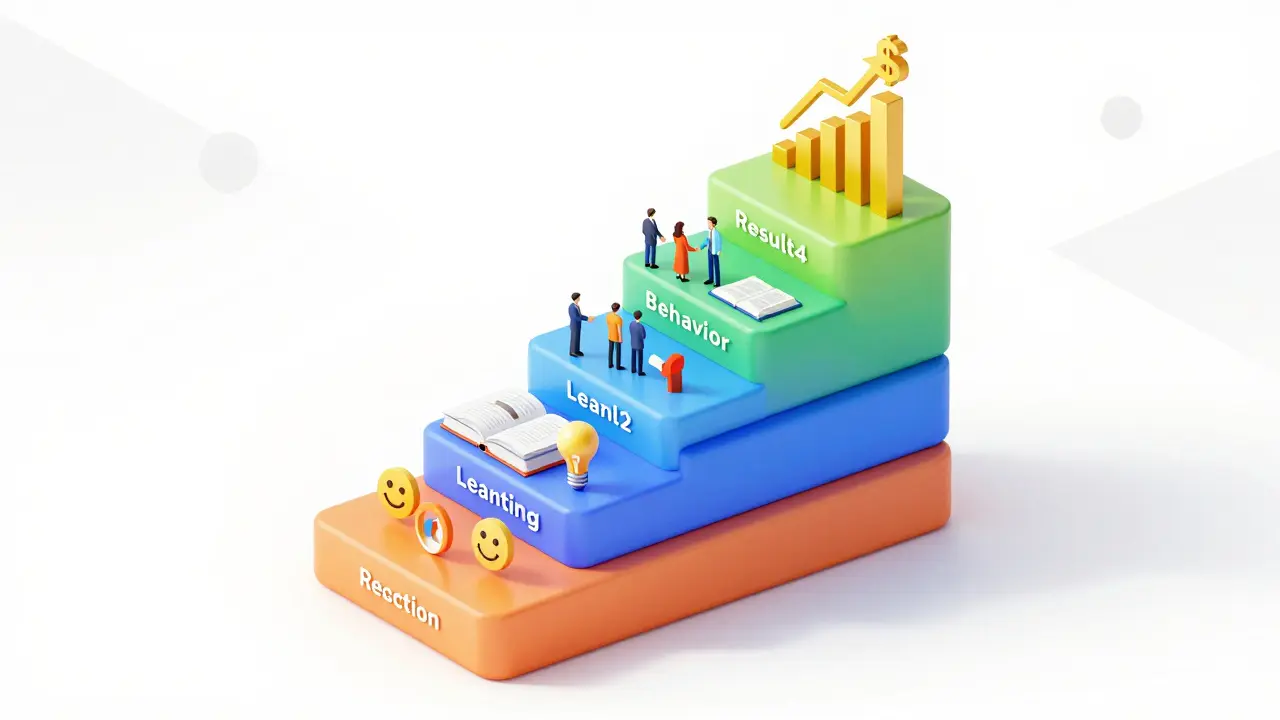
Most companies struggle here because they stop measuring at the wrong level. They count attendance sheets or survey happiness levels and call it a day. That’s not measurement; that’s guesswork. To prove real value, you need a framework that connects classroom activity to business results. That framework is the Kirkpatrick Model, which is a four-level system for evaluating training effectiveness, developed by Donald Kirkpatrick in 1959.
This isn't just academic theory. It’s the industry standard used by Fortune 500 companies to justify their L&D budgets. In this guide, we will walk through how to apply each of the four levels-Reaction, Learning, Behavior, and Results-to calculate actual Return on Investment (ROI). We’ll skip the fluff and focus on the data points that matter to executives.
Why Traditional Metrics Fail
Before diving into the model, let’s look at why most training evaluations fail. The biggest culprit is the "smile sheet." You know the one: a survey sent immediately after a session asking, "Did you enjoy the trainer?" and "Was the room too hot?"
These are Level 1 metrics. While useful for logistical feedback, they tell you nothing about whether employees actually learned anything or if they applied it on the job. A trainer can be charming, funny, and engaging, yet deliver content that is completely irrelevant to daily tasks. Conversely, a dry, technical workshop might be boring but transformative for productivity.
If you only measure satisfaction, you’re optimizing for entertainment, not performance. To get to ROI, you must move beyond the smile sheet and dig into behavioral change and financial impact. This requires more effort, yes, but it transforms L&D from a cost center into a strategic partner.
Level 1: Reaction - Did They Engage?
The first step in the Kirkpatrick Four-Level Training Evaluation Model is Reaction. This measures how participants felt about the training experience. But don’t just ask if they liked it. Ask if they found it relevant.
To gather actionable data here, structure your post-training survey around three key questions:
- Relevance: "Will you use what you learned in your current role?"
- Engagement: "Was the content clear and easy to understand?"
- Environment: "Were there any barriers to learning (e.g., technology issues, distractions)?"
If relevance scores are low, stop there. No amount of perfect behavior change will happen if the content doesn’t match the job. For example, if you train customer service reps on advanced Excel functions, but their job involves phone calls, the reaction score will reveal a mismatch before you waste time on Levels 2 and 3.
Level 2: Learning - Did They Acquire Knowledge?
Now we move to Learning. This level assesses whether participants gained the intended knowledge, skills, or attitudes. This is where you test for competency, not opinion.
Avoid multiple-choice quizzes if possible. Instead, use practical assessments that mirror real-world scenarios. Here are effective methods for measuring learning:
- Pre- and Post-Tests: Compare scores before and after training to measure knowledge gain.
- Role-Playing Simulations: Observe participants handling a difficult customer complaint or negotiating a sale.
- Skill Demonstrations: Have technicians demonstrate a repair procedure safely and correctly.
For instance, if you’re training sales staff on a new CRM software, don’t just ask them to identify buttons. Have them input a complex deal stage and generate a forecast report. If they can’t do it, they haven’t learned it. Record these scores. You’ll need them later to correlate with performance data.
Level 3: Behavior - Did They Apply It?
This is the hardest level to measure, and where most organizations drop off. Behavior change happens weeks or months after training. It requires observation and context.
To measure behavior, you need data from the workplace, not the classroom. Use these strategies:
- Manager Observation: Train managers to use a checklist during routine check-ins. Are employees using the new communication protocol? Are they following the updated safety guidelines?
- Peer Feedback: Collect 360-degree reviews focusing on specific behaviors taught in the training.
- System Data: Pull logs from software systems. Did users start using the new features introduced in the training?
Let’s say you trained staff on active listening. Three months later, you analyze customer interaction logs. Do you see fewer escalations? Are customers rating interactions higher on empathy? If the behavior hasn’t changed, the training failed-or worse, the environment prevented application. Maybe managers aren’t reinforcing the new skills. Identifying this gap is crucial before moving to ROI.
Level 4: Results - Did It Impact Business Goals?
Results are the bottom line. This level measures the impact of training on organizational goals such as increased sales, reduced errors, higher retention, or improved quality. This is where you connect L&D to the P&L statement.
To isolate the effect of training, you must control for other variables. Did sales go up because of training, or because of a seasonal trend? Use comparison groups if possible. Compare the performance of trained employees against a control group that didn’t receive the training.
Key metrics to track include:
- Productivity: Units produced per hour, tickets resolved per day.
- Quality: Error rates, defect percentages, customer satisfaction scores (CSAT).
- Retention: Turnover rates in departments that received engagement training.
- Revenue: Average deal size, conversion rates for sales teams.
For example, a manufacturing plant implemented safety training. Within six months, workplace accidents dropped by 20%. This is a tangible result. Now, you need to assign a monetary value to that reduction to calculate ROI.

Calculating Training ROI: The Formula
Once you have your Level 4 results, you can calculate ROI. The formula is straightforward:
| Component | Description | Example Value |
|---|---|---|
| Benefit | Monetary value of improved performance | $100,000 (saved from reduced errors) |
| Cost | Total investment in training (design, delivery, materials, lost time) | $20,000 |
| Net Benefit | Benefit - Cost | $80,000 |
| ROI % | (Net Benefit / Cost) x 100 | 400% |
In this example, for every dollar spent on training, the company earned $4 back. That’s a compelling story for stakeholders. However, be conservative in your estimates. Only attribute benefits directly linked to the training. If sales rose by 10%, but market conditions also improved by 5%, only claim the remaining 5% as attributable to training.
Common Pitfalls to Avoid
Measuring ROI is tricky. Here are common mistakes that skew results:
- Ignoring Isolation of Effects: Assuming all improvement came from training without ruling out external factors like new tools or market shifts.
- High Costs: Including unnecessary expenses like lavish venues or excessive travel. Keep costs lean to improve ROI percentage.
- Lack of Follow-Up: Not checking behavior change long enough. Some skills take months to integrate. Wait 3-6 months before finalizing Level 3 and 4 data.
- Poor Data Collection: Relying on self-reported data alone. Always triangulate with objective metrics like system logs or manager observations.
Another pitfall is trying to measure everything. Not every training program needs an ROI analysis. Compliance training, for instance, is mandatory regardless of ROI. Focus your ROI efforts on high-stakes programs where business impact is critical, such as sales, leadership, or technical upskilling.
Implementing the Model in Your Organization
Start small. Pick one pilot program to test the full four-level evaluation. Gather baseline data before training begins. This is non-negotiable. Without pre-training metrics, you can’t measure change.
Involve stakeholders early. Work with department heads to define what success looks like. If HR says, "We want better teamwork," that’s vague. Push for specifics: "Reduce project delays caused by miscommunication by 15%." Clear objectives make measurement possible.
Use technology to streamline data collection. Learning Management Systems (LMS) can automate Level 1 and 2 tracking. Integrate with HRIS or CRM systems to pull Level 3 and 4 data automatically. Manual data entry is error-prone and discourages consistent evaluation.
Finally, share the results. Create dashboards that show the progression from Reaction to Results. Visualize the journey. When leaders see the direct line between training dollars and business outcomes, support for L&D initiatives grows significantly.
Is the Kirkpatrick Model still relevant in 2026?
Yes, absolutely. While newer models like Phillips’ ROI Methodology exist, the Kirkpatrick Model remains the foundational framework for most L&D evaluations. Its strength lies in its simplicity and logical progression. Many modern digital learning platforms build their analytics reports directly around these four levels.
How long does it take to complete a full Kirkpatrick evaluation?
It varies by program complexity. Levels 1 and 2 can be completed within days of training. Level 3 typically requires 3-6 months of observation. Level 4 may take 6-12 months to capture significant business impact. Plan your timeline accordingly and set realistic expectations with stakeholders.
What if I can’t isolate the effect of training?
If you can’t perfectly isolate effects, use comparative analysis. Compare trained groups vs. untrained groups, or compare performance trends before and after training while noting other changes. Be transparent about limitations. Stakeholders appreciate honesty over inflated claims.
Do I need special software to use the Kirkpatrick Model?
No, you can start with spreadsheets and surveys. However, as you scale, an LMS with robust reporting capabilities will save time. Look for integrations with business intelligence tools to automate data flow from HR and operational systems.
How do I handle negative ROI results?
Negative ROI indicates a problem, but it’s valuable data. Analyze which level broke down. Was it poor content (Level 2), lack of application (Level 3), or misaligned goals (Level 4)? Use these insights to redesign the program. Sometimes, discontinuing a program is the best ROI decision.