

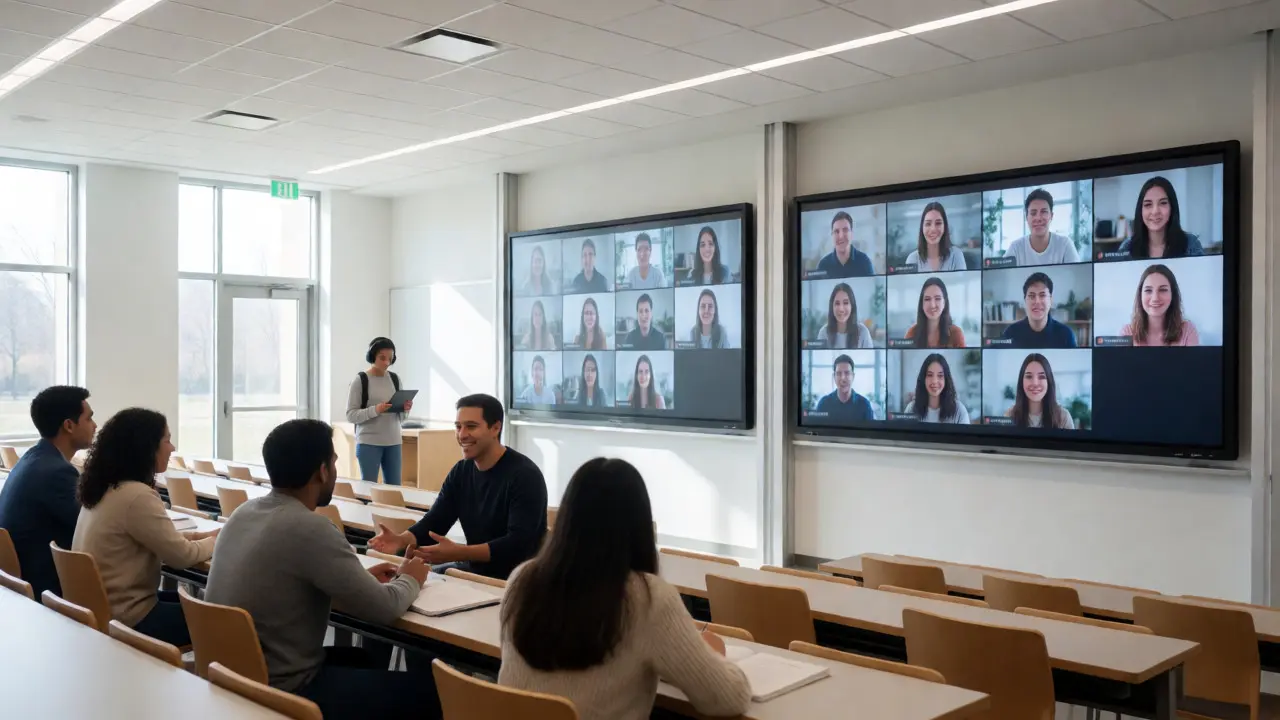
Imagine a classroom where some students sit in rows, others join via Zoom from their living rooms, and a third group watches a recorded lecture at midnight because they work night shifts. This isn't a chaotic mess; it's HyFlex learning, a course design model that allows students to choose how they participate in each class session: in-person, synchronous online, or asynchronous online. It sounds like the ultimate solution for modern learners juggling jobs, families, and health concerns. But does it actually work? Or is it just a fancy way to say "we're trying to do everything at once"?
If you've been involved in higher education since 2020, you know the pain of rapid pivots. We went from traditional lectures to emergency remote teaching overnight. Now, as we settle into a post-pandemic reality, institutions are scrambling for a middle ground. They want the social benefits of face-to-face interaction without excluding those who can't physically be there. That's where HyFlex comes in. It’s not just about technology; it’s about equity and choice. But implementing it requires a complete rethink of pedagogy, not just buying new webcams.
What Exactly Is HyFlex?
The term HyFlex was coined by Brian Beatty at San Francisco State University. Unlike blended learning, where everyone does the same mix of online and offline work, HyFlex gives individual students agency over their attendance mode for every single session. You might come to campus on Tuesday but log in from home on Thursday. There is no penalty for choosing one mode over another, provided you meet the learning outcomes.
This flexibility addresses a critical gap in traditional education. Many students drop out not because they lack intelligence, but because life gets in the way. A sick child, a car breakdown, or a sudden shift change shouldn't mean missing a core concept. By allowing asynchronous participation, HyFlex ensures that learning continues regardless of physical presence. It shifts the focus from "seat time" to actual mastery of content.
The Three Pillars of Participation
To understand why this model is gaining traction, look at its three distinct participation modes. Each serves a different learner need, and a well-designed HyFlex course balances all three seamlessly.
- In-Person: The classic experience. Students engage directly with peers and instructors, benefiting from non-verbal cues and immediate social bonding. This mode is crucial for labs, performances, or discussions requiring physical presence.
- Synchronous Online: Students join live via video conferencing tools. They see and hear the class in real-time. This maintains the rhythm of the course and allows for immediate Q&A, bridging the distance gap while keeping everyone on the same schedule.
- Asynchronous Online: Students watch recordings or read transcripts after the fact. This is the lifeline for those with conflicting schedules or poor internet connectivity. It demands more self-discipline but offers maximum flexibility.
The magic lies in the equivalence. If an asynchronous student watches a recording, they must have access to the same materials and interactions as the live participants. This means active chat logs, shared digital whiteboards, and clear instructions are non-negotiable.
Why Institutions Are Betting Big on Flexibility
Enrollment numbers tell a compelling story. According to recent data from the National Student Clearinghouse Research Center, undergraduate enrollment has declined steadily since 2019. Universities are desperate to retain students who might otherwise leave due to logistical barriers. HyFlex acts as a retention tool by removing friction.
Consider the case of a working professional pursuing a master's degree. In a traditional program, missing two classes could derail their progress. In a HyFlex setup, they can catch up asynchronously without falling behind. This reduces stress and increases completion rates. Furthermore, it broadens the potential student pool. You’re no longer limited to people living within commuting distance of the campus. You can attract learners from rural areas or even other countries who can’t relocate but want access to specific expertise.

The Pedagogical Challenge: Designing for Everyone
Here’s the hard truth: HyFlex fails if you just point a camera at a lecturer. Traditional lecturing relies heavily on reading the room-seeing confused faces, noticing when energy drops. When half your audience is invisible or delayed, that feedback loop breaks. Instructors must redesign activities to be inclusive across all modes.
For example, think-pair-share doesn't work if the online students can't break out easily. Instead, use collaborative documents where everyone contributes simultaneously. Use polling tools that capture responses from both in-room and remote participants instantly. The goal is to create a unified community, not three separate audiences watching the same show.
| Feature | In-Person Focus | Synchronous Online Focus | Asynchronous Online Focus |
|---|---|---|---|
| Interaction Speed | Immediate, multi-sensory | Real-time, text/audio/video | Delayed, reflective |
| Technology Need | Basic AV setup | Stable internet, headset | Device with media player |
| Instructor Role | Facilitator & Observer | Tech Manager & Moderator | Content Curator & Assessor |
| Student Effort | Physical presence required | Schedule adherence required | Self-motivation required |
Technology Stack: More Than Just Zoom
You can't run a robust HyFlex course on consumer-grade gear. The audio quality is often the biggest complaint from remote students. If they can't hear the professor clearly, they tune out. Invest in ceiling microphones or table mics that pick up voices from all directions, not just the speaker's podium. Cameras should track movement automatically so remote viewers aren't staring at a static shot of an empty chair.
Learning Management Systems (LMS) like Canvas or Moodle play a central role here. They serve as the single source of truth. Recordings must be auto-posted within hours, not days. Transcripts are essential for accessibility and searchability. Integration between your video platform and LMS should be seamless to reduce technical friction for students. If logging in feels like jumping through hoops, adoption will suffer.

Pitfalls to Avoid
First, don't assume students will choose wisely. Some may default to asynchronous because it's easier, missing out on valuable peer interaction. Provide guidance and perhaps require a minimum number of live sessions per term to maintain community ties.
Second, beware of instructor burnout. Managing three modes simultaneously is exhausting. Faculty need training and support, not just mandates. Peer mentoring programs, where experienced HyFlex instructors guide newcomers, can significantly ease the transition. Also, consider reducing course load slightly during the initial implementation phase to allow for experimentation.
Third, ensure equitable access. Not every student has high-speed internet or a quiet space at home. Universities must provide loaner laptops, hotspots, or designated study spaces on campus for asynchronous viewing. Otherwise, HyFlex becomes a privilege for the tech-savvy rather than a tool for inclusion.
The Human Element in Digital Spaces
Despite the tech focus, HyFlex is fundamentally about human connection. Loneliness is a major driver of dropout rates in online education. To combat this, build structured social opportunities. Virtual coffee hours, group projects with mixed-mode teams, and mentorship circles help bridge the gap. Instructors should make a conscious effort to learn names and stories, even for remote students. A personalized email or voice note goes a long way in making someone feel seen.
Assessment also needs rethinking. High-stakes exams that rely on proctoring software can be stressful and inequitable. Consider competency-based assessments where students demonstrate skills through portfolios or projects. This aligns better with the flexible nature of HyFlex, allowing students to showcase learning in ways that fit their lives.
Looking Ahead: Hybrid-Plus and Beyond
As AI tools become more integrated into education, HyFlex will evolve further. Imagine AI tutors providing instant feedback to asynchronous learners, freeing up instructors to focus on complex discussions. Virtual Reality (VR) classrooms might soon offer immersive experiences that rival physical presence, blurring the lines between modes even further.
But the core principle remains unchanged: respect for the learner's context. Education shouldn't force students to mold their lives around rigid schedules. It should adapt to them. HyFlex is a step toward that ideal, acknowledging that flexibility isn't a luxury-it's a necessity for the modern workforce and society.
Are you ready to embrace this shift? Whether you're an administrator, instructor, or student, understanding HyFlex is key to navigating the future of learning. It challenges us to be more creative, empathetic, and technologically savvy. And honestly, that's a challenge worth taking on.
Is HyFlex the same as blended learning?
No. Blended learning typically involves a fixed mix of online and face-to-face activities for all students. HyFlex allows individual students to choose their mode of participation for each session, offering greater flexibility and autonomy.
Does HyFlex lower academic standards?
Not necessarily. While the delivery method changes, the learning outcomes remain the same. However, assessment methods may need adjustment to ensure fairness across different participation modes. Properly designed HyFlex courses maintain rigor while accommodating diverse lifestyles.
What technology is essential for HyFlex success?
High-quality audio capture systems (like ceiling mics), automated tracking cameras, reliable video conferencing platforms, and an integrated Learning Management System (LMS) are critical. Accessibility features like auto-transcriptions are also vital for asynchronous learners.
How do I keep online students engaged?
Use interactive tools like polls, breakout rooms, and collaborative documents. Ensure remote students have equal speaking time and visibility. Regular check-ins and creating small mixed-mode groups for projects can also foster a sense of belonging.
Is HyFlex suitable for all subjects?
It works best for discussion-based, theoretical, or project-oriented courses. Subjects requiring heavy hands-on lab work or physical performance may struggle with full HyFlex implementation unless specialized remote simulation tools are used.
Comments
Meagan Mueller
they're hiding the fact that this is just a way to cut staff and replace professors with recordings so they can sell you the same degree for less money while you sit in your pajamas feeling like you're learning something but really you're just watching netflix with extra steps
Elizabeth Brooks
this is actually super helpful info! i've been trying to figure out how to set up my own classes like this and the part about ceiling mics was exactly what i needed. we tried using laptop mics at first and it was terrible audio quality so remote students kept dropping out. also curious if anyone has tips for keeping async students engaged without making them feel left out?
alex kobri
the essence of education is presence
when you remove the physical shared space you remove the soul of the interaction
hyflex tries to bridge this but ultimately creates three separate realities
one where people connect
one where they watch
and one where they consume
can we truly call that unified learning when the experience is fundamentally fractured by choice?
Quintin Franzese
oh wow another article telling me how great it is to do everything at once because apparently doing one thing well is too hard for modern institutions. sure let's pretend that managing three different modes of participation isn't going to turn every instructor into a tech support hotline by week two.
Tamara Miller
I simply cannot believe how tone-deaf this approach is. It places an unfair burden on instructors who are already overworked, and frankly, it lowers the standard of education by treating serious academic engagement as optional. If you choose to be asynchronous, you are opting out of the community, plain and simple. We should not be catering to laziness under the guise of 'flexibility.' It is disrespectful to those who show up prepared and ready to learn.
Savara Gunn
it sounds tough but maybe worth a try for some folks
michelle veluz
THIS IS A SCAM!!! They want us all glued to screens paying premium prices for watered-down content!! Why are universities pushing this?? Because they don't care about AMERICAN STUDENTS anymore!! They just want data points and revenue streams!! Wake up!! The system is rigged against us!! Don't let them fool you with fancy words like HyFlex!! It's just corporate greed disguised as educational innovation!!!
Zach Loescher
i think there's merit in both sides here. alex raises a good point about the fracturing of experience, but elizabeth's practical concerns about accessibility are valid too. maybe the key is finding a balance rather than picking a side entirely. i'm still forming my opinion on whether the benefits outweigh the logistical nightmares though.
Susan Cole
respectfully disagreeing with tamara here. flexibility doesn't equal laziness. many of us have caregiving responsibilities or health issues that make rigid schedules impossible. hyflex allows us to stay in school instead of dropping out. it's about inclusion, not lowering standards.