

You've spent months recording videos, writing workbooks, and polishing your curriculum. Now comes the part that usually gives creators a headache: where do you actually host it? If you're choosing between Kajabi is an all-in-one business platform designed to handle everything from website building to email marketing and course hosting. and Teachable is a dedicated online course platform focusing specifically on the delivery and sale of educational content. , you're not just picking a piece of software. You're deciding whether you want a specialized tool or a complete digital headquarters.
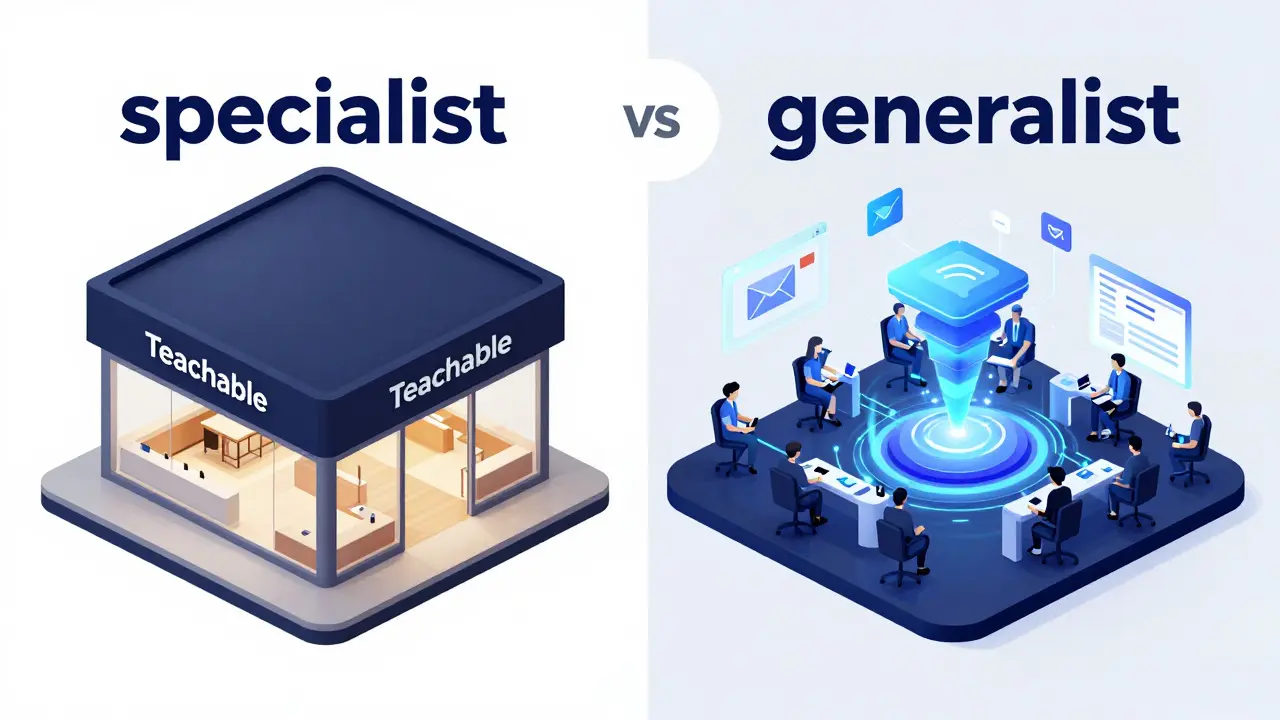
The Big Picture: Specialist vs. Generalist
Think of it like this: Teachable is like renting a high-end storefront in a mall. They provide the space, the lights, and the security, but you have to bring your own signage and marketing plan to get people through the door. Kajabi vs Teachable boils down to how much of the "business side" you want to manage yourself.
Kajabi isn't just a place to put videos; it's a growth engine. It replaces your email provider, your landing page builder, and your funnel software. If you're using a separate tool for emails (like ConvertKit) and another for your website (like WordPress), Kajabi lets you delete those subscriptions and put everything under one roof. On the flip side, Teachable focuses on the student experience. They've spent years perfecting the checkout process and the course player, making the act of buying and learning a course incredibly frictionless.
Breaking Down the Costs and Value
Pricing is where most creators feel the sting. Teachable offers a tiered approach that's generally more accessible for people just starting out. They have a free plan that lets you test the waters, though they'll take a cut of your sales. As you move up, you pay a monthly fee to remove those transaction fees and unlock more control.
Kajabi doesn't do "free." It's a premium product with a premium price tag. When you see the monthly cost, it looks high-until you realize you're no longer paying for a separate email autoresponder, a CRM, and a page builder. For a creator making $50k a year, paying $150/month for one tool is often cheaper and less stressful than paying $30 here and $40 there for five different tools that don't always talk to each other.
| Feature | Kajabi | Teachable |
|---|---|---|
| Core Purpose | All-in-one Business Hub | Course Delivery Specialist |
| Email Marketing | Built-in (Native) | Requires Integration |
| Website Builder | Full Site & Funnels | Basic Landing Pages |
| Pricing Entry | Higher Monthly Base | Free / Low-cost options |
| Transaction Fees | None | Depends on Plan |
Course Creation and Student Experience
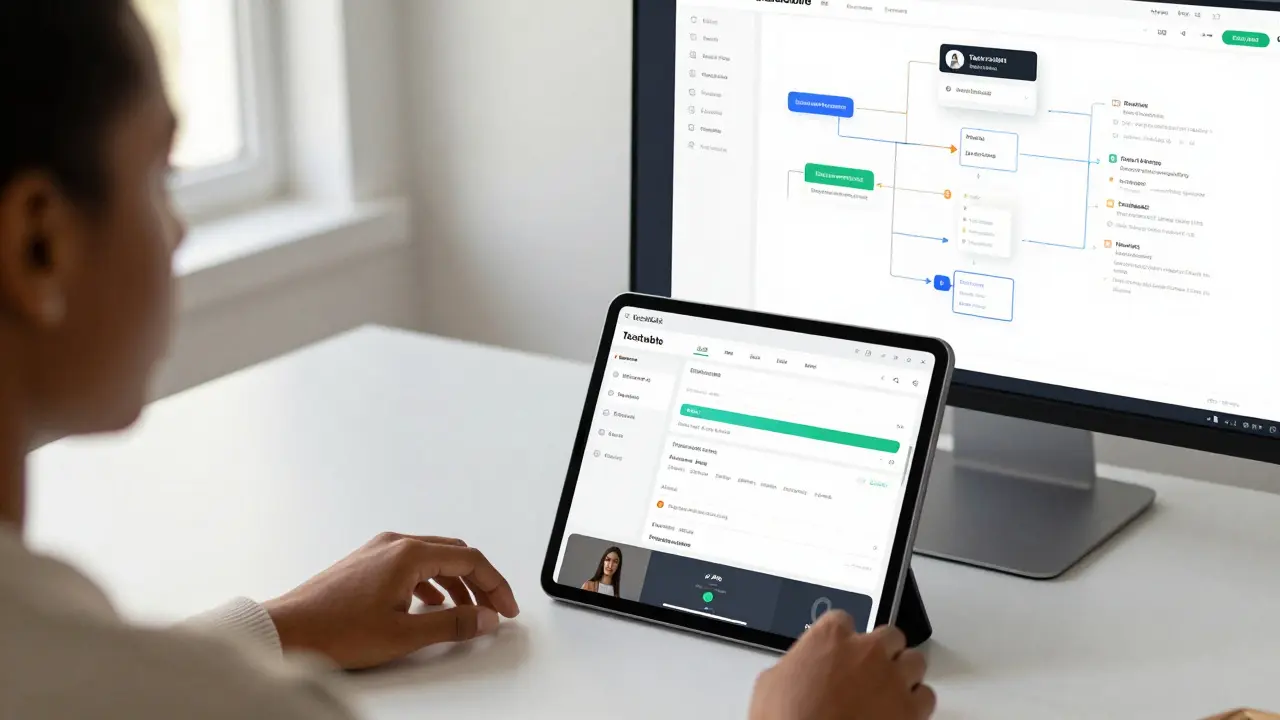
When it comes to the actual learning environment, Teachable shines in simplicity. The interface is clean, and the student dashboard is intuitive. They've nailed the "plug and play" aspect. You upload your videos, organize your modules, and you're live. For a student, the experience is seamless; they log in, see their progress, and keep moving through the lessons.
Kajabi's course builder is equally powerful but offers more "bells and whistles." You can create sophisticated membership sites and tiered access levels more easily here. For example, if you want to sell a basic course for $99 and a "VIP" version for $499 that includes extra bonuses and a private community, Kajabi's internal logic handles this effortlessly. You aren't just selling a course; you're building an ecosystem.
Marketing, Funnels, and Growth
This is where the two platforms diverge completely. Teachable is a destination; you have to send traffic *to* it. If you want to build a complex sales funnel-say, a free lead magnet that leads to a webinar, which then leads to a limited-time offer-you'll need a third-party tool like ClickFunnels or a sophisticated email sequence in an external app.
Kajabi builds those funnels directly into the platform. You can create a Sales Funnel (a series of strategic pages designed to convert a visitor into a customer) in minutes. Because the email system is connected, the platform knows exactly who clicked which link and can trigger a "reminder" email automatically. This automation is a game-changer for creators who are tired of playing "integration tetris" with Zapier.

Which One Should You Choose?
If you are a "pure educator"-meaning you have a massive following on YouTube or Instagram and just need a reliable, professional place to host your videos and collect payments-Teachable is the smarter move. It's faster to set up, cheaper to start, and does the one thing it promises (hosting courses) exceptionally well.
However, if you view yourself as a "business owner" who needs to manage leads, nurture prospects, and automate sales without spending ten hours a week on tech support, go with Kajabi. It's the choice for the creator who wants to scale. When you're managing five different products, a newsletter, and a membership site, having a single login for your entire business is worth every penny of the higher monthly fee.
Do I need a separate website if I use Kajabi?
No. Kajabi includes a full website builder. You can host your primary domain, create an About page, a Blog, and your sales pages all within the platform. This eliminates the need for WordPress or Squarespace.
Can I migrate my courses from Teachable to Kajabi?
Yes, but it is not a one-click process. You will typically need to export your student list as a CSV file and re-upload your video content and curriculum structure manually or use a migration service.
Which platform is better for beginners?
Teachable is generally easier for absolute beginners because the learning curve is shallower and there are free/cheap options to get started. Kajabi has more features, which can feel overwhelming at first.
Does Teachable handle taxes and VAT?
Yes, Teachable offers a "Tax」service (Teachable EduSwap/Tax) that helps handle the complexities of VAT and sales tax for international students, which is a massive relief for global creators.
Is Kajabi's email marketing as good as ConvertKit or Mailchimp?
For 90% of creators, yes. It handles automation, tagging, and sequencing perfectly. However, if you are a professional email marketer who needs hyper-advanced deliverability analytics or complex splitting tests, you might still prefer a dedicated tool.
Next Steps for Your Setup
If you're still on the fence, start by mapping out your "Tech Stack." List every tool you currently pay for. If your list includes a website host, an email tool, and a landing page builder, try the Kajabi trial-you'll likely save money by consolidating. If you already have a website you love and just need a place for your students to log in, Teachable is your best bet.
Regardless of the tool, remember that the platform doesn't make the course-your content does. Pick the one that gets out of your way so you can focus on teaching.
Comments
mark nine
been using teachable for a bit and its definitely the way to go if you dont want to spend your whole life tinkering with a website builder just to sell a few videos
Sandi Johnson
Oh sure, because nothing says "productive business day" like spending six hours trying to figure out why a single Kajabi automation trigger isn't firing correctly. Truly a dream scenario for any entrepreneur.
Eva Monhaut
It is absolutely splendid to see a breakdown that actually weighs the holistic business approach against a streamlined tool. Choosing a digital home can feel like a gargantuan task for a creative soul, but this makes the path feel much more luminous and clear.
Michael Gradwell
imagine paying for kajabi when you could just learn how to actually build a site yourself if you had any real discipline
mark nine
lol just use a template man
Ronnie Kaye
Wow, a "premium price tag" for a tool that basically does what a few free plugins could do if you had a shred of patience. I'm just vibrating with excitement at the thought of consolidating my bills into one giant payment to a corporate overlord!
Priyank Panchal
This analysis is completely surface level and ignores the actual API limitations of both platforms. Completely useless for anyone running a high-volume operation.
Rakesh Kumar
OH MY GOD! I never realized how much of a nightmare "integration tetris" actually was until this was mentioned! My brain is literally exploding thinking about all the time I've wasted on Zapier!
Ian Maggs
One must wonder... is the consolidation of tools a liberation of time, or merely a surrender of control to a singular ecosystem??? The philosophical implication of "all-in-one" is quite troubling, don't you think???
Flannery Smail
Kajabi is overrated. Just use a simple WordPress setup with Learndash. Way more flexible and you actually own your data instead of renting it from some SaaS company that can hike prices whenever they feel like it.
Emmanuel Sadi
Cute that you think a "growth engine" is just a software subscription. Some of us actually understand market psychology, but sure, keep pretending that a fancy landing page builder is the secret to a million-dollar business. Truly adorable.
Chuck Doland
It is imperative that one considers the long-term sustainability of their operational infrastructure. While the allure of a simplified interface is strong, the professional practitioner must weigh the cost of vendor lock-in against the efficiency of a centralized system. Such a decision requires a rigorous assessment of one's projected growth trajectory and the requisite technical aptitude to manage a fragmented stack.
Bill Castanier
Great summary. Very clear.