

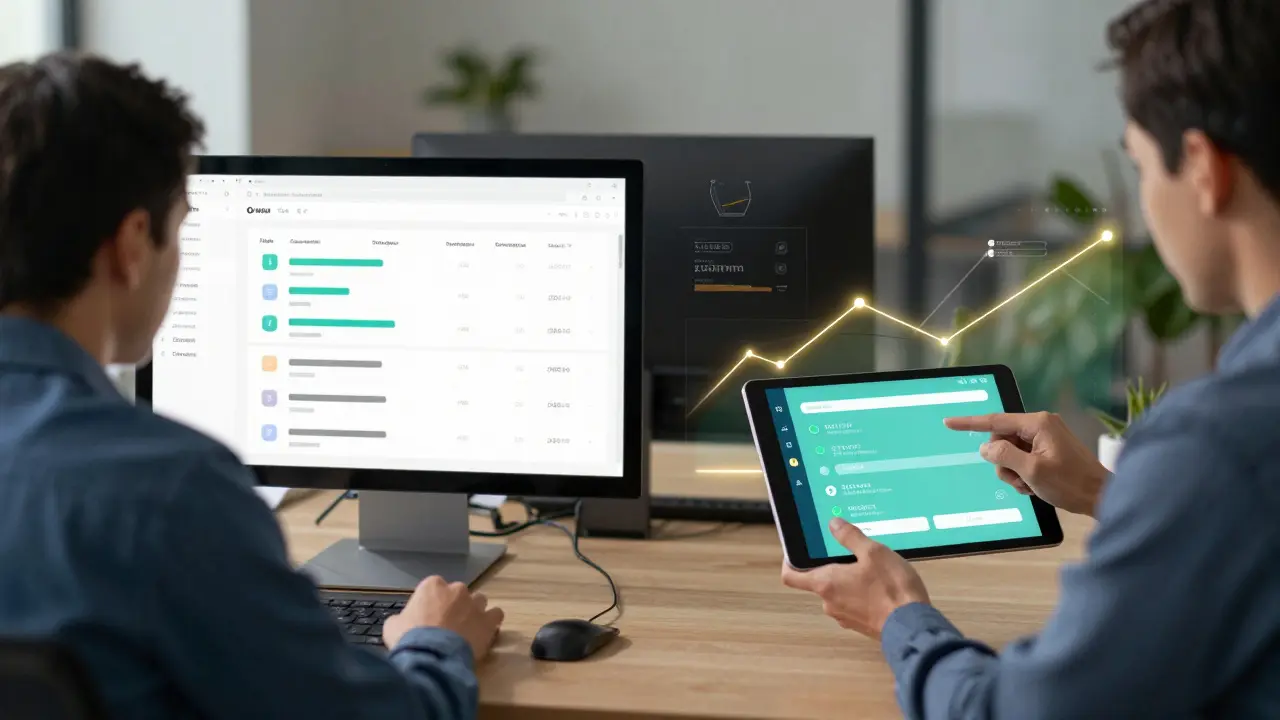
Most companies track sales, customer retention, and operational efficiency-but how many are tracking learning? If your team isn’t improving, no amount of sales targets or customer service scores will fix the real problem: skill gaps. Learning analytics isn’t just for schools. When tied to real business KPIs, it turns training from a cost center into a growth engine.
What learning analytics actually measures
Learning analytics tracks what learners do in training systems. It’s not about how many people finished a course. It’s about how they engaged. Did they pause and replay a module? Did they skip quizzes? Did they spend 30 seconds on a 10-minute video? These tiny actions reveal whether someone truly understood the material-or just clicked through to check a box.
Modern learning management systems (LMS) now capture data like:
- Time spent per module
- Quiz scores over time
- Repetition of failed attempts
- Click paths through content
- Discussion forum participation
- Completion rates by department or role
That data means nothing unless it connects to what happens in the real workplace. A sales rep who scores 95% on a product training module but still can’t close deals? The system flagged it. The manager saw it. They didn’t just send another email. They redesigned the training around real objections the rep was hearing.
Why most companies fail to connect learning to results
Here’s the brutal truth: 74% of organizations say their training programs have little to no impact on business outcomes. Why? Because they measure completion, not competence.
Think about it. You run a training program on CRM usage. You report that 92% of reps completed it. Sounds great. But if those same reps still log 40% fewer customer interactions in Salesforce than top performers, the training didn’t work. You measured activity, not performance.
The disconnect happens because HR and L&D teams use different metrics than sales, operations, or customer service leaders. HR tracks enrollment. Sales tracks revenue. No one connects the dots.
How to link learning data to real KPIs
Start by picking one high-impact business metric that’s struggling. Then ask: What skills are missing?
Example: Customer support ticket resolution time is up 22% in the last quarter. You suspect reps aren’t using the knowledge base effectively. So you:
- Track how often reps search the knowledge base during training simulations
- Measure how many times they rewatch video tutorials on troubleshooting common issues
- Compare those behaviors to actual ticket resolution times in the live system
After three weeks, you notice a pattern: reps who watched the troubleshooting video twice resolved tickets 31% faster than those who watched it once or not at all. That’s your signal. You update the training to require a second viewing before certification.
Within two months, resolution time drops back to pre-increase levels. That’s learning analytics driving KPI change-not just training.
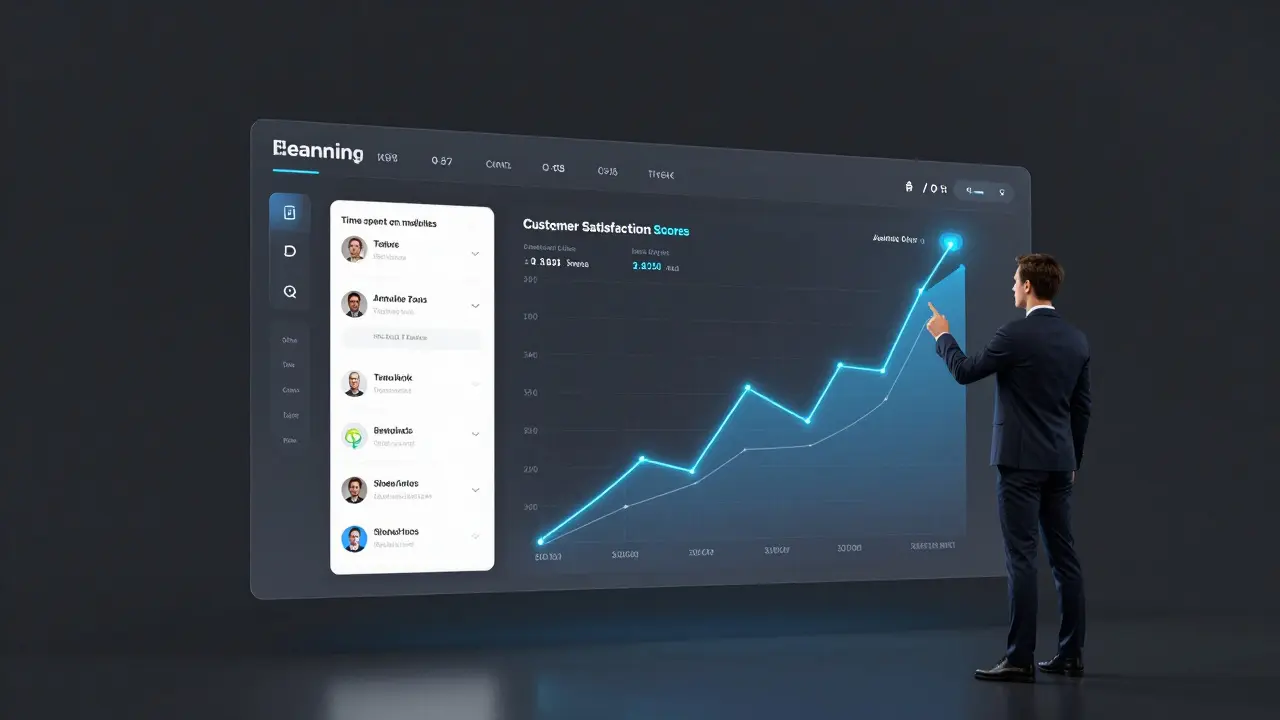
Real examples that worked
A logistics company noticed delivery delays were rising in the Midwest region. They looked at their driver safety training data and found something odd: drivers in that region were skipping the module on weather-related route adjustments. They assumed it didn’t apply to them. But data showed those same drivers had 47% more near-miss incidents during rain or snow.
The fix? They made the module mandatory and added a short quiz based on local weather patterns. Completion rate jumped from 58% to 98%. Within six weeks, incident reports dropped by 39%. Delivery delays fell 18%.
Another example: a retail chain used learning analytics to improve upselling. They noticed employees who completed the product knowledge module with high quiz scores were 2.5x more likely to upsell premium products. But those who scored low? They rarely even mentioned the upgrades. So they redesigned the training to include role-play scenarios with real customer objections. Sales of premium products rose 29% in three months.
Tools that make this connection possible
You don’t need a data science team. Many modern LMS platforms now include built-in analytics dashboards:
- Cornerstone OnDemand lets you map training completion to HRIS data like promotion rates
- SAP Litmos integrates with CRM systems to show how training impacts lead conversion
- Docebo has AI-powered insights that flag at-risk learners before performance drops
- Lessonly ties learning activity directly to performance reviews
Even if your LMS doesn’t have deep integrations, you can manually connect the dots. Export learner data from your LMS. Pull sales or service metrics from your CRM or ERP. Use Excel or Google Sheets to match names and look for patterns. It’s not glamorous-but it works.

What to track: 5 KPIs that actually move the needle
Here are five business KPIs you can directly link to learning analytics:
- Customer satisfaction scores - Did training on empathy or de-escalation improve NPS?
- Sales conversion rates - Did product knowledge training increase upsell success?
- Errors or compliance violations - Did safety or policy training reduce incidents?
- Time to proficiency - How long does it take new hires to reach productivity benchmarks? Did onboarding changes shorten that?
- Employee retention - Do teams with high training engagement have lower turnover?
Don’t try to track all five at once. Pick one. Measure it before and after a training change. Prove the link. Then expand.
Common mistakes to avoid
People think learning analytics means collecting more data. It doesn’t. It means collecting the right data.
- Mistake: Tracking completion rates only. Fix: Track behavior change, not checkbox ticking.
- Mistake: Letting IT or HR own the data alone. Fix: Involve the managers who see the results daily.
- Mistake: Waiting for annual reviews to act. Fix: Use real-time dashboards to flag issues as they happen.
- Mistake: Assuming one-size-fits-all training. Fix: Use analytics to personalize learning paths.
One company tried to fix low engagement by adding more videos. Engagement dropped further. Why? The data showed learners were skipping videos because they were too long. They cut each video to under 4 minutes. Completion jumped from 41% to 89%.
Where to start today
You don’t need a budget. You don’t need a new system. Just ask three questions:
- What’s one business metric we’re missing this quarter?
- What skill gap could be causing it?
- Can we see how our training is (or isn’t) helping with that skill?
Open your LMS. Pull the data. Compare it to your performance dashboard. Look for patterns. Talk to frontline managers. You might be surprised what you find.
Learning analytics isn’t about tracking learners. It’s about tracking performance. And when you do that right, training stops being something you pay for-and starts being something that pays for itself.
How do I know if my learning analytics data is meaningful?
Meaningful data connects directly to a business outcome. If you can’t answer "Did this training change a number that matters?"-like sales, errors, or retention-then you’re just collecting activity logs. Start by picking one KPI that’s underperforming, then trace training behaviors back to it. If you see a clear pattern-like higher quiz scores linked to faster task completion-you’ve got meaningful data.
Can small businesses use learning analytics too?
Absolutely. You don’t need a fancy LMS. Even Google Sheets can work. Track who completes training, then compare that to their performance on tasks-like customer feedback scores, error rates, or project deadlines. Look for trends over time. If employees who finished the training consistently outperform others, you’ve got proof of impact. Start simple: one metric, one group, one change.
What if training doesn’t improve KPIs?
That’s not a failure-it’s a discovery. If training doesn’t move the needle, the problem isn’t the learner. It’s the training itself. Maybe the content is outdated. Maybe it’s not relevant to daily work. Maybe managers aren’t reinforcing it. Use the data to diagnose why. Sometimes, the fix isn’t more training-it’s better coaching, clearer job aids, or redesigned workflows.
How often should I review learning analytics?
Check it monthly. Business KPIs change fast. If you wait until year-end to review training impact, you’ve missed 11 months of chances to fix problems. Set a recurring calendar reminder. Pull the data. Compare it to performance metrics. If something’s off, investigate immediately. Real-time feedback loops make training agile and effective.
Do I need to hire a data analyst to make this work?
No. Most LMS platforms have simple dashboards. You can export data to Excel in a few clicks. The real skill isn’t data analysis-it’s asking the right questions. Start by asking your team: "What’s slowing you down?" Then look at the training data to see if it matches. You don’t need fancy tools. You need curiosity and a willingness to act on what the data shows.
Comments
Frank Piccolo
Let me guess-you’re one of those HR drones who thinks watching a 45-minute video on CRM usage counts as 'learning.' Newsflash: completion rates are vanity metrics. I’ve seen companies spend $2M on LMS platforms and still have sales teams who can’t explain their own product. The real problem? Managers don’t care enough to connect the dots. You don’t need analytics. You need accountability. And by the way, if your 'training' is just another checkbox, you’re already dead in the water.
James Boggs
Thank you for this thoughtful and well-structured piece. The emphasis on behavioral data over completion rates is exactly the shift we need. I’ve implemented similar linking between LMS engagement and customer satisfaction scores in my organization, and the results have been transformative. Small, consistent adjustments based on real data yield outsized returns.
Addison Smart
I appreciate how this post bridges the gap between corporate training and operational outcomes-it’s something I’ve been advocating for years across multinational teams. In my work across Southeast Asia, Latin America, and Eastern Europe, I’ve seen how cultural context affects learning engagement. For instance, in collectivist cultures, peer discussion metrics matter more than quiz scores. The real power here isn’t in the dashboards-it’s in the humility to listen to frontline teams. When a field rep in Nairobi says, 'The module didn’t prepare me for the power outages,' that’s not a failure-it’s a design opportunity. Learning analytics should be a dialogue, not a report card.
Thabo mangena
This is a remarkably insightful framework. The linkage between training behaviors and tangible KPIs such as customer retention and time-to-proficiency is not merely theoretical-it is empirically validated across industries. I commend the author for emphasizing actionable data over superficial metrics. In South Africa, where digital infrastructure varies widely, even basic Excel-based correlation has yielded measurable improvements in frontline productivity. The key is intentionality.
Karl Fisher
OMG. I just spent 3 hours watching my team's LMS analytics and I swear, one guy watched the same 3-minute video 17 times. I thought he was stuck. Turns out he was just... obsessed. Like, he screenshot the slides and framed them. I didn't know people could be this emotionally invested in compliance training. I'm not sure if he's a genius or needs a therapist. Either way, I'm promoting him.
Tony Smith
Ah yes, the classic 'we’ll fix this with more training' reflex. Let me guess-your company also sends out a 'Thank you for completing cybersecurity training!' email with a confetti animation. You’re not tracking learning. You’re tracking compliance theater. The real metric? How many people still click phishing links after 'training.' That’s the number that matters. Stop measuring activity. Measure behavior. Or better yet, stop pretending training is the solution to bad hiring or poor management.
Rakesh Kumar
Bro this is FIRE!! I work in a startup in Bangalore and we didn’t even have an LMS until last month. We just used Google Forms and WhatsApp. But we matched who finished the sales module with who actually closed deals. Guess what? The top 3 closers all watched the video on handling objections TWICE. We made it mandatory. Sales jumped 40% in 4 weeks. No fancy AI. No data scientists. Just curiosity. People think analytics is complicated. Nah. It’s just asking ‘Why?’ and then looking.
Bill Castanier
The most underutilized tool in corporate learning is the manager. If frontline supervisors aren’t reviewing training data weekly, it’s meaningless. I’ve seen teams with 95% completion rates and 30% drop in productivity. The training wasn’t broken. The feedback loop was. Simple fix: managers get a 5-minute daily digest. No dashboards. Just one number: 'Who improved? Who regressed?' That’s all you need.
Ronnie Kaye
I love this. But let’s be real-most companies don’t have the guts to do this. They’ll spend $50k on a shiny new LMS dashboard and then bury the reports in a folder called 'Training - Do Not Touch.' Why? Because if the data shows that the VP’s favorite trainer’s course has zero impact, they’ll have to admit they’ve been wasting money for years. And nobody wants to be the person who killed the 'Leadership Excellence' program that’s been running since 2012. So they keep the lights on. And the learners? They just click through.
Priyank Panchal
This entire article is naive. You assume data is clean. You assume managers care. You assume employees aren’t gaming the system. In India, we have employees who use bots to auto-complete modules. We have teams that share login credentials so one person takes all the training. You think your 'quiz scores' mean anything? They mean nothing. Real impact? Look at turnover. Look at customer complaints. Look at who gets promoted. The rest is noise.
Ian Maggs
The notion that learning analytics can 'turn training into a growth engine' is, perhaps, a poetic metaphor-but it risks conflating correlation with causation. One must ask: is the training driving performance, or is performance-driven by intrinsic motivation, organizational culture, or prior experience-simply enabling better engagement with training? The data may reflect the latter. One must, therefore, exercise epistemological caution before institutionalizing these correlations as causal truths.
Michael Gradwell
You think this is new? My uncle ran a hardware store in '08 and he did this exact thing. He tracked who watched the product videos and who sold the most tools. He fired the guy who scored 100% on the quiz but sold zero hammers. Simple. No LMS. No AI. Just common sense. Everyone’s acting like this is some revolutionary breakthrough. Nah. It’s just basic management. The problem isn’t the data. It’s the idiots running companies who think 'completion' equals 'competence.'
Flannery Smail
I read the whole thing. Honestly? It’s fine. But I’m not convinced. What if the data is just noise? What if the guy who watched the video twice is just really into videos? What if the sales spike had nothing to do with training and everything to do with a competitor going out of business? I’m not saying it’s wrong. I’m just saying… maybe it’s not that simple.
Emmanuel Sadi
Let’s be brutally honest: this is corporate fluff wrapped in data. You’re not fixing skill gaps. You’re just giving managers a new spreadsheet to hide behind. Meanwhile, the real problems-poor hiring, toxic leadership, no feedback culture-are still there. You think tracking video views will fix a manager who hoards promotions? You think quiz scores will undo a culture of fear? This isn’t analytics. It’s distraction. And you’re all just rearranging deck chairs on the Titanic.