


Want to start a career in healthcare but don’t want to spend years in school? Medical and nursing assistant certifications offer a fast, affordable way to jump into patient care-with real jobs waiting on the other side. These roles aren’t just entry-level-they’re essential. You’ll be the first face patients see, the one checking vitals, preparing exam rooms, and making sure everything runs smoothly. And yes, hospitals, clinics, and nursing homes are hiring.
What’s the Difference Between a Medical Assistant and a Nursing Assistant?
People mix these up all the time. They’re both support roles, but they’re not the same.
A medical assistant (MA) works mostly in outpatient settings like doctor’s offices and urgent care clinics. You’ll do both clinical and administrative tasks: take blood pressure, schedule appointments, update records, prep patients for exams, and sometimes even assist with minor procedures. It’s a hybrid role. You need to be comfortable switching between paperwork and patient care.
A nursing assistant (NA), also called a certified nursing assistant (CNA), works mostly in hospitals and long-term care facilities. Your focus is hands-on daily care: helping patients bathe, eat, move in and out of bed, and use the bathroom. You report changes in condition to nurses. It’s physically demanding but deeply rewarding. You’re not just helping someone get dressed-you’re keeping them dignified.
Both roles require certification, but the training paths are different.
Medical Assistant Certification: What You Need to Know
To become a certified medical assistant, you need to complete a training program and pass a national exam. Most programs take 9 to 12 months. You can find them at community colleges, vocational schools, and even online (but make sure they’re accredited).
The two most recognized certifications are:
- CCMA (Certified Clinical Medical Assistant) from the National Healthcareer Association (NHA)
- CMA (Certified Medical Assistant) from the American Association of Medical Assistants (AAMA)
Both require passing an exam. The CMA is more widely respected, but the CCMA is easier to get into if you’re just starting out. Neither requires a degree-just completion of an accredited program.
Your training will cover:
- Anatomy and physiology
- Medical terminology
- Phlebotomy and EKG basics
- Medication administration (in some states)
- Electronic health records (EHR)
- Office procedures and billing
Many programs include a 160-hour externship. That’s where you get real experience. Employers care more about this than your GPA.
Nursing Assistant Certification (CNA): The Straightforward Path
Becoming a CNA is faster. Most state-approved programs last 4 to 12 weeks. You’ll train in a classroom and then do 75+ hours of clinical practice. The state exam has two parts: a written test and a skills demonstration.
You’ll learn how to:
- Take and record vital signs
- Turn and reposition bedridden patients
- Help with feeding and hygiene
- Use transfer belts and wheelchairs safely
- Recognize signs of infection or pressure sores
After you pass, your name goes on your state’s nurse aide registry. That’s your license. You can’t work as a CNA without being listed there.
Some states let you train for free through nursing homes or hospitals. If you’re hired as a CNA trainee, they’ll often pay for your certification. Ask around.

Where Can You Take These Courses?
You’ve got options. Not all are equal.
- Community colleges: Usually the best value. Programs are accredited, instructors are experienced, and externships are built in. Tuition ranges from $1,000 to $3,000.
- Vocational schools: Faster, more focused. But check accreditation. Some are for-profit and overcharge. Look for programs approved by your state’s health department.
- Online courses: Only if they include in-person clinicals. You can’t learn to draw blood or help someone stand up from a chair through a screen. Avoid fully online programs unless they’re partnered with a local facility.
- Hospitals and nursing homes: Many hire and train CNAs on the spot. You work as a trainee, get paid, and finish certification without debt. Great if you need income while learning.
Always verify that the program is accredited by a recognized body:
- Commission on Accreditation of Allied Health Education Programs (CAAHEP)
- Accrediting Bureau of Health Education Schools (ABHES)
If it’s not listed, you won’t be eligible for certification.
Costs and Financial Aid
Medical assistant programs cost between $1,500 and $6,000. CNA programs run $500 to $1,800. But here’s the good news: financial aid is often available.
- FAFSA: You can use it for accredited community college programs.
- State grants: Many states offer healthcare workforce grants. Check your local workforce development board.
- Employer reimbursement: If you’re hired as a trainee, ask if they’ll pay for certification after you pass.
- Nonprofits: Organizations like the National Nursing Assistant Association sometimes offer scholarships.
Don’t assume it’s too expensive. Many people pay less than $1,000 out-of-pocket.
What Happens After Certification?
Once you’re certified, you’re not done. You need to keep learning.
Medical assistants must renew certification every 5 years. That usually means continuing education-online courses, workshops, or conferences. CNAs renew every 2 years. Most states require 48 hours of work and 12 hours of training.
And here’s the real win: these certifications open doors.
- With experience, MAs can specialize in areas like ophthalmology, pediatrics, or cardiology.
- CNAs often become LPNs (licensed practical nurses) by enrolling in bridge programs. Some schools let you skip the first semester if you’re a CNA.
- Both roles are stepping stones to nursing degrees. Many RNs started as MAs or CNAs.
Job growth is strong. The Bureau of Labor Statistics projects 14% growth for medical assistants and 7% for nursing assistants through 2032. That’s faster than average.
Common Pitfalls to Avoid
People make the same mistakes over and over.
- Choosing a non-accredited program: You’ll waste time and money. No one will hire you.
- Skipping the externship: You’ll be unprepared for real work. Employers expect you to know how to handle a blood draw or an EKG machine on day one.
- Thinking certification is enough: Soft skills matter. Patients remember how you made them feel. Practice empathy. Learn to listen.
- Not checking state rules: Some states require extra training for MAs to give injections or draw blood. Know your state’s scope of practice.
Is This Career Right for You?
You don’t need to be a genius. You do need to be:
- Reliable
- Detail-oriented
- Comfortable with blood, needles, and bodily fluids
- Good at following protocols
- Willing to stand for long shifts
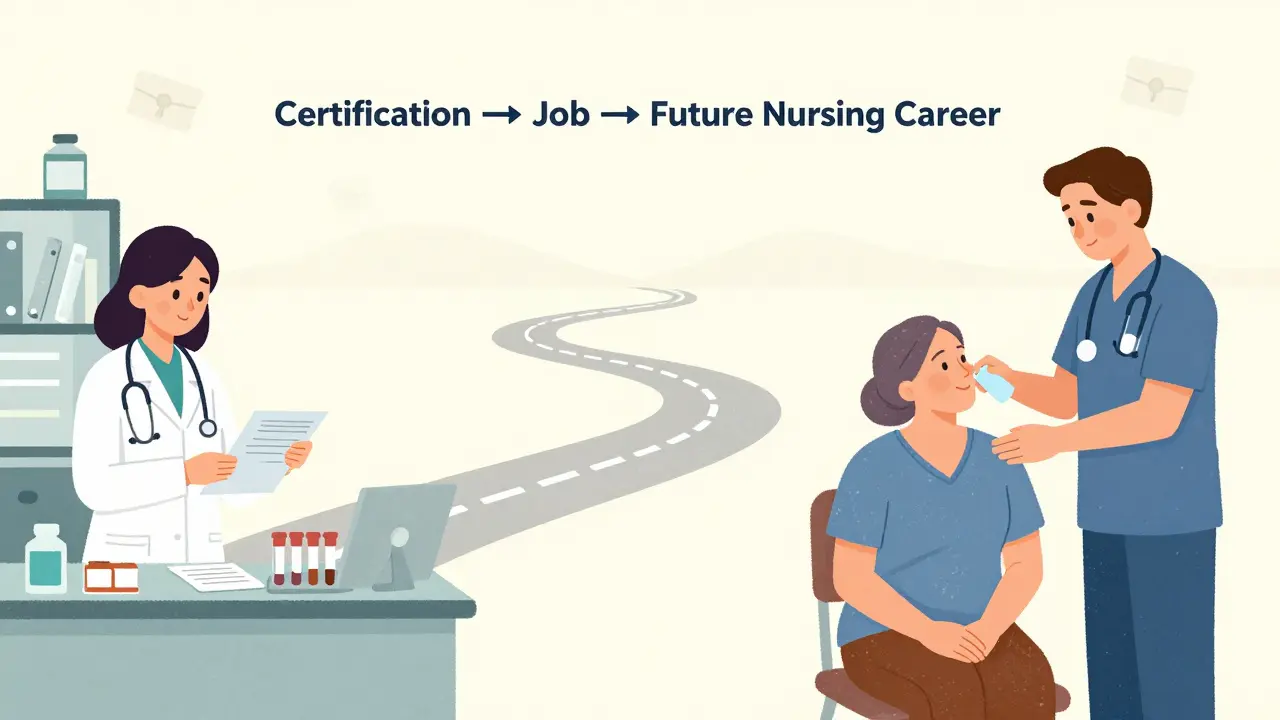
If you’re drawn to helping people but don’t want to spend a decade in school, this is one of the clearest paths in healthcare. No debt. No waiting. Just a certification, a job, and a future you can build on.
Do I need a high school diploma to get certified as a medical or nursing assistant?
Yes, most programs require a high school diploma or GED. Some states allow you to take the CNA exam without one, but you won’t qualify for financial aid or most employer-sponsored training. A diploma or equivalent is the minimum entry point.
Can I work while I’m taking the course?
Absolutely. Many people do. CNA programs are short enough to fit around a job. Medical assistant programs are longer, but many offer evening or weekend classes. Some employers even let you work as a unit clerk or aide while you’re in school, which counts toward clinical hours.
Are online medical assistant certifications legitimate?
Only if they’re accredited and include in-person clinical training. Fully online programs without hands-on labs won’t prepare you for the certification exam or real work. Look for programs that partner with local clinics or hospitals for externships. If they don’t mention clinicals, walk away.
How long does it take to get hired after certification?
Most graduates find jobs within 4 to 8 weeks. Demand is high. Facilities in rural areas and nursing homes often hire immediately. If you’ve completed an externship, you’re already known to at least one employer. Use that connection.
What’s the difference between a CNA and a PCA?
A PCA (Personal Care Assistant) provides similar help with daily tasks, but doesn’t need state certification. PCAs are often hired by home care agencies and can’t work in hospitals or nursing homes. CNAs have more training, are state-registered, and can work in regulated facilities. If you want stability and advancement, go for the CNA.
Comments
Zelda Breach
Let me guess-you think this is some kind of golden ticket to a career? No degree, no debt, just magic certification fairy dust? Please. The system is rigged. Employers don't care about your CCMA unless you’ve got experience. And don’t even get me started on online programs that skip clinicals. You think you’re saving money? You’re just training to be a liability.
Alan Crierie
I really appreciate how clear this guide is. It’s easy to feel overwhelmed when starting out, but breaking down MA vs CNA like this helps so much. I’ve seen people jump into programs without checking accreditation-big mistake. Always verify CAAHEP or ABHES. And yes, the externship? Non-negotiable. It’s where theory becomes muscle memory.
Teja kumar Baliga
In India, we call this path ‘fast-track service.’ Many here start as CNAs to support families while studying nursing later. The key? Find a hospital that trains you for free. I did it-worked nights, studied days. No debt. No stress. Just steady progress. You don’t need to be perfect. Just show up.
k arnold
Wow. A whole article about how to get a job that pays $15/hour and requires you to clean up after people who can’t wipe themselves. Congrats. You’ve unlocked the ‘Human Trash Can’ achievement. Next stop: minimum wage heaven.
Tiffany Ho
I just started my CNA course and this helped so much. I was scared I wouldn’t be good enough but now I feel like maybe I can do this. I’m not smart but I care. And that’s enough right?
Fred Edwords
I must correct a minor but critical error: the article states that CNAs renew every two years. That’s accurate-but it omits that the 48 hours of work must be documented and submitted *before* the renewal deadline. Failure to do so? You lose your registry status. And yes, I checked the CDC guidelines. This is not optional. Also, semicolons are underused in healthcare communication. Just saying.
Sarah McWhirter
You know what they don’t tell you? The government’s pushing these certs because they’re trying to replace RNs with cheaper labor. It’s a slow erosion of care. Next thing you know, a 19-year-old with a CCMA will be ‘assessing’ your chest pain. And who’s behind this? Big Pharma. Big Hospitals. Big AAMA. Wake up. They want you tired, compliant, and too busy to ask questions.
Ananya Sharma
This whole guide is a capitalist fantasy. You think certification gives you power? It gives you a badge that says ‘I am expendable.’ CNAs work 12-hour shifts with no breaks while nurses sip coffee. MAs? They’re glorified receptionists with a stethoscope. And don’t even mention the ‘stepping stone’ nonsense-no one gets promoted unless they’re already connected. This isn’t upward mobility. It’s a trap dressed as opportunity. I’ve seen it. I’ve lived it. You’re being sold a dream that only benefits the institutions.
kelvin kind
Solid overview. I did the CNA route. Took 6 weeks. Got hired the day after my exam. Worked nights. Saved money. Then went back for my MA. No regrets. Just do the work. The rest follows.
Ian Cassidy
The externship is where the real learning happens. You think you know how to take BP until you’re standing over a diabetic in shock with a shaking hand. Then you realize: this isn’t a class. It’s a life. And you’re the one holding the cuff.
Nicholas Zeitler
I’m glad someone mentioned the externship! I’ve had students who skipped it-told me they ‘knew it already.’ Two weeks on the job, and they couldn’t tell a 12-lead EKG from a coffee stain. Don’t be that person. Show up. Listen. Ask. And yes-I’m still here, because I care. And I’m not done.