

Setting the right price for your online course is one of the most stressful parts of launching. Charge too little, and you undervalue your expertise; charge too much, and potential students walk away. The truth is, there is no single "correct" number. Pricing is a strategic lever that determines your revenue model, your target audience, and even how you market your content. This guide breaks down the proven strategies used by successful educators to maximize profit while delivering genuine value.
Why Cost-Plus Pricing Fails for Digital Products
Many creators start with a simple calculation: add up the hours spent recording videos, writing quizzes, and designing slides, then multiply by an hourly rate. This is known as cost-plus pricing. It works for baking cakes or fixing cars because materials and labor have hard limits. But digital products are different. Once your course is built, the cost to deliver it to one extra student is near zero.
If you base your price solely on your time, you ignore the market's perception of value. A beginner might spend 100 hours creating a mediocre course, while an expert spends 20 hours creating a transformative one. If both charge based on hours, the expert undercharges and the beginner overcharges relative to the outcome they provide. You need to shift from selling hours to selling outcomes.
The Value-Based Pricing Framework
Value-based pricing sets the price according to the perceived worth of the result to the customer, not the effort it took you to create it. To use this method, you must understand the financial impact your course has on the buyer.
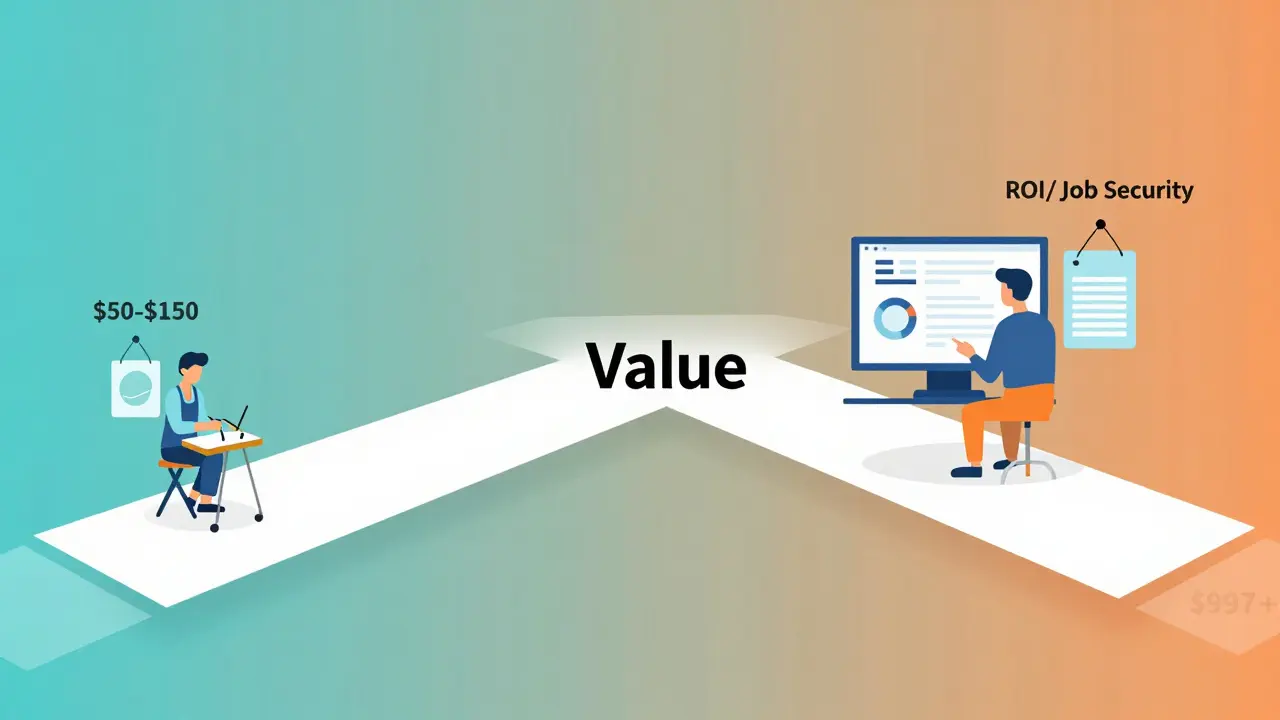
Consider two scenarios:
- Personal Interest: A course on watercolor painting for hobbyists. The outcome is relaxation and a new skill. The financial impact is low. Prices typically range from $50 to $150.
- Professional ROI: A course on advanced Excel for financial analysts. The outcome is faster reporting and job security. If the course saves them 10 hours a month, and their hourly wage is $50, the course saves them $500 a month. Charging $997 for a lifetime access pass is a no-brainer for them.
To apply this, ask yourself: What problem does my course solve? How much does that problem cost the customer in time, money, or stress? Your price should be a fraction of that saved cost.
Pricing Models: One-Time vs. Subscription
Your pricing structure dictates your cash flow and your relationship with students. There are three dominant models in the e-learning space today.
| Model | Best For | Pros | Cons |
|---|---|---|---|
| One-Time Payment | Evergreen skills, certifications, specific projects | Predictable revenue per sale, no churn anxiety | Requires constant new marketing to maintain income |
| Subscription (Membership) | Ongoing education, community support, frequent updates | Recurring revenue, higher lifetime value (LTV) | High churn risk, requires continuous content creation |
| Cohort-Based | High-touch accountability, networking, complex topics | Higher prices ($1k+), strong completion rates | Not scalable, limited seats, high operational load |
In 2026, we see a rise in hybrid models. Many creators offer a low-cost self-paced version for passive income and a high-ticket cohort-based version for premium service. This captures both budget-conscious learners and those who crave human interaction.
Tiered Pricing: The Power of Three
Psychologically, people struggle to make binary decisions (buy or don't buy). They feel more comfortable choosing between options. This is why tiered pricing is so effective. By offering three levels, you anchor the middle option as the best deal.
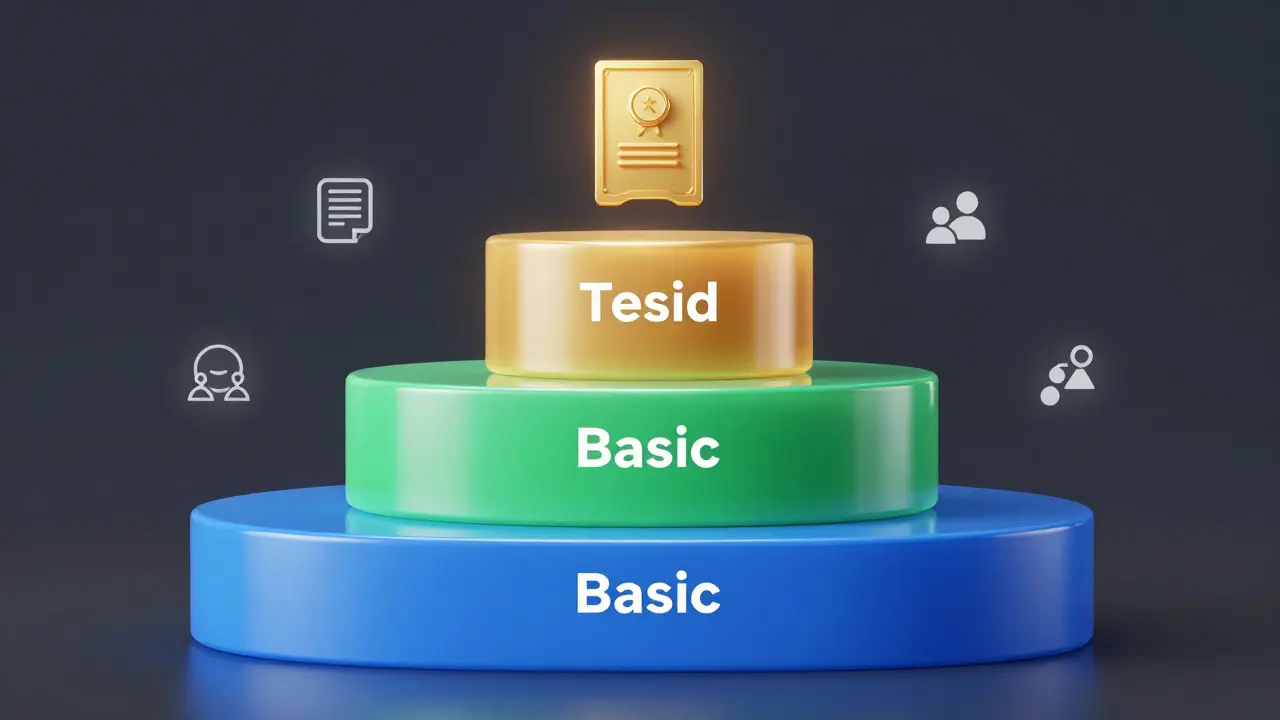
A common structure looks like this:
- Basic Tier ($49): Video lessons only. Good for skeptics who want to test the waters.
- Standard Tier ($199): Videos + downloadable resources + quiz certificates. This is your primary target. It offers enough value to justify the price without overwhelming the buyer.
- Premium Tier ($499): Standard + 1-hour group coaching call + private community access. This targets power users who want accountability and networking.
Notice how the Premium tier makes the Standard tier look affordable. If you only offered the $199 option, some customers would hesitate. With the $499 option visible, $199 feels like a safe, reasonable choice.
Anchoring and Price Perception
Price is relative. A $1,000 course sounds expensive if compared to a $10 Udemy class. It sounds cheap if compared to a $10,000 university degree. You control this comparison through price anchoring.
When presenting your price, always show the total value before revealing the discount. For example:
"The complete training includes 20 hours of video ($2,000 value), 50 templates ($500 value), and monthly Q&A sessions ($1,000 value). Total value: $3,500. Today's price: $997."
This doesn't mean you actually sell these components separately. It helps the brain calculate the deal size. Without the anchor, $997 is just a large number. With the anchor, it represents a 70% savings.
Competitor Analysis: Don't Copy, Differentiate
It is tempting to check what similar courses charge and match them. However, copying competitors' prices ignores your unique positioning. If you are a well-known expert with social proof, you can charge significantly more than an unknown competitor with better production quality but less authority.
Instead of matching prices, map your features against theirs. Create a comparison chart on your sales page that highlights what you offer that they do not. Perhaps you include live feedback, whereas they only offer automated quizzes. This justifies a higher price point without entering a race to the bottom.
Testing and Iterating Your Price
You rarely get the price right on the first launch. Start with a conservative price to gather testimonials and case studies. As you collect success stories, you can raise the price for future cohorts.
Use A/B testing on your checkout page. Test different price points, such as $197 vs. $297. Sometimes, raising the price increases conversions because it signals higher quality. Other times, it drops sales. Track your conversion rate and average order value (AOV) to find the sweet spot where total revenue is maximized.
Also, consider payment plans. Offering a 3-month installment plan can increase conversion rates by 20-30% among buyers who are interested but lack immediate liquidity. Just ensure your payment processor supports split payments.
Common Pricing Mistakes to Avoid
Even experienced educators fall into these traps:
- Discounting too early: Running perpetual discounts trains customers to wait for a sale. Instead, offer bonuses (like an extra workshop) rather than lowering the price.
- Ignoring transaction fees: Platforms like Stripe or PayPal take 2.9% + $0.30 per transaction. Factor this into your final price. A $100 course nets you roughly $96.80. A $1,000 course nets you $971.70. Higher prices are more efficient.
- Underpricing for scale: Thinking you need thousands of sales at $20 to make a living. It is often easier to sell 100 units at $200 than 1,000 units at $20. Lower prices require massive marketing budgets and generate more support tickets.
Final Thoughts on Course Economics
Pricing is not static. As your brand grows, your price should grow. Re-evaluate your pricing every six months. Look at your refund rates-if they are low, you may be undercharging. Look at your sales velocity-if it is slow, you may be overcharging or misaligned with your audience's expectations.
Remember, the goal is not just to set a number, but to align your price with the transformation you promise. When students feel the value exceeds the cost, they become advocates, not just customers.
How do I decide between one-time payment and subscription pricing?
Choose one-time payment if your course teaches a specific, finite skill (e.g., 'How to Build a Website'). Choose subscription if you provide ongoing value, such as weekly updates, community access, or a library of constantly growing content. Subscriptions require consistent engagement to prevent churn.
What is a good starting price for a new online course?
For beginners, a price between $49 and $97 is often recommended. This range is low enough to reduce purchase friction for cold audiences but high enough to signal quality. Once you have testimonials and case studies, you can raise prices to $197 or higher.
Should I offer discounts for my online course?
Avoid permanent discounts. They devalue your brand. Instead, use limited-time launch discounts or offer bonus materials (like a workbook or live Q&A) during promotional periods. This creates urgency without lowering your baseline price.
How does cohort-based pricing differ from self-paced?
Cohort-based courses charge significantly more (often $1,000+) because they include live instruction, peer interaction, and direct feedback from the instructor. Self-paced courses are cheaper because they rely on pre-recorded content and automation. Cohorts sell on accountability; self-paced sells on convenience.
Can I change the price of my course after launch?
Yes, but communicate clearly. Existing students usually retain their original price or get grandfathered in. New students pay the updated rate. Increasing prices is a sign of growth and increased value, which can actually attract higher-quality students.