

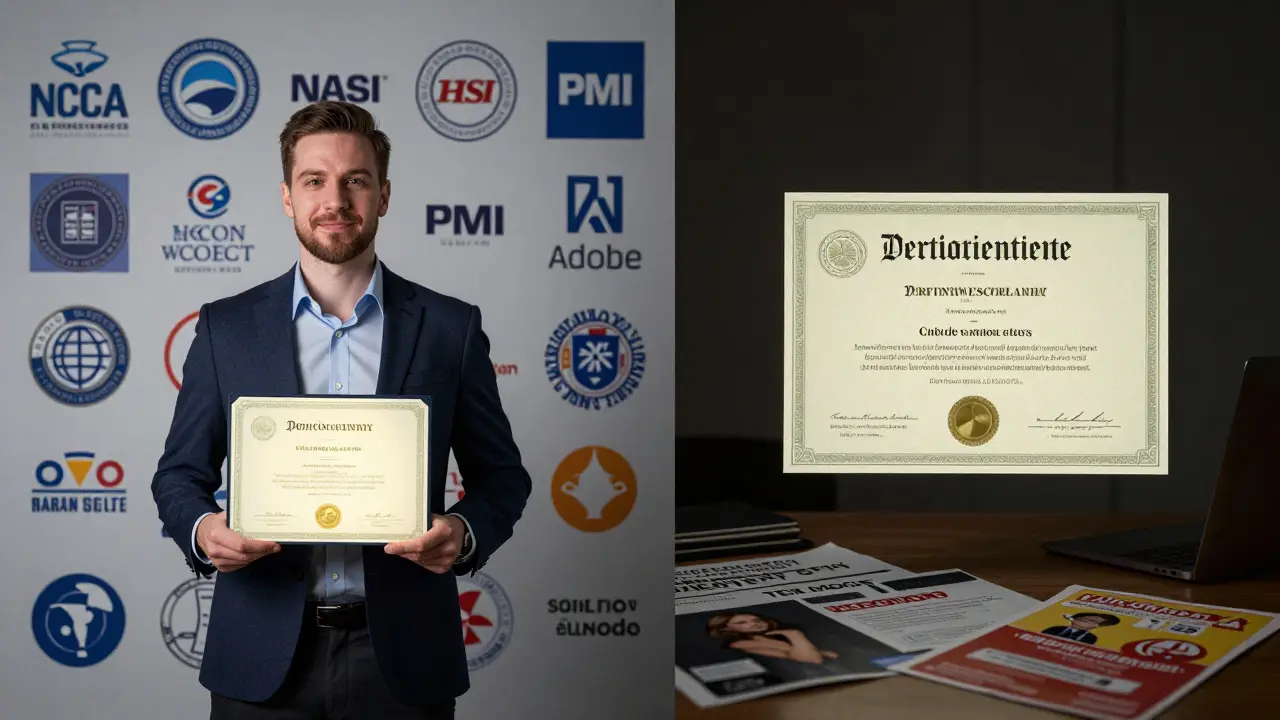
Getting certified through a professional association isn’t just about adding a letter after your name. It’s about proving you meet real, measurable standards that employers and clients actually care about. But here’s the problem: not all certifications are created equal. Some are respected. Others? They’re just expensive pieces of paper. So how do you know which ones to chase?
What Makes a Certification Worth Your Time?
A certification that actually moves the needle has three things: clear standards, independent validation, and industry buy-in. It’s not enough for an organization to say, "We offer a certification." You need to see the actual criteria. What skills must you demonstrate? What exams must you pass? What continuing education is required to keep it active?
Take the Project Management Professional (PMP) from PMI. You can’t just sign up. You need 35 hours of formal education, 36 months of project leadership experience (or 60 months without a bachelor’s), and you must pass a 180-question exam based on a publicly available exam content outline. That’s a standard. That’s accountability.
Compare that to a certification from a company that sells training courses. They hand out certificates after a two-hour webinar. No exam. No experience check. No renewal requirement. That’s not a credential-it’s a marketing tool.
Check the Governing Body Behind the Certification
Who’s behind the certification matters more than the name on the certificate. Look for associations that are:
- Non-profit and mission-driven, not profit-driven
- Transparent about their governance structure
- Affiliated with national or international standards bodies
- Recognized by government agencies or major employers in your field
In healthcare, for example, the American Nurses Credentialing Center (a subsidiary of the American Nurses Association that sets national standards for nurse certification) is the gold standard. Nurses who hold ANCC certifications are trusted across hospitals and clinics because the standards are rigorous and reviewed annually by subject matter experts.
Meanwhile, some for-profit companies offer "certified wellness coach" credentials with no clinical oversight, no peer review, and no legal standing. They might look good on LinkedIn, but they won’t get you hired in a hospital or insurance setting.
Look for Accreditation from Recognized Bodies
Professional certifications should be accredited. Not by themselves, but by independent third parties. In the U.S., the National Commission for Certifying Agencies (NCCA) (the accrediting body for certifications in health, human services, and other regulated professions) and the American National Standards Institute (ANSI) (the official U.S. representative to the International Organization for Standardization) are the benchmarks. If a certification is NCCA- or ANSI-accredited, it means it went through a rigorous review process for validity, reliability, and fairness.
Outside the U.S., look for equivalents like the Australian Skills Quality Authority (ASQA) (the national regulator for vocational education and training providers) or the UK Register of Learning Providers (UKRLP) (the official government database for approved education and training providers). If your certification isn’t tied to one of these, ask why.

Ask: Who Recognizes This Certification?
Don’t take the association’s word for it. Go to the source. Look at job postings in your field. Do employers list this certification as preferred or required? Check LinkedIn. Search for people with the credential and see where they work. Are they in roles you want?
In cybersecurity, the Certified Information Systems Security Professional (CISSP) (a globally recognized certification for security leaders managed by (ISC)²) appears in over 80% of senior security job postings in New Zealand and Australia. That’s not an accident. It’s because the exam covers real-world domains like risk management, security architecture, and compliance-standards that align with the ISO/IEC 27001 framework.
On the other hand, a certification like "Certified Digital Marketing Guru" might show up in a few startup job ads, but you won’t find it in any Fortune 500 company’s HR system. That’s a red flag.
Don’t Ignore Renewal Requirements
A certification that never expires is usually a sign it doesn’t matter. The best certifications require ongoing learning. Why? Because your field changes. Regulations update. Tools evolve. Standards must keep up.
The Certified Public Accountant (CPA) (a license granted by state boards in the U.S. and equivalent bodies in other countries, requiring continuing education to maintain) requires 40 hours of continuing professional education every year in most states. The Project Management Professional (PMP) (a certification from the Project Management Institute requiring 60 PDUs every three years) requires 60 professional development units every three years. That’s not a penalty-it’s a guarantee that the person holding it is still sharp.
If a certification says "lifetime," dig deeper. Is it because it’s outdated? Or because the organization doesn’t want to invest in maintaining standards? Either way, it’s a warning.
What to Do Before You Pay
Before you spend $1,000 or more on a certification, run this checklist:
- Find the official certification standards document-published and publicly accessible.
- Check if it’s accredited by NCCA, ANSI, ASQA, or another recognized body.
- Search job boards for the credential. Is it listed in 5+ real postings in your region?
- Look up the association’s website. Is it a nonprofit? Does it have a board of directors with industry names?
- Call or email someone who holds the certification. Ask: "Did it help you get hired or promoted?"
If even one of these checks fails, walk away. You’re better off investing in a targeted course or a mentorship than wasting money on a credential that won’t open doors.
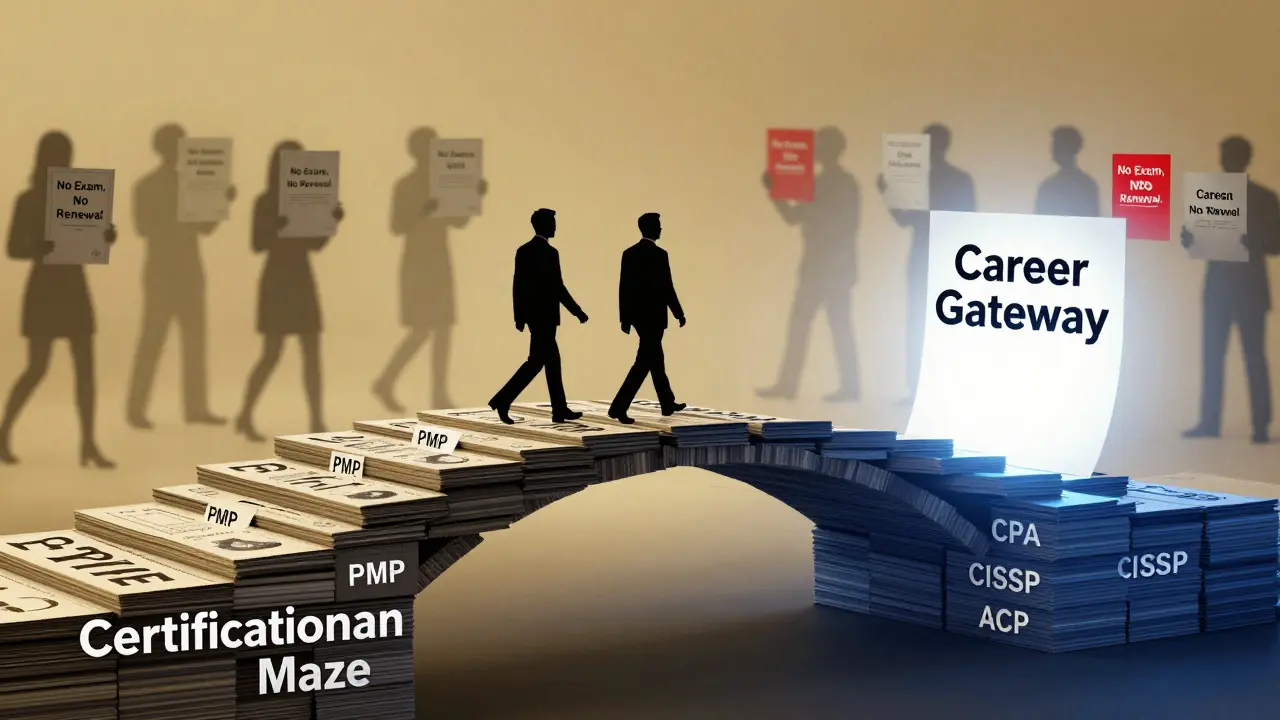
Real-World Example: Why One Certification Worked, Another Didn’t
A graphic designer in Wellington spent $1,200 on a "Certified Brand Identity Specialist" certification from a private training company. Six months later, she still wasn’t getting more clients. She checked LinkedIn-only 12 people in New Zealand had it. None worked at agencies. No employers mentioned it in job posts.
She switched to the Adobe Certified Professional (ACP) (a vendor-neutral certification validating skills in Adobe Creative Cloud tools, recognized globally by design firms). It cost $150. She studied for two weeks. Passed the exam. Within three months, three agencies asked if she was ACP-certified. One hired her on the spot.
Why? Because Adobe tools are the industry standard. The certification is backed by a global company with transparent exam blueprints. It’s not about prestige-it’s about relevance.
Bottom Line: Align With Standards, Not Symbols
Professional certifications aren’t trophies. They’re signals. They tell employers you’ve met a known, measurable threshold. The best ones are tied to real skills, verified by third parties, and required by the market.
Don’t chase the flashiest name. Chase the one that’s listed in job ads, backed by a nonprofit, and requires you to prove you know your stuff. That’s the kind of credential that builds your career-not just your resume.
How do I know if a professional certification is legitimate?
Look for three things: a publicly available standards document, accreditation from a recognized body like NCCA or ANSI, and evidence that employers actually require or prefer it in job postings. If the certification is only promoted by the training provider and not mentioned by industry leaders, it’s likely not credible.
Are all professional associations trustworthy?
No. Some are decades-old, nonprofit organizations with strict standards. Others are for-profit businesses selling certificates as a product. Check if the association is registered as a nonprofit, has a transparent governance structure, and is affiliated with national or international standards bodies. Avoid associations that don’t list their board members or funding sources.
Is it worth getting certified if my field doesn’t require it?
Only if the certification is widely recognized and adds demonstrable value. For example, in digital marketing, a Google Analytics certification can help you stand out-even if it’s not required-because it proves you can use a tool that 90% of businesses rely on. But if no one in your industry mentions it, it’s just noise.
What’s the difference between a certification and a license?
A license is legally required to practice a profession-like a medical license or teaching license. A certification is voluntary and issued by a professional association. Licenses are granted by government agencies. Certifications are granted by industry groups. One is mandatory. The other is optional-but the best ones are still highly valued.
Can I get a certification online, or do I need to attend in person?
Many reputable certifications are fully online, including PMP, CISSP, and Adobe Certified Professional. What matters isn’t how you study, but how you’re tested. If the exam is proctored, based on published standards, and requires demonstrated competence-not just attendance-you’re fine. Avoid any certification that gives you a certificate just for watching videos.
How often should I renew my certification?
The best certifications require renewal every 1-3 years through continuing education, exams, or work experience. If a certification never expires, it’s likely outdated or not taken seriously by employers. Renewal ensures you stay current with industry changes and maintains the credential’s value.
What if my professional association doesn’t have accreditation?
It’s not automatically invalid, but you need to dig deeper. Ask: Who created the standards? Are they industry experts? Is the exam validated by third-party psychometricians? Are major employers in your field accepting it? If the answer is no to any of these, the certification may not be worth the investment.
What to Do Next
Start by listing the top three certifications mentioned in job ads for your dream role. Then, visit each association’s website and download their certification handbook. Read the eligibility requirements. Check for accreditation. Look at the exam outline. Compare them side by side.
Then talk to someone who holds each one. Ask them: "What did you have to do to get it? Did it change your career? Would you do it again?"
The right certification doesn’t just look good on paper. It changes how people see you-and how you see yourself. Choose wisely.
Comments
deepak srinivasa
Been through this with my IT certs. Got one from a shady online school that cost me 20k rupees. Zero employers asked about it. Then I got CompTIA Security+ - suddenly recruiters started replying. Real standards matter. Not just the logo on the certificate.
Shivani Vaidya
My sister spent six months preparing for PMP. She failed twice. Third time, passed. Now she leads global projects. The exam is brutal. That’s why it means something. Easy certs? They’re just for your ego.
Raji viji
Let’s be real - most of these certifications are corporate snake oil. PMP? Sure. But half the NCCA-accredited ones are just rebranded bootcamps with a fancy PDF. I’ve seen people pay $3000 for a "Certified Agile Transformation Guru" that no one outside the vendor has heard of. Wake up.
Rajat Patil
I read this carefully. It made me think. I was considering a wellness coach cert. Now I won’t. If no hospital or insurance company takes it seriously, why waste time? Simple truth.
Rubina Jadhav
I got my Adobe Certified Professional last year. Cost me 1500 rupees. Took me 10 days. Got a job offer in 2 weeks. No drama. Just skills. This post nailed it.
sumraa hussain
Bro… I got a "Certified Digital Marketing Mastermind" from some guy in Florida who runs a YouTube channel. Got a PDF. Got a badge. Got zero job calls. Now I laugh every time I see it in my folder. Lesson learned the hard way.
NIKHIL TRIPATHI
I work in HR. We get 200 applications a week. If someone has PMP or CISSP? We look. If they have "Certified Leadership Ninja"? We skip. Not because we’re mean - because the market has already decided what’s real. Don’t fight the signal.
Also, renewal matters. We once hired someone with a "lifetime" project management cert. Turned out they hadn’t updated their knowledge since 2012. Disaster.
Rajashree Iyer
Certifications are modern-day talismans - we attach meaning to objects because we fear the void of true competence. The real question isn’t whether the cert is accredited… it’s whether the soul behind it has grown. But no one asks that, do they? We just want the shiny badge to prove we’re worthy.
Parth Haz
My advice? Don’t chase certs for the sake of it. Chase skills. If a certification helps you learn something valuable - go for it. But if it’s just a transaction? Save your money. Invest in a mentor or a course that teaches you how to solve real problems.
Vishal Bharadwaj
Wait… you’re telling me NCCA accreditation matters? LOL. That’s just another bureaucracy. I’ve seen NCCA-certified exams that were easier than a high school quiz. And ANSI? Please. Most of their reviewers are retired consultants with zero skin in the game. This whole system is a scam dressed in suits.
anoushka singh
Okay but what about people who don’t have time to study for 6-month prep? Like single moms or night shift workers? Are they just not allowed to grow? Maybe the system is broken, not the people.
Jitendra Singh
I used to think certs were useless. Then I got my Google Data Analytics cert. Got my first job in analytics. Didn’t have a degree. Just the cert and a portfolio. Sometimes the door opens with a key you didn’t know existed.
Rohit Sen
PMP? Overrated. CISSP? Overpriced. The only cert that matters is the one you earn by shipping real work. No exam. No fee. Just results.
pk Pk
For anyone starting out - don’t get discouraged if you can’t afford the big certs. Start small. Google Certificates. Microsoft Learn. FreeCodeCamp. Build something. Share it. Then go for the big ones. The journey matters more than the badge. I’ve mentored 3 people this year who went from zero to hired - none had PMP. All had portfolios.
Vimal Kumar
My cousin in Delhi got a "Certified AI Specialist" from a local institute. Paid 40k. No exam. Just attendance. Got fired after 3 months because he couldn’t run a basic Python script. Meanwhile, his friend got the AWS Certified Solutions Architect - studied for 3 months, passed, now makes 3x more. Same city. Same age. One chose signal. The other chose noise.
Don’t be the guy with the certificate that no one respects. Be the guy who actually knows how to do the thing.