

Think about the last time you tried to automate something tedious. Maybe it was renaming a hundred photos or scraping prices from three different websites. If you didn’t use Python, you probably did it by hand. That’s because Python isn’t just another coding language; it is the Swiss Army knife of modern computing. It powers Instagram’s backend, drives Tesla’s autopilot simulations, and runs the algorithms that decide what you see on Netflix. But here’s the catch: most people quit learning it within two weeks. Why? Because they treat it like a textbook subject instead of a tool for building things.
You don’t need a computer science degree to get started. You need a clear path. This guide cuts through the noise of thousands of Python programming courses to give you a roadmap that actually works. We’ll look at what makes a course good, how to pick one based on your goals, and exactly what skills you need to move from "Hello World" to getting paid.
Why Python Is Still The Best Starting Point
Let’s be real. There are newer languages. Rust is faster. Go is great for cloud infrastructure. JavaScript rules the browser. So why start with Python? Simplicity wins every time for beginners. Compare a simple print statement in Java versus Python:
| Language | Code Required | Boilerplate |
|---|---|---|
| Java | public class Main { public static void main(String[] args) { System.out.println("Hello"); } } |
High (classes, methods, types) |
| Python | print("Hello") |
None |
This readability lowers the barrier to entry. You spend less time fighting syntax errors and more time solving logic problems. According to Stack Overflow’s Developer Survey, Python consistently ranks as the second most popular programming language globally, trailing only JavaScript. But unlike JavaScript, which requires understanding the DOM and browser quirks immediately, Python lets you focus on core concepts like loops, functions, and data structures first.
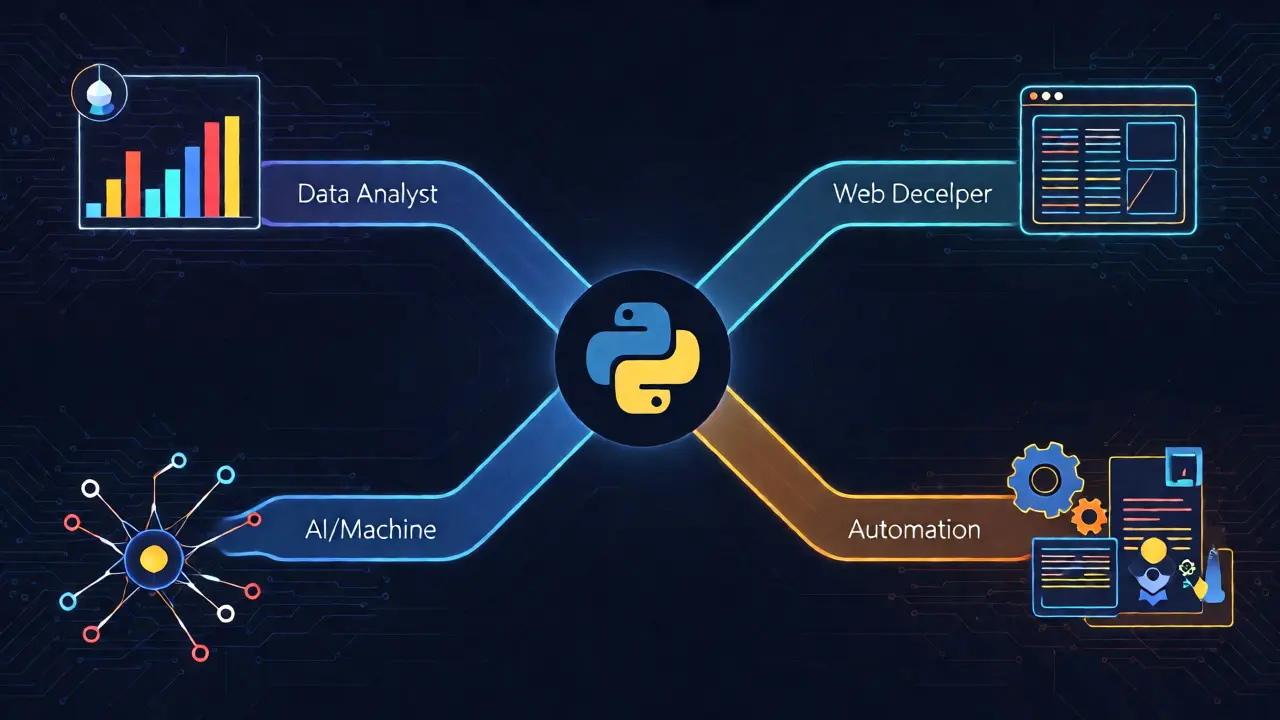
If you’re looking to break into tech, Python offers the widest range of entry-level roles. Data analysts use it to clean spreadsheets. Web developers use it to build backends. Machine learning engineers use it to train models. One skill set, multiple career doors.
Defining Your Goal Before You Buy A Course
Here is where most learners fail. They buy a generic "Learn Python" course without knowing what they want to do with it. A course designed for data analysis looks very different from one designed for web development. Before you spend a dollar, ask yourself: What problem am I trying to solve?
- The Automator: You want to save time on office tasks. Look for courses focusing on scripting, file handling, and libraries like Pandas.
- The Data Aspirant: You want to analyze trends. Focus on NumPy, Pandas, Matplotlib, and basic statistics.
- The Builder: You want to make apps. Look for frameworks like Django or Flask.
- The AI Curious: You want to understand machine learning. Prioritize linear algebra basics and libraries like Scikit-Learn.
Don’t try to learn everything at once. Pick one lane. Trying to master web development and data science simultaneously is a recipe for burnout. Once you’re comfortable in one area, switching to another is easy because the core language remains the same.
Anatomy Of A Great Python Course
Not all courses are created equal. Some are outdated, teaching Python 2 when Python 3 has been the standard since 2020. Others are too theoretical, drowning you in memory management details before you’ve written ten lines of code. Here is what separates the winners from the losers.
Project-Based Learning is Non-Negotiable. Watching videos feels productive, but it’s passive. Real learning happens when you hit an error and have to fix it. Good courses force you to build projects early. By week two, you should be building a simple calculator or a number guessing game. By month one, you should be scraping a website or analyzing a CSV file.
Community Support Matters. Coding is frustrating. When you’re stuck on a bug at 11 PM, having access to a forum, Discord server, or instructor feedback can save you hours. Self-paced platforms like Udemy often lack this, while bootcamps include mentorship. Decide how much support you need based on your personality. Are you stubborn enough to debug alone, or do you need a nudge?
Check The Syllabus For Modern Tools. Ensure the course covers:
- Virtual environments (
venv) - Package management (
pip) - Version control (
Gitand GitHub) - Basic testing (
pytest)
If a course skips Git, run away. Employers won’t care how well you know Python if you can’t collaborate on a team project.
Top Platforms Compared: Where To Learn
You have options ranging from free YouTube tutorials to $15,000 bootcamps. Which one fits your budget and schedule? Let’s break down the major players.
| Platform | Cost Model | Best For | Key Feature |
|---|---|---|---|
| Coursera | Subscription ($49/mo) or Free Audit | University-backed theory & credentials | Peer-graded assignments from top universities |
| Udemy | One-time purchase ($10-$20) | Specific topics & quick fixes | Huge variety, lifetime access |
| DataCamp | Subscription ($25/mo) | Data Science & Analytics | In-browser coding exercises, no setup required |
| freeCodeCamp | Free | Self-motivated learners | Comprehensive curriculum with certifications |
| Bootcamps (e.g., General Assembly) | $10k - $16k upfront | Career switchers needing job placement | Intensive, immersive, networking |
For most people starting out, Udemy offers the best value. You can find highly-rated courses by instructors like Jose Portilla or Angela Yu for under $20 during sales. These courses are comprehensive and updated regularly. If you prefer structure and academic rigor, Coursera’s "Python for Everybody" specialization by Dr. Charles Severance is legendary for a reason. It breaks down complex ideas into digestible chunks.
Do not underestimate free resources. The official Python documentation is excellent, though dry. Combine it with interactive sites like HackerRank or LeetCode to practice algorithmic thinking. Free doesn’t mean low quality; it means high effort.
The Learning Roadmap: From Zero to Job-Ready
How long does it take? If you study 10 hours a week, expect to feel competent in 3-6 months. Here is a realistic timeline.
Month 1: Syntax and Basics
Focus on variables, data types (strings, integers, lists, dictionaries), control flow (if/else, loops), and functions. Do not worry about object-oriented programming yet. Build small scripts: a tip calculator, a unit converter, or a text-based adventure game.
Month 2: Intermediate Concepts
Now tackle Object-Oriented Programming (OOP). Understand classes, inheritance, and encapsulation. Learn how to read and write files. Start using external libraries. Install packages via pip. Try automating a simple Excel task using openpyxl.
Month 3: Specialization Track
Pick your lane.
- Web: Learn HTML/CSS basics, then dive into Flask. Build a personal blog engine.
- Data: Master Pandas. Clean messy datasets. Visualize data with Seaborn. Answer questions like "Which product sold the most in Q3?"
Month 4+: Portfolio Building
Stop taking courses. Start building. Create a GitHub profile. Upload your projects. Write README files explaining what the code does. This is your new resume. Employers hire based on what you can show, not what certificates you hold.

Common Pitfalls And How To Avoid Them
Tutorial Hell. This is the state of endlessly watching tutorials without writing original code. You feel like you’re learning, but you can’t build anything from scratch. Break the cycle by pausing the video after each concept and trying to implement it differently. Change variable names. Add features. Break it intentionally.
Ignoring Debugging Skills. Beginners fear red error messages. Experienced devs love them because they tell you exactly what went wrong. Learn to read tracebacks. Use print statements liberally. Eventually, learn to use a debugger in VS Code. Being able to diagnose your own bugs makes you independent.
Skipping Version Control. Many beginners work on their desktop folder until disaster strikes. Initialize a Git repository from day one. Commit your changes daily. Push to GitHub weekly. This habit saves your code and teaches you professional workflows.
Is Certification Worth It?
Short answer: No, not for entry-level jobs. Most hiring managers care about your portfolio and technical interview performance. Certificates from Coursera or edX prove you finished a course, but they don’t prove you can solve business problems. However, if you’re already employed and need to upskill for a promotion, a certificate might tick a box for HR. For career switchers, skip the paper. Spend that time building three solid projects instead.
That said, specialized certifications in niche areas like AWS Certified Developer - Associate (which uses Python heavily) can add weight to your resume later in your career. But for now, code speaks louder than credentials.
How many hours a week do I need to study Python?
Consistency beats intensity. Studying 1 hour every day is far better than cramming 7 hours on Sunday. Aim for at least 5-10 hours per week to maintain momentum. If you can do more, great, but avoid burnout. Small, daily wins keep the neural pathways active.
Do I need a powerful computer to learn Python?
No. Python is lightweight. Any laptop bought in the last five years will handle beginner and intermediate projects easily. Even a Chromebook running Linux can work for coding. You only need heavy hardware if you’re training large machine learning models, and even then, cloud services can handle the load.
Is Python harder than JavaScript?
Generally, yes, Python is considered easier to read and write due to its strict indentation and English-like syntax. JavaScript allows more flexibility but has confusing quirks (like 'this' context or type coercion). However, both languages have steep learning curves when you reach advanced topics. Start with whichever aligns with your immediate goal: web frontend (JS) or general automation/data (Python).
Can I get a job with just self-taught Python skills?
Absolutely. Many successful developers are self-taught. The key is demonstrating competence through a strong portfolio. Show projects that solve real-world problems. Contribute to open-source projects. Network on LinkedIn and local meetups. Degrees help, but skills pay the bills.
What is the difference between Python 2 and Python 3?
Python 2 reached end-of-life in 2020. Always learn Python 3. The syntax differences are minor (mostly print statements and integer division), but library support for Python 2 is dead. Using Python 2 today limits your access to modern tools and security updates.