

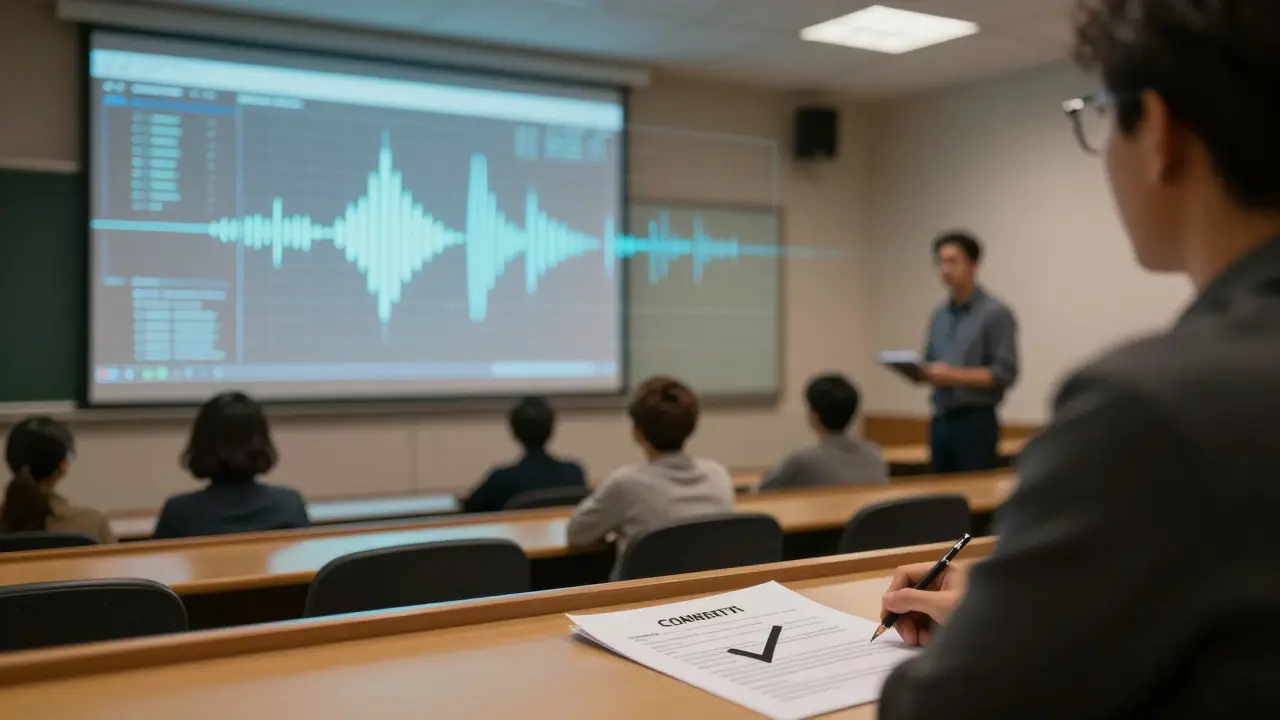
When you record student data in a course-whether it’s audio of class discussions, video of presentations, or even keystroke patterns in an online quiz-you’re handling sensitive personal information. It’s not just about keeping good records. It’s about following the law. And in many places, including New Zealand, the United States, and the EU, failing to get proper consent can lead to serious consequences: fines, lawsuits, or even losing your license to teach.
What counts as student data?
Student data isn’t just names and grades. It includes anything that can identify a student, directly or indirectly. That means:
- Audio or video recordings of students speaking or presenting
- Screen recordings of their online activity during assessments
- Log files showing login times, quiz attempts, or discussion board posts
- Biometric data like facial recognition used for attendance
- Even anonymized data can become identifiable if combined with other datasets
In New Zealand, under the Privacy Act 2020, this data is classified as personal information. In the U.S., the FERPA (Family Educational Rights and Privacy Act) applies to schools receiving federal funding. The EU’s GDPR treats student data as personal data, with strict rules around processing.
When do you need consent?
You don’t always need consent-but you almost always need to ask.
For example, if you’re recording a lecture and students are just listening quietly, you probably don’t need individual consent. But if the recording includes students speaking, asking questions, or sharing personal experiences, then yes-you need their permission.
Here’s a simple rule: If a student can be recognized in the recording, you need consent. That includes:
- Group discussions where voices are clearly audible
- Presentations where students show their faces or speak
- Online breakout rooms where students are recorded
- Any use of recordings beyond the original class purpose (like sharing on YouTube or in marketing materials)
Consent must be informed, specific, and voluntary. You can’t say, “By attending class, you agree.” That’s not enough. Students need to know:
- What is being recorded
- How it will be used
- Who will have access
- How long it will be kept
- How they can withdraw consent
How to get proper consent
Written consent is best. But in modern courses, digital consent works too. Here’s how to do it right:
- Use a clear consent form-no legalese. Say it plainly: “We will record your voice during group work. This will be used only for grading and class review. It will be deleted after 6 months.”
- Offer alternatives. If a student doesn’t consent, give them another way to participate. Maybe they can submit a written summary instead of speaking.
- Store consent records securely. Don’t just email it. Use a password-protected system. Keep it separate from academic records.
- Reconfirm consent every semester. People change their minds. Don’t assume last year’s permission still counts.
- Train your teaching assistants. They need to know the rules too. A TA recording a student without consent is still a violation.
What happens if you don’t follow the rules?
It’s not just about getting in trouble. It’s about trust.
In 2023, a university in New Zealand faced a formal complaint after recording student Zoom sessions without consent. The Privacy Commissioner ordered them to delete all recordings and issue a public apology. The department lost its funding for tech upgrades.
In the U.S., FERPA violations can trigger federal investigations. Schools have been fined hundreds of thousands of dollars for unauthorized recordings. And students? They’re filing lawsuits. One 2024 case in California resulted in a $1.2 million settlement after a professor uploaded student presentations to a public YouTube channel.
Even if you’re not fined, your reputation takes a hit. Students stop trusting you. They stop participating. And that kills learning.
Best practices for course design
Don’t wait for a problem to fix this. Build privacy into your course from day one.
- Record only what you need. If you don’t need to see a student’s face to grade their presentation, don’t record it.
- Use anonymous tools. For peer feedback, use text-based tools where names are hidden.
- Set automatic deletion. Use LMS settings to auto-delete recordings after finals week.
- Label recordings clearly. If you archive them, label them with course code, term, and deletion date.
- Include a privacy notice in your syllabus. Put it in bold. Make it impossible to miss.
Some institutions use a “privacy by design” checklist. Here’s a simple version:
| Step | Check | Tool/Method |
|---|---|---|
| 1 | Is recording necessary? | Only record if it directly supports learning outcomes |
| 2 | Did you get consent? | Written or digital form signed by each student |
| 3 | Can students opt out? | Alternative assignment available |
| 4 | Where is data stored? | Encrypted, access-controlled LMS or university server |
| 5 | When will it be deleted? | Auto-delete after 6-12 months |
| 6 | Who can access it? | Only instructors and graders-no third parties |
What about minors?
If you’re teaching high school students or under-18s in college programs, the rules get stricter.
In New Zealand, you need consent from a parent or guardian. In the U.S., FERPA gives parents rights until the student turns 18 or attends college. Even then, if the student is still claimed as a dependent on tax forms, parents may still have access.
Never assume a minor’s consent is enough. Always check your institution’s policy. Many schools require dual consent: from the student and the parent.
What if a student withdraws consent?
They have the right to do so-at any time. And you must act immediately.
If a student says, “I don’t want my voice on that recording,” you must:
- Remove their audio/video from any public or shared files
- Blunt or edit out their contribution if possible
- Not use their data for any future analysis
- Confirm in writing that their data has been deleted
Some LMS platforms let you tag student recordings. If consent is withdrawn, you can filter and delete them in bulk. That’s a lifesaver.
Where to find your local rules
Rules vary by country, state, and even institution. Here’s where to start:
- New Zealand: Office of the Privacy Commissioner-Privacy Act 2020 guidelines
- United States: U.S. Department of Education FERPA website
- EU: GDPR Article 6 and 9 on lawful processing of personal data
- Canada: PIPEDA (Personal Information Protection and Electronic Documents Act)
- Australia: Privacy Act 1988 and Australian Privacy Principles
Your institution’s legal office should also have a policy document. If they don’t, ask them to make one. It’s your right-and your responsibility.
Final thought: It’s not just legal-it’s ethical
Recording student data isn’t just about compliance. It’s about respect. Students share their ideas, their voices, their struggles. That’s a gift. You owe it to them to protect it.
When you get consent right, you create a classroom where students feel safe to speak up. Where they know their privacy matters. That’s not just good policy. It’s good teaching.
Do I need consent to record a lecture if students aren’t speaking?
No, if only the instructor is speaking and no students are visible or audible, consent isn’t required. But if students are present in the room and could be recorded-like in a small class or lecture hall with microphones-you should still notify them. Best practice is to announce at the start: “This session is being recorded for review. If you don’t want to be recorded, please let me know.”
Can I use student recordings for training new teachers?
Only if you have explicit, written consent for that specific use. General consent for “educational purposes” is too vague. You need to say: “We may use your recording to train future instructors.” And even then, you must remove any personally identifiable details-like names, faces, or unique stories-if the recording will be shared outside the course.
What if a student refuses consent but still wants to participate?
You must accommodate them. Denying participation because someone refuses consent is illegal. Offer alternatives: written assignments, private one-on-one presentations, or anonymous submissions. The goal is equal access-not punishment for privacy.
Are AI tools that analyze student voice or speech covered by these rules?
Yes. If an AI tool processes student speech-even to analyze engagement or emotion-it’s processing personal data. You need consent. And you must tell students what the AI does, how it works, and how long it keeps their data. Many AI vendors claim they’re “anonymous,” but if the input is a student’s voice, it’s not anonymous. It’s identifiable.
How long should I keep student recordings?
Keep them only as long as needed for educational purposes. Most institutions set a retention period of 6 to 12 months after the course ends. After that, they must be deleted. Some places require deletion within 30 days of request. Never keep recordings “just in case.” If you don’t have a clear reason to keep it, delete it.
Comments
ANAND BHUSHAN
Recording student data is one of those things people overlook until they get called out. I’ve seen professors record entire lectures and later share them online without thinking twice. The law isn’t just a suggestion-it’s a shield for students. If you’re not sure, don’t record. Simple as that.
Indi s
I teach at a small college and we started using consent forms last year. It changed everything. Students felt respected. One kid even said he didn’t know he had a right to say no. That hit me hard. Now we include the form in the syllabus, read it aloud, and give a printed copy. It’s not a burden-it’s part of teaching well.
Rohit Sen
Let’s be real-most students don’t care. They’re too busy scrolling to read a consent form. Why not just record everything and blur faces later? It’s easier than chasing signatures. The real issue isn’t consent-it’s overregulation.
Vimal Kumar
Agree with Indi. The consent form isn’t paperwork-it’s a conversation starter. I’ve had students ask why we’re recording, and that led to a 10-minute talk about digital ethics. Those moments matter more than any grade. And yes, we offer alternatives. One student wrote a 10-page reflection instead of speaking. Got an A+.
Amit Umarani
"Consent must be informed, specific, and voluntary." Where did this come from? GDPR? FERPA? You’re mixing legal frameworks like a bad cocktail. Also, "delete after 6 months"-why not 12? Or 3? Arbitrary numbers don’t make policy. Fix the grammar before you fix the policy.
Noel Dhiraj
Best part? When you build privacy into your course from day one. No drama. No panic. Just clear rules. I tell my students: "Your voice matters. So does your privacy." They respond better when they know you’re not just collecting data-you’re protecting it.
vidhi patel
It is imperative that institutions implement a standardized, legally auditable consent protocol. The use of the term "digital consent" is insufficiently defined under statutory frameworks. Furthermore, the suggestion to "label recordings with course code and deletion date" constitutes a dangerous precedent, as it implies a de facto retention schedule, which may violate Article 5(1)(e) of GDPR. Recommend immediate revision.
Priti Yadav
Wait. You’re telling me they’re recording my students’ voices and no one’s asking if it’s going to be sold to advertisers? Or used by AI training bots? I’ve seen what happens when data leaks. This isn’t about consent-it’s about control. And if your university doesn’t have a full data audit, you’re already compromised. Check your LMS. Now.