

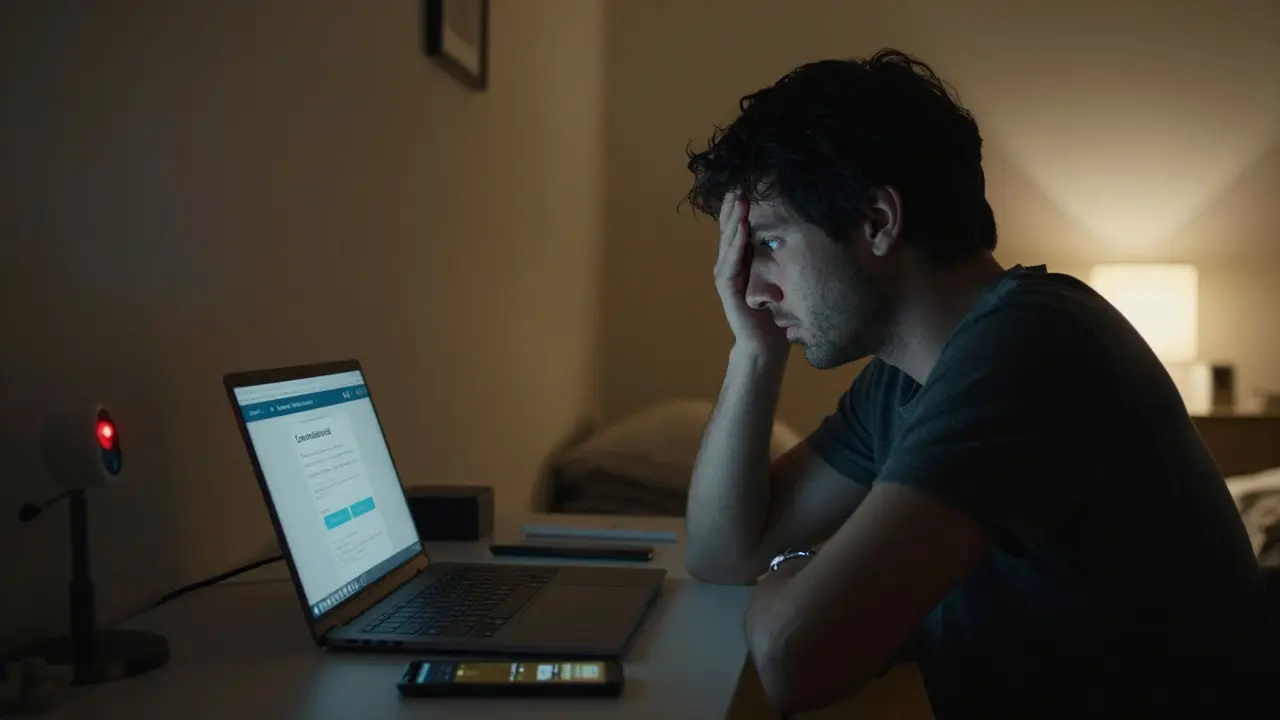
When you’re preparing for a professional certification-whether it’s for IT, nursing, accounting, or project management-you face a choice: take the test at a physical test center or from your living room. Both options promise the same credential, but they work very differently. And the difference isn’t just about convenience. It’s about trust, control, and what really happens behind the screen or behind the desk.
Remote Proctoring: The Convenience Factor
Remote proctoring lets you take your exam from anywhere with a stable internet connection. No commute. No waiting in line. No need to book weeks in advance. You log in, show your ID, let the camera scan your room, and start. For many, this is the only realistic option-especially if you live in a rural area, work irregular hours, or have a disability that makes travel difficult.
Platforms like ProctorU, Examity, and Pearson VUE’s OnVUE use AI to watch your screen, track eye movement, and flag unusual behavior. Some systems even require you to show your desk, walls, and windows with your phone before starting. It sounds invasive, but for certification bodies, it’s about minimizing fraud. In 2024, Pearson reported a 62% drop in suspected cheating incidents after switching to AI-enhanced remote proctoring for their IT certifications.
But it’s not flawless. Internet drops can freeze your exam. Background noise-like a barking dog or a child walking in-can trigger false alarms. I’ve heard from nurses in New Zealand who had to retake their licensing exam because their neighbor’s drone flew over their house during the check-in. The system flagged it as a potential second person in the room. They were cleared after submitting video evidence, but lost two days and $150 in rescheduling fees.
Test Centers: The Controlled Environment
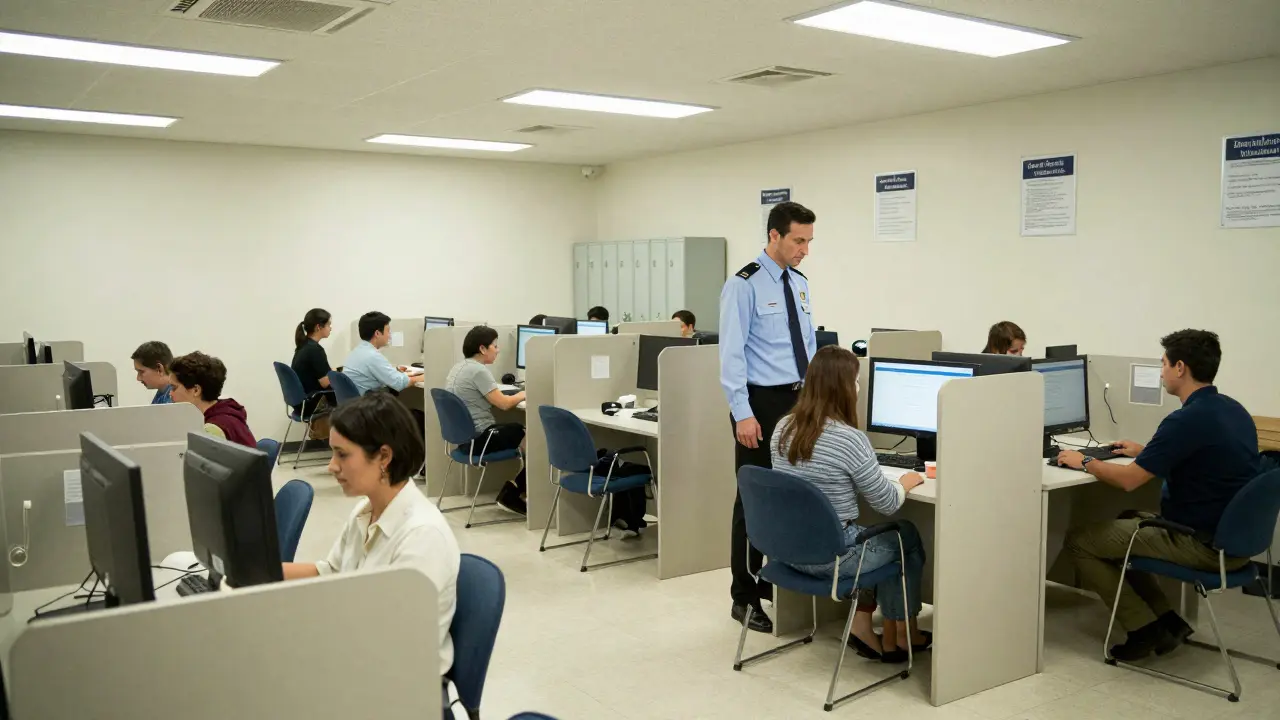
Test centers-like those run by Prometric or Pearson VUE-have been the gold standard for decades. You show up, hand over your ID, store your phone and wallet in a locker, sit at a sealed computer station, and take the exam under the watch of a live proctor. No distractions. No tech glitches from your home network. No risk of someone else entering the room.
The physical presence of a proctor adds a layer of deterrence. People don’t cheat when someone’s watching them in real time. In a 2023 study by the National Council of State Boards of Nursing, only 0.3% of candidates at test centers were flagged for misconduct, compared to 1.1% in remote settings.
But the cost of this control is high. You might need to drive an hour to the nearest center. If you’re in a small town, you might have to book your exam months ahead. Some centers charge extra for weekend slots. And if you’re sick the day before? Too bad-you lose your fee and have to wait weeks to rebook.
Security: What’s Really Being Protected?
Both systems aim to stop cheating. But they approach it differently. Remote proctoring relies on technology: screen recording, keystroke analysis, facial recognition, and behavior algorithms. Test centers rely on human oversight and physical barriers.
Here’s the catch: neither is perfect. Remote proctoring can misidentify normal behavior as cheating. Blinking too much? Flagged. Adjusting your glasses? Flagged. Taking a sip of water? Sometimes flagged. A 2024 report from the University of California found that 17% of remote proctoring alerts were false positives-meaning honest candidates were wrongly accused.
Test centers aren’t immune to fraud either. There have been cases of people using hidden earpieces, swapping test-takers, or bribing proctors. In 2023, a major certification body in the U.S. canceled 800 exam results after discovering a ring of candidates who had paid others to take their exams at test centers.
The real issue isn’t which method is more secure-it’s which method is more reliable for the type of exam you’re taking. High-stakes exams like medical licensing or CPA require near-perfect integrity. For those, test centers still win. For lower-risk certifications-like Google Cloud or CompTIA-it’s often fine to use remote proctoring.
Cost and Accessibility: Who Benefits?
Remote proctoring is cheaper for the exam provider. No need to rent space, pay staff, or maintain physical infrastructure. That savings usually gets passed to you: remote exams often cost $20-$50 less than in-person ones.
But cost isn’t just about money. It’s about access. In New Zealand, over 40% of certified professionals live outside major cities. For them, a test center might be 150 kilometers away. Remote proctoring levels the playing field. It’s not just fair-it’s necessary.
On the flip side, not everyone has a quiet room, a reliable computer, or high-speed internet. A 2025 survey by the Global Certification Alliance found that 28% of remote test-takers had to borrow a laptop or use public Wi-Fi just to sit their exam. That’s not convenience. That’s compromise.
What About the Human Element?
Some people feel more comfortable with a person in the room. They like the structure. The ritual. The sense that someone’s there to help if something goes wrong.
Test centers offer that. Proctors can answer basic questions like, “Where’s the restroom?” or “Can I get a whiteboard?” They can pause the exam if you have a medical issue. Remote proctoring doesn’t offer that. You’re on your own. If your screen freezes, you have to wait for a chat agent-sometimes 15 minutes-while the clock keeps ticking.
And let’s be honest: the stress of being watched by a camera all day is real. People report higher anxiety during remote exams. One nurse in Christchurch told me she cried during her remote nursing certification because she felt like she was being judged for every breath she took.

Choosing the Right Option for You
So how do you decide?
- Choose remote proctoring if: You’re tech-savvy, have a quiet space, reliable internet, and need flexibility. Good for IT, project management, or entry-level certifications.
- Choose a test center if: You’re taking a high-stakes exam (medical, legal, financial), prefer human interaction, or don’t trust your home environment. Essential for licensing exams with legal consequences.
Check your certification provider’s policy. Some require test centers for the first attempt and allow remote for retakes. Others ban remote entirely for certain credentials.
And if you’re unsure? Do a dry run. Most remote proctoring services offer a free system check. Use it. Test your microphone, camera, and internet speed. Make sure your room is clear. Practice showing your ID and scanning your space. It’s not just preparation-it’s damage control.
What’s Next for Certification Exams?
The future isn’t remote vs. centers. It’s hybrid. Some providers are testing “on-demand centers”-small, local kiosks with live proctors, open during evenings and weekends. Others are adding blockchain-based credential verification to reduce fraud after the exam.
But for now, the choice remains yours. And it’s not just about what’s easier. It’s about what gives you the best shot at passing without the stress of being accused of cheating when you’re just nervous.
Is remote proctoring safe for my privacy?
Remote proctoring tools record your screen, audio, and video during the exam. They don’t access your personal files or history, but they do monitor your environment. Most providers delete recordings within 30 days unless fraud is suspected. Always read the privacy policy before agreeing. If you’re uncomfortable, choose a test center.
Can I use a laptop for remote proctoring?
Yes, most systems allow laptops, but you must disable Wi-Fi and Bluetooth if required. You’ll also need a built-in or external webcam and microphone. Some exams require a second device (like a smartphone) to scan your room. Check your provider’s system requirements before the exam day.
What happens if I get flagged during a remote exam?
Being flagged doesn’t mean you failed. It means the system detected something unusual-like a person entering the room or unusual eye movement. A human reviewer will watch the recording and decide if it was a false alarm. You’ll usually get an email within 2-5 business days. If you’re cleared, your score stands. If not, you may be banned from retaking the exam for a period.
Are test centers more expensive?
Usually, yes. Test center exams often cost $20-$50 more than remote ones because of overhead. Some centers also charge extra for weekend or after-hours slots. But if you’re taking a high-stakes exam, the extra cost may be worth the peace of mind.
Can I take a remote exam if I live outside the country?
Yes, as long as the certification provider allows it and your internet connection meets the technical requirements. Many global certifications (like PMP or AWS) support remote testing internationally. Just make sure your ID is valid, your room is quiet, and you’re not violating any local laws about screen recording.
Final Thoughts
The best method isn’t the one that’s cheaper or more convenient. It’s the one that lets you focus on the exam-not the fear of being watched, or the stress of getting there on time. Take time to evaluate your situation. Test your setup. Know your options. And remember: your certification is about your skill, not your location.
Comments
Rohit Sen
Remote proctoring is just corporate surveillance with a certification sticker. They don’t care if you pass-they care if you look innocent while doing it. I took my AWS exam in a park because my apartment had a mirror behind me. The system flagged it as ‘potential cheating device.’ I had to send a 12-minute video of my entire neighborhood to prove I wasn’t smuggling a cheat sheet in the neighbor’s cat.
Vimal Kumar
For folks in small towns or with disabilities, remote proctoring isn’t a luxury-it’s the only way in. I’m a diabetic nurse in rural Bihar and the nearest test center was 200km away. I took my exam at 3am after my shift, with my mom holding a flashlight to light up my desk. No proctor yelled at me. No one made me remove my prayer shawl. That’s dignity.
Amit Umarani
‘AI flags blinking’? That’s not a bug, it’s a feature. You’re not supposed to blink. You’re supposed to be a robot. Also, ‘test center proctors can answer questions’-no they can’t. They’re trained to say ‘I don’t know’ and stare at you like you’re a suspect. And ‘privacy’? They record your bathroom break. Read the TOS. It’s all in the fine print. You agreed to this.
Noel Dhiraj
If you’re stressing over whether to use remote or center just ask yourself this: do you want to be judged by a camera that thinks your yawn is fraud or a human who’s had 14 exams today and just wants to go home? I chose remote. My dog barked once. I laughed. The system flagged it. I got cleared. It was fine. Stop overthinking. You got this.
vidhi patel
It is imperative to note that the assertion regarding false positives in remote proctoring systems is statistically insignificant and lacks peer-reviewed validation. Furthermore, the casual tone employed throughout this article undermines the gravitas of professional certification integrity. One does not casually discuss surveillance protocols as if they were a Netflix documentary. The integrity of credentialing is not a matter of convenience-it is a solemn covenant.
Priti Yadav
They’re using your webcam to train facial recognition for the police. I read a leak from ProctorU’s parent company-they’re selling anonymized behavioral data to a private security firm. That ‘AI detects cheating’? Nah. It’s building a database of how people react under stress. Next thing you know, your certification gets flagged because you sighed too hard during the exam. They’re not protecting the credential-they’re profiling you.
Ajit Kumar
Let us not overlook the fundamental flaw in the entire remote proctoring paradigm: the assumption that a static, two-dimensional video feed can accurately interpret the nuanced, dynamic behavior of a human being under pressure. The algorithmic model, trained on biased datasets derived predominantly from Western, urban, neurotypical subjects, systematically misclassifies culturally normative behaviors-such as averted gaze in South Asian cultures, or the natural adjustment of corrective eyewear-as indicators of malfeasance. Furthermore, the invocation of ‘false positives’ as a mere statistical footnote is a gross disservice to the psychological trauma inflicted upon candidates who are subjected to the humiliation of being accused of dishonesty without recourse. The institutional reliance on such technology is not merely flawed-it is ethically indefensible, and the certification bodies that endorse it are complicit in the erosion of academic integrity under the guise of efficiency.
Diwakar Pandey
I took both. Remote for CompTIA, center for PMP. Remote was easier logistically but way more stressful. Center felt like a quiet library with a person who nodded if you looked up. No weird AI alerts. No ‘why is your cat in frame?’ emails. If you’re nervous, go center. If you’re tech-savvy and have a quiet room, remote works. But honestly? Just do the system check. It’s free. And if your internet drops? Don’t panic. It’s just a test. Not the end of the world.