


Most business courses teach you how to run a company. But few teach you how to build the course itself. If you're designing a strategic planning and business analysis course, you're not just organizing topics-you're shaping how future leaders think, decide, and act. This isn't about slides and syllabi. It's about creating a learning experience that turns theory into real-world muscle.
Start with the problem, not the textbook
Too many courses begin with a list of frameworks: SWOT, Porter’s Five Forces, PESTEL. But if you start there, you’re teaching memorization, not thinking. Real strategic planning doesn’t happen in a textbook. It happens when a regional manager realizes their supply chain is crumbling because they ignored geopolitical risk. It happens when a startup’s CFO spots a hidden cost in their SaaS pricing model that’s bleeding cash.
So instead of opening with definitions, open with a case. Use real data. Show how a New Zealand dairy cooperative lost 18% of its export revenue in 2023 because their strategy didn’t account for China’s import quota shifts. Then ask: Where did they miss the signal? Let students wrestle with that before you name a single model.
Build the course around decisions, not disciplines
Business analysis isn’t about gathering data. It’s about answering urgent questions under pressure. Your course should be organized around decision points:
- Should we enter a new market? (Market analysis)
- Is our pricing model sustainable? (Financial modeling)
- Are our customers leaving because of product flaws or poor service? (Root cause analysis)
- Can we afford to pivot without killing cash flow? (Scenario planning)
Each unit becomes a decision simulation. Students don’t read about SWOT-they use it to evaluate whether a local Auckland tech startup should expand to Australia. They don’t memorize KPIs-they build a dashboard that tracks churn for a subscription service.
Use tools like Excel, Tableau, or Google Data Studio. But don’t teach the tools first. Teach the why behind the numbers. A student who can explain why a 12% drop in customer retention matters more than a 5% rise in revenue is already thinking like a strategist.
Require real data, not hypotheticals
Hypothetical case studies are safe. They’re also useless. Students know they’re playing pretend. Real strategic planning happens with messy, incomplete, contradictory data.
Partner with local businesses. A small Auckland-based export firm might share anonymized sales data from the last 18 months. A nonprofit might let students analyze donor retention patterns. A mid-sized manufacturer might open their production cost logs. You’re not asking for confidential secrets-you’re asking for the kind of data that’s public, raw, and messy.
One course in Wellington last year had students work with a regional tourism board. The data showed a 22% drop in international visitors from Japan, but no one had investigated why. The students found it wasn’t the pandemic-it was a new visa rule that delayed approvals by 60 days. The board changed its outreach strategy. That’s the kind of impact your course should aim for.
Teach the human side of analysis
Numbers don’t lie-but people do. And they lie to themselves all the time.
One of the most powerful modules in any business analysis course should be cognitive bias. Not as a lecture. As a game. Give students financial reports from a company that failed. Then ask them to pick out the red flags. Most will miss the obvious: confirmation bias. The CEO kept hiring consultants who only confirmed his belief that “growth was just around the corner.”
Use real examples. Show how Blockbuster’s leadership dismissed Netflix because “people still like going to the store.” Show how Kodak’s engineers invented the first digital camera in 1975 but buried it because they thought film was untouchable.
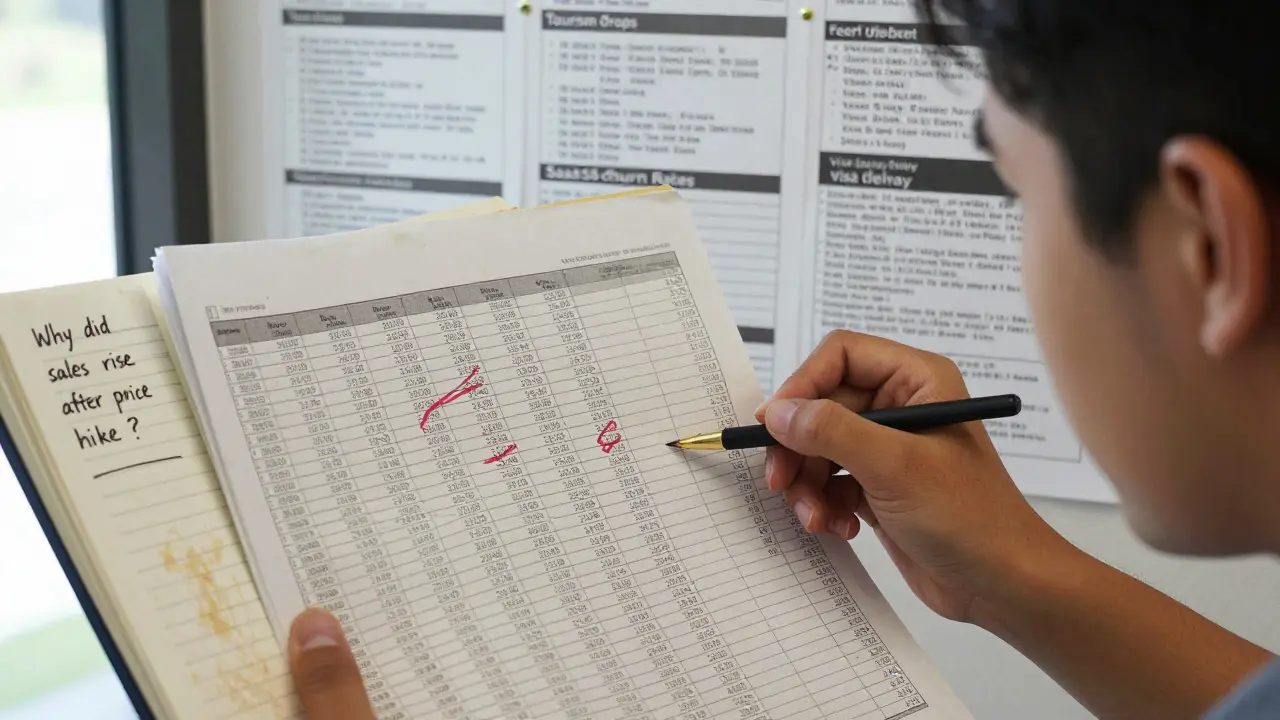
Then give students their own bias test. Have them analyze a dataset where the answer is counterintuitive. Did sales go up after the price hike? Why? Maybe it wasn’t the product-it was the perception. A $10 increase made customers think it was premium. That’s strategy. That’s analysis. That’s human.
Assess with projects, not exams
Final exams measure recall. Projects measure thinking.
Instead of a multiple-choice test, require a capstone: Design a strategic plan for a real organization using real data. The deliverable? A 10-minute presentation and a one-page executive summary. No slides. Just clarity. Can they explain why they chose one metric over another? Can they admit what they don’t know? Can they say, “We need more customer feedback here,” instead of pretending they have all the answers?
Grade based on process, not perfection. A team that finds a flawed assumption and admits it should get higher marks than a team that presents a polished but unrealistic plan.
Include failure reviews
Every great strategist learns from failure. So should your students.
Each term, pick one major business failure from the last two years. Not Enron. Not Lehman Brothers. Something recent. Something local. Maybe a New Zealand fintech that raised $3M but shut down because their user onboarding was too complex. Or a café chain that expanded too fast and lost its brand identity.
Break it down. What data did they ignore? What assumptions did they make? Who had the warning signs? What would you have done differently? Let students role-play the boardroom. Let them argue. Let them be wrong.
Connect analysis to action
Business analysis without action is just research. Strategic planning without execution is just a PowerPoint.
Build in a “next step” requirement. After every major project, students must propose one concrete action the organization should take. Not a suggestion. Not a recommendation. A specific, measurable, time-bound step. For example: “Implement a monthly customer feedback pulse survey using Typeform and track changes in NPS over 90 days.”
Then, if possible, follow up. Did the business do it? What happened? That feedback loop turns students from observers into participants.
What this course is not
This isn’t a finance course. You don’t need to teach discounted cash flow models in depth. Save that for the accounting track.
This isn’t a project management course. You’re not teaching Agile sprints or Gantt charts.
This isn’t a leadership seminar. You’re not talking about emotional intelligence or team dynamics.
This course is about making better decisions with data. It’s about asking the right questions. It’s about seeing patterns before they become crises. It’s about recognizing when the numbers are lying-and when they’re the only truth left.
Real tools, real stakes, real outcomes
The best strategic planning courses don’t just prepare students for jobs. They prepare them to lead. To question. To fix what’s broken before it’s too late.
If your course feels like a lecture hall with spreadsheets, you’re missing the point. If it feels like a war room with real data, real stakes, and real consequences-you’ve built something that lasts.
What’s the biggest mistake in designing a strategic planning course?
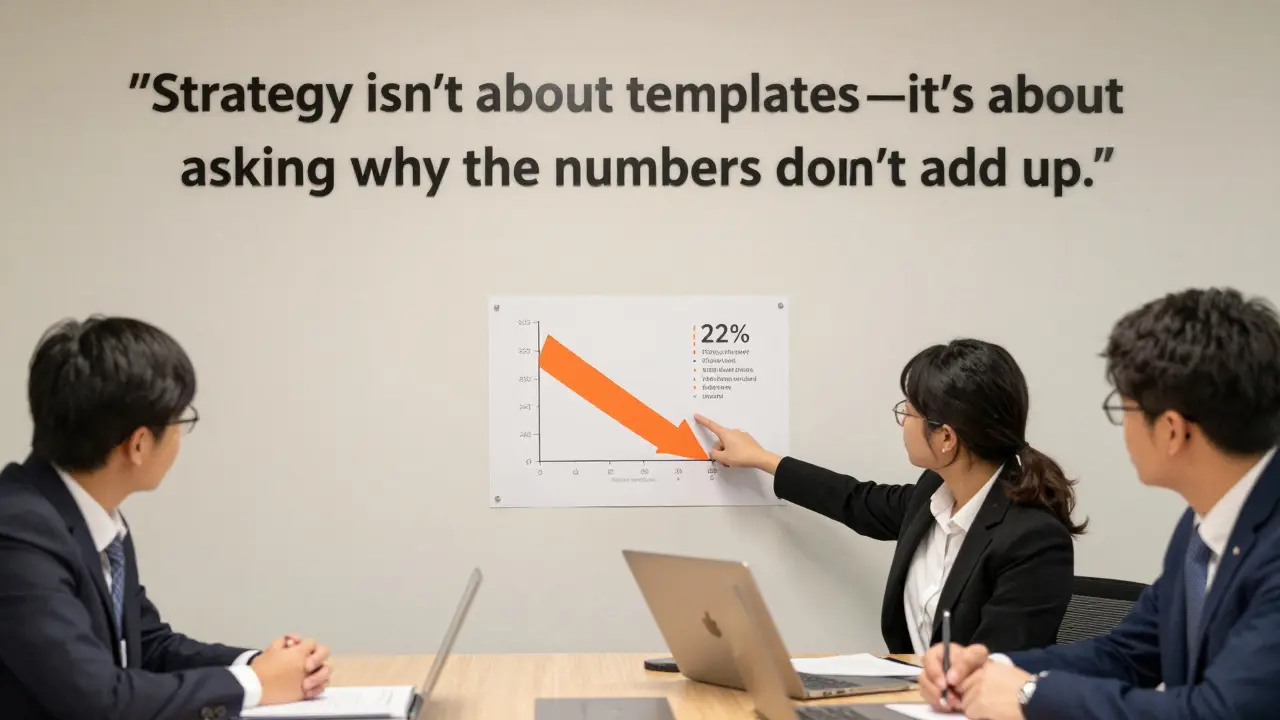
The biggest mistake is starting with frameworks instead of real problems. Students remember SWOT and Porter’s models, but they don’t learn how to use them when things are messy. Real strategy isn’t about applying a template-it’s about asking why the numbers don’t add up. Start with a broken business, then let the tools emerge from the need.
Should students learn Excel or specialized software like Tableau?
They need both, but not at the same time. Start with Excel-it’s universal. Teach pivot tables, VLOOKUP, and basic charts. Once they understand how data connects to decisions, introduce Tableau or Power BI. The goal isn’t to make them data scientists. It’s to make them fluent in asking, "What does this trend mean?" and "Why did this happen?"
How do you teach business analysis without a business background?
You don’t need a business degree to analyze a business. You need curiosity. Use simple analogies: "Think of customer churn like a leaky bucket. If you’re filling it faster than it’s leaking, you’re growing. If not, you’re losing ground." Focus on patterns, not jargon. A student who can explain why sales dropped after a pricing change-even if they’ve never worked in retail-has grasped the core of business analysis.
How often should course content be updated?
At least once a year. Business environments change faster than textbooks can be printed. If your case studies still use 2020 data, you’re teaching history, not strategy. Swap out two cases each term. Replace them with recent failures or turning points-like how a small retailer survived inflation by shifting to local suppliers in 2024. Freshness keeps students engaged and relevant.
Can this course be taught online?
Yes-but not like a recorded lecture. Online works when it’s interactive. Use breakout rooms for case debates. Require students to upload real data files and peer-review each other’s analysis. Use live dashboards where students can see how their decisions affect simulated outcomes. The medium doesn’t matter. The engagement does.
Comments
sonny dirgantara
this is solid. i just finished teaching a similar class and honestly? the part about real data over hypotheticals? game changer. my students were bored until we partnered with a local taco truck that was losing customers. turned out their app didn’t work on android 9. no one saw it coming. now they fix it. that’s learning.
Andrew Nashaat
Okay, I'm going to be that guy-but you said 'don't teach Excel first'? That's a catastrophic oversight. Excel is the lingua franca of business analysis. Pivot tables are the gateway drug to insight. If you skip teaching SUMIFS, VLOOKUP, and conditional formatting-you're not teaching analysis-you're teaching theater. And don't even get me started on Tableau. It's a black box for people who don't understand data relationships. Teach the math first. Always.
Gina Grub
Let’s be real-this whole framework is just corporate jargon repackaged as ‘innovation.’ Real strategic thinking doesn’t happen in a classroom. It happens in the backroom of a failing startup at 3 a.m. when the founder realizes their ‘data-driven’ decision was based on a single metric from a survey of 12 people. You can’t simulate chaos with case studies. You can only survive it. This course sounds like a TED Talk with a syllabus.
Lauren Saunders
I appreciate the sentiment, but you're romanticizing messiness. Real-world data isn’t ‘raw’-it’s contaminated, biased, and often legally restricted. Partnering with ‘local businesses’ sounds noble, but in practice, it’s a liability minefield. GDPR, HIPAA, NDAs-you’re not teaching strategy, you’re teaching litigation risk. And ‘grading process over perfection’? That’s just a euphemism for lowering standards. If they can’t produce a coherent, defensible plan, they don’t deserve to lead.
Nathan Jimerson
I really like how you're emphasizing action over theory. In my country, we have so many brilliant students who can analyze anything-but they never do anything with it. The ‘next step’ requirement? That’s the spark. One of my students convinced a local farmer to switch from bulk sales to direct-to-consumer boxes. Sales tripled. That’s the kind of ripple effect this course can create.
Sandy Pan
There’s a deeper truth here that’s being overlooked: analysis is not about finding answers. It’s about learning to live with uncertainty. The moment a student admits ‘I don’t know why this happened’-that’s when real growth begins. We’ve trained generations to treat data as scripture. But data is a mirror-it reflects our biases, our fears, our blind spots. The course isn’t about tools. It’s about humility. And that’s the hardest thing to teach.
Eric Etienne
Honestly? This feels like a professor trying to sound edgy. ‘Use real data’? Who’s gonna get that? Small businesses aren’t handing over their spreadsheets. And ‘grade process over perfection’? That’s just an excuse to pass flunkies. I’ve seen these courses. Half the students are just Googling ‘SWOT template’ and pasting in numbers. This isn’t innovation. It’s performance art.
Dylan Rodriquez
To the person who said Excel is the gateway-yes, but only if you teach it as a tool for questioning, not just calculation. I’ve seen students build perfect pivot tables and still miss the story. The real skill is asking: Why is this cluster of data behaving this way? Why does the outlier exist? That’s not in any textbook. And to the cynic who thinks this is performance art-this is how change happens. One student, one real business, one flawed assumption exposed at a time. It’s messy. It’s imperfect. And it’s the only way learning sticks.