

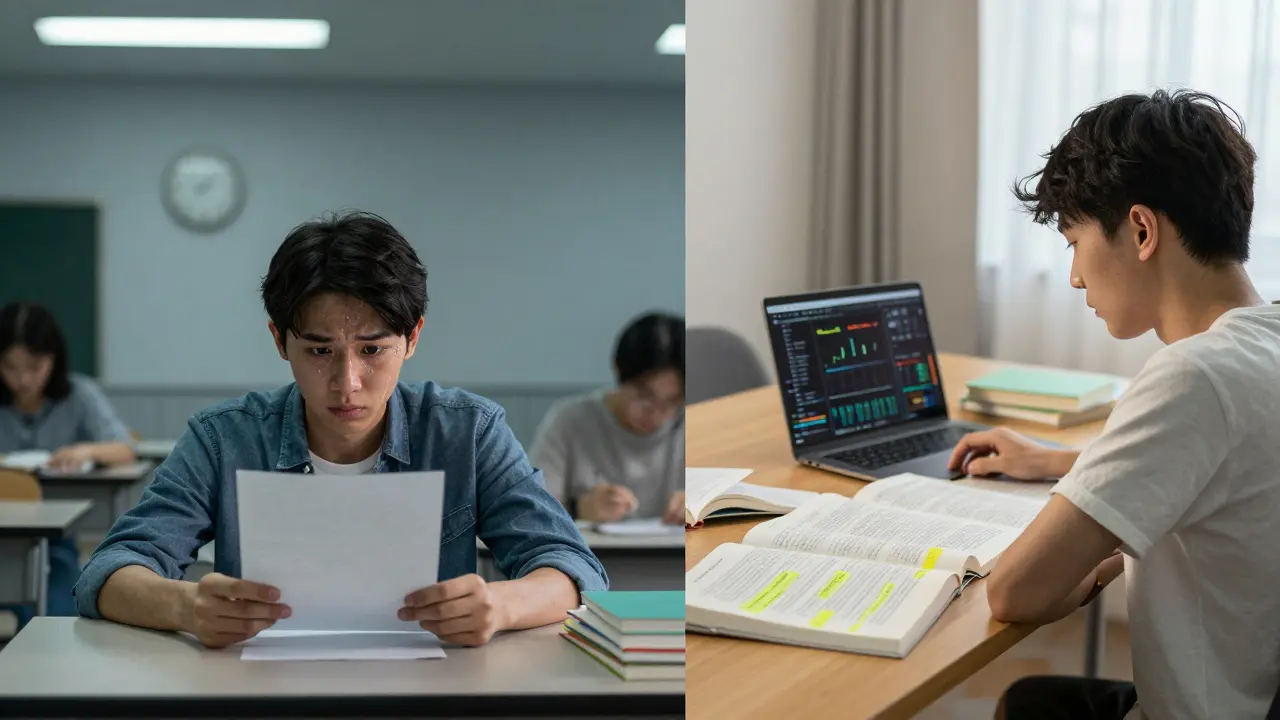
Picture this: It’s 2 PM on a Tuesday. The room is silent except for the scratch of pens and the hum of the projector. Students are sweating, eyes darting between questions they’ve memorized but don’t fully understand. Now picture another scene: A student sits at their desk, textbook open, laptop buzzing with tabs, synthesizing information from three different sources to solve a complex problem. Which one actually measures what you taught?
The debate between timed exams is traditional high-stakes testing conducted under strict time limits without external resources and open-book assessments is evaluation methods that allow students to use textbooks, notes, and other resources during testing isn't just about convenience. It’s about what we value in education. Do we want students who can recall facts under pressure, or do we want professionals who can find, analyze, and apply information in the real world? In 2026, where AI tools and instant information access are ubiquitous, the old guard of closed-book testing is facing its biggest challenge yet.
Why We Still Use Timed Exams (And Why It’s Fading)
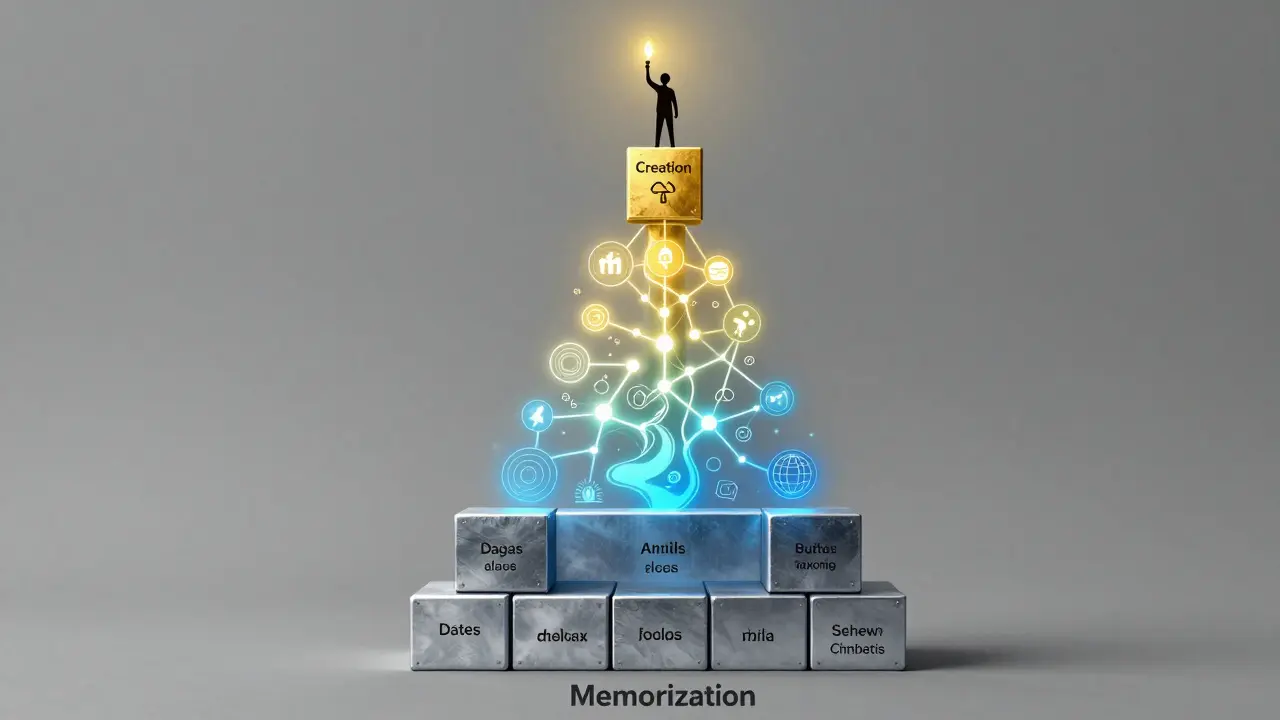
Timed exams have been the backbone of academic evaluation for over a century. The logic is simple: if you know it, you should be able to retrieve it quickly. This method tests rote memorization is the process of learning information through repetition to recall it verbatim and basic comprehension. For foundational knowledge-like multiplication tables, chemical formulas, or historical dates-this still has merit. You need those basics on autopilot before you can build complex structures upon them.
However, the flaw in timed exams is that they often measure test-taking anxiety more than actual understanding. Research from the American Psychological Association is a leading scientific and professional organization representing psychology in the United States consistently shows that high-stakes testing environments trigger cortisol spikes, which impair working memory. A brilliant student might freeze up, not because they lack knowledge, but because their brain is in survival mode. Furthermore, timed exams rarely reflect modern workplace scenarios. When was the last time a manager asked you to recite a policy from memory during a crisis? They asked you to look it up, interpret it, and apply it.
- Pros: Efficient grading, standardized comparison, discourages cheating (in theory), builds quick-recall skills.
- Cons: High stress, encourages cramming, poor predictor of long-term retention, doesn't test application skills.
The Rise of Open-Book Assessments
Open-book assessments flip the script. By allowing students to use their materials, you remove the barrier of memory and force them to demonstrate higher-order thinking skills. This aligns with Bloom's Taxonomy is a framework categorizing educational learning objectives into levels of complexity and specificity, specifically moving students from "remembering" to "analyzing" and "creating." If a student can find the answer in five seconds, why ask them to memorize it? Ask them to explain *why* that answer matters.
In 2026, open-book doesn't just mean having a PDF handy. It means navigating an ecosystem of information. Students must evaluate source credibility, synthesize conflicting data, and construct arguments supported by evidence. This mirrors the daily work of engineers, marketers, doctors, and policymakers. An open-book exam asks: "Here is a messy, real-world problem. How do you use available resources to solve it?"
But there’s a catch. Open-book exams require careful design. If the questions are too simple (e.g., "What is the definition of photosynthesis?"), students will just copy-paste. The questions must demand synthesis. Instead of asking for a definition, ask: "Compare the efficiency of C3 and C4 photosynthesis in drought conditions, citing specific physiological adaptations." Now, the book helps, but the thinking is entirely the student’s.
- Pros: Reduces anxiety, tests application and analysis, reflects real-world workflows, encourages deep study habits.
- Cons: Harder to grade, requires sophisticated question design, potential for collaboration cheating if not monitored.
Comparing the Two: What Actually Gets Measured?
| Feature | Timed Exams | Open-Book Assessments |
|---|---|---|
| Cognitive Level Tested | Recall, Comprehension | Application, Analysis, Evaluation |
| Stress Factor | High (Time Pressure) | Low to Moderate (Cognitive Load) |
| Study Strategy Encouraged | Cramming, Rote Memorization | Organization, Concept Mapping, Deep Reading |
| Grading Complexity | Low (Objective answers) | High (Subjective rubrics needed) |
| Cheating Risk | High (if proctored poorly) | Moderate (requires honor code/monitoring) |
| Real-World Relevance | Low (except for emergency protocols) | High (information literacy) |
Designing Effective Open-Book Questions
If you decide to shift toward open-book assessments, your question bank needs a major overhaul. You cannot reuse multiple-choice questions from 2019. Here is how to write questions that prevent lazy copying:
- Use Case Studies: Present a unique scenario. "A client wants to launch a product in Japan but has a budget of $50k. Using the marketing frameworks from Chapter 4, propose a strategy and justify your choices."
- Require Synthesis: Force connections between disparate topics. "How does the concept of entropy in thermodynamics relate to data compression algorithms? Explain using examples from both fields."
- Ask for Critique: "Here is a flawed argument about climate change policy. Identify three logical fallacies and correct them using data from the provided readings."
- Limit Resources: Specify exactly what can be used. "You may use your textbook and lecture slides, but no internet search engines." This forces preparation rather than panic-searching.
The goal is to make the resource a tool, not a crutch. When students prepare for an open-book exam, they spend less time highlighting every sentence and more time creating index systems, summary sheets, and concept maps. This organizational skill is invaluable in any career.
The Hybrid Approach: Best of Both Worlds?
You don’t have to choose one side exclusively. Many educators in 2026 are adopting a hybrid model. Start with a short, timed section to ensure baseline knowledge retention (e.g., 10% of the grade). Follow it with a longer, open-book section that tackles complex problems (e.g., 90% of the grade).
This approach acknowledges that some foundational knowledge *must* be automatic. A surgeon needs to know anatomy without looking it up during an operation. A programmer needs to know syntax to flow state. But beyond that foundation, the ability to think critically with resources is paramount. The hybrid model also helps students transition. It signals: "We trust you to handle the hard stuff, but we still expect you to know the basics."
Addressing Cheating Concerns
The elephant in the room is academic integrity. With open-book exams, especially online, how do you know the student did the work? First, shift your mindset. If your questions are well-designed (as described above), cheating becomes difficult and unrewarding. Copying a generic answer won’t get full marks if the prompt requires personal application to a unique case study.
Second, use technology wisely. Proctoring software exists, but it’s invasive and often flawed. Instead, focus on process-based assessment. Require students to submit drafts, show their calculation steps, or record a brief video explaining their reasoning. These artifacts provide proof of thought process, which is harder to fake than a final answer key.
Finally, cultivate a culture of honor. Explain *why* you’re using open-book formats. When students understand that the goal is mastery, not gatekeeping, they are less likely to cheat. Transparency builds trust.
Conclusion: Matching Assessment to Learning Objectives
There is no single "best" method. The right choice depends entirely on your learning objectives. Are you teaching a language? You need timed speaking drills to simulate conversation. Are you teaching law? You need open-book briefs to simulate courtroom preparation. Are you teaching coding? You need practical labs where they can reference documentation while building.
Stop asking "Which is harder for the student?" Start asking "Which better prepares the student for life after graduation?" In an age where information is free and abundant, the premium is on judgment, synthesis, and application. Your assessment methods should reflect that reality. Whether you stick with timed exams, go fully open-book, or blend the two, ensure every question serves a purpose beyond just sorting students into grades.
Are open-book exams easier than timed exams?
Not necessarily. While they reduce time pressure, well-designed open-book exams are often more cognitively demanding. They require higher-order thinking skills like analysis and synthesis, whereas timed exams often rely on rote memorization. Students frequently find open-book exams more challenging because they cannot simply recall facts; they must apply them to complex scenarios.
How do I prevent cheating in open-book assessments?
Prevention starts with question design. Avoid simple factual questions that can be easily Googled. Instead, use unique case studies, require personal reflection, and ask for synthesis of multiple concepts. Additionally, requiring submission of draft work, calculation steps, or oral explanations provides evidence of the student's thought process, making it difficult to plagiarize.
When should I use timed exams instead of open-book?
Timed exams are appropriate when testing foundational knowledge that must be recalled instantly, such as medical procedures, emergency response protocols, or basic mathematical operations. They are also useful for large classes where objective grading is necessary for efficiency. However, they should not be the sole method for assessing complex understanding.
Do open-book exams lead to lower grades?
Initially, yes, if students are unprepared for the depth required. However, over time, grades often stabilize or improve as students adapt to studying for understanding rather than memorization. The key is clear communication of expectations and providing practice opportunities with similar question types before the final assessment.
Can I combine timed and open-book sections in one exam?
Yes, this hybrid approach is highly effective. You can start with a short timed section to test basic recall and then move to an open-book section for complex problem-solving. This ensures students have mastered foundational material while also demonstrating their ability to apply knowledge in realistic contexts.