


Key Takeaways
- Unlockable content creates a sense of achievement and prevents cognitive overload.
- Discovery mechanics encourage active exploration rather than passive consumption.
- Progressive disclosure keeps learners motivated by providing a clear, rewarding path.
- The balance between challenge and reward is critical to prevent frustration.
To understand how this works, we first need to look at Gamification is the application of game-design elements and game principles in non-game contexts to improve user engagement. It isn't about making a full-blown video game; it's about using the psychological hooks that make games addictive-like curiosity, achievement, and ownership-and applying them to a learning environment.
The Power of the Locked Door
We've all played games where a certain area is blocked off by a "locked door" or a "level requirement." In an online course, Unlockable Content is educational material that remains hidden or inaccessible until the learner meets specific criteria, such as completing a quiz or earning a badge. Why do this? Because giving a student everything at once is overwhelming. It's called cognitive overload. When you hide the advanced modules, you create a "curiosity gap." The student isn't just studying to pass; they're studying to see what's behind the door.
Think about a coding bootcamp. Instead of listing all 20 lessons on day one, the platform only shows Lesson 1. Once the student successfully writes a "Hello World" script and passes the automated test, Lesson 2 pops up with a satisfying animation. This creates a tight feedback loop. The reward (new content) is immediate and directly tied to the effort (coding the script). This triggers a dopamine release that makes the learner want to keep going.
Designing Discovery Mechanics
While unlocking is about progression, Discovery Mechanics are design patterns that encourage learners to find information through exploration and trial-and-error rather than direct instruction. In a traditional course, you tell the student: "Here is the fact; now memorize it." In a discovery-based course, you say: "Here is a mystery; go find the facts to solve it."
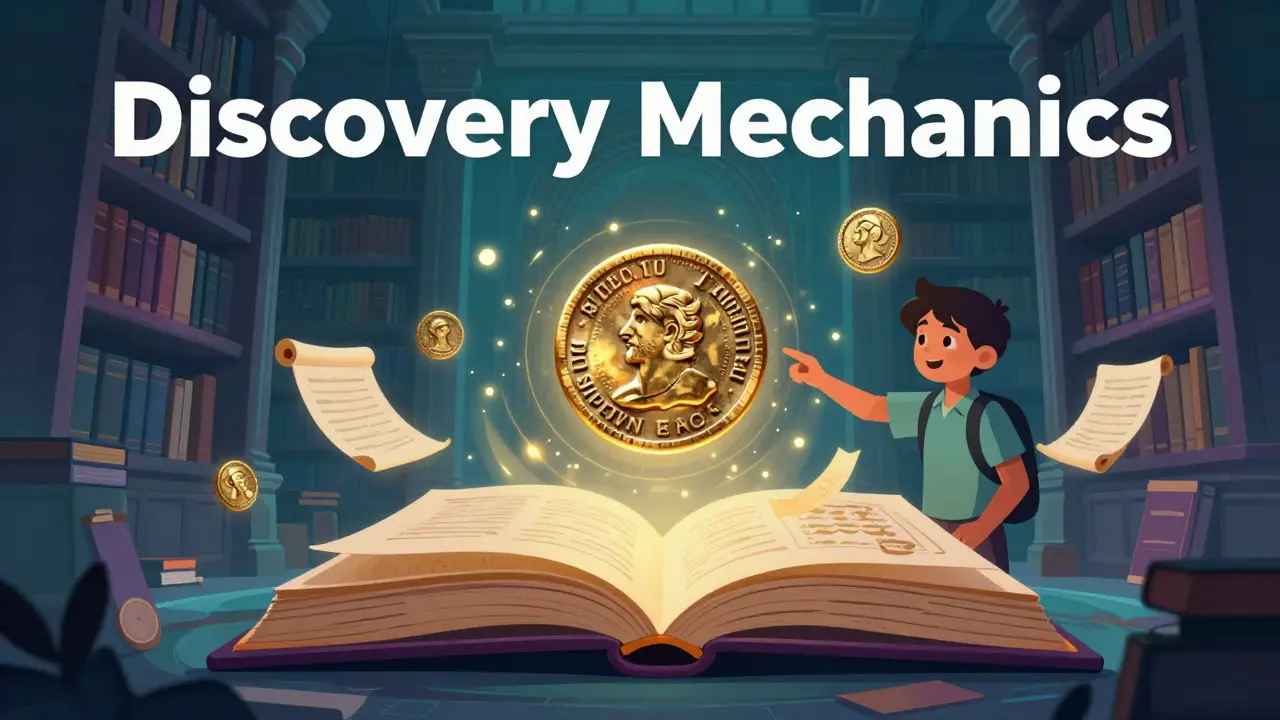
A great example is the "Easter Egg" approach. Imagine a history course where the main text is standard, but if a student clicks on a specific, subtle image of a coin in the background, they unlock a "Secret Archive" containing rare primary sources. This doesn't just teach history; it teaches the habit of investigation. The student becomes an active participant in their own education. They aren't just reading a screen; they are hunting for knowledge.
| Feature | Linear Progression | Unlockable Progression | Discovery Progression |
|---|---|---|---|
| Access | All content open or sequential | Gated by milestones | Hidden/Found via exploration |
| Motivation | Extrinsic (Grade/Completion) | Achievement (Leveling up) | Intrinsic (Curiosity) |
| Student Role | Passive Consumer | Goal-Oriented Achiever | Active Explorer |
| Risk | Boredom/Disengagement | Frustration if too hard | Confusion if too vague |
Implementing Progressive Disclosure
The technical side of these mechanics is called Progressive Disclosure, a UX design technique where information is sequenced across several screens to reduce clutter and focus the user's attention. In learning, this means you don't dump the entire theory of a subject on page one. You provide a small piece of information, ask the user to apply it, and then reveal the next layer of complexity.
Let's look at a real-world scenario: a corporate compliance training module on cybersecurity. Instead of a 40-slide PowerPoint, the course is designed as a "Virtual Office." The learner has to find the security flaws in a simulated office (e.g., a password written on a sticky note). Each flaw they find unlocks a short, 30-second video explaining the risk and how to prevent it. The learner is essentially "mining" for information. Because they found the problem first, they are much more likely to remember the solution.
Avoiding the "Gamification Trap"
It's easy to go overboard. When you add too many badges, points, and locked levels, you risk creating a "chocolate-covered broccoli" experience. That's when the gamification is just a thin layer of sugar over a boring, tedious task. If the locks are too hard, students get frustrated and quit. If they're too easy, the sense of achievement vanishes.
To avoid this, follow the Flow State principle. The challenge must perfectly match the student's skill level. If a student is struggling with a concept, the "lock" for the next section should be a helpful review quiz, not a punishingly hard exam. The goal is to keep them in that sweet spot between boredom and anxiety. Use Learning Analytics, the measurement, collection, analysis, and reporting of data about learners and their contexts, to see where students are dropping off. If 60% of your students stop at a specific unlockable gate, your gate is too high.

Connecting the Dots: From Mechanics to Mastery
The ultimate goal of using Instructional Design-the practice of creating learning experiences that make the acquisition of knowledge more efficient-is mastery. Unlockables and discovery mechanics aren't just tricks to keep people clicking. They mimic the way we actually learn in the real world.
Think about how you learned to drive or cook. You didn't read a manual from page 1 to 500. You learned a basic skill, tried it, failed, discovered a better way, and then "unlocked" a more complex task. By bringing this structure to online learning, we move away from the "industrial model" of education and toward a personalized, agentic experience. When a student discovers a piece of information on their own, they feel a sense of ownership over that knowledge. It's no longer "the teacher's fact"; it's "their discovery."
Will unlockable content frustrate students who want to move fast?
It can, if the requirements are arbitrary. The key is to make the unlock criteria meaningful. If a student can prove they already know the material through a "test-out" quiz, let them unlock the next section immediately. This rewards existing knowledge while still maintaining the structure for those who need the guidance.
What is the difference between a gated course and unlockable content?
Gating is often used for payment or administrative reasons (e.g., you must pay before you see the course). Unlockable content is a pedagogical tool. It's about the sequence of learning. Gating is a barrier; unlockables are milestones that celebrate progress.
How do I implement discovery mechanics in a standard LMS?
Even in basic systems, you can use "hidden" links in PDFs or text, or use conditional release rules based on quiz scores. You can also create a "treasure hunt" where the answer to a quiz in Module 1 is actually hidden in a reading for Module 2, encouraging them to skim ahead and explore.
Do these strategies work for adult learners in corporate settings?
Absolutely. In fact, adult learners often appreciate them more because they value efficiency. By using a "choose your own adventure" style of discovery, adults can bypass what they already know and focus on the gaps in their knowledge, making the training feel less like a waste of time.
Can these mechanics lead to "gaming the system"?
Yes, if the reward is based on a simple metric (like clicks or time spent). To prevent this, tie unlockables to competency-based assessments. Instead of "spend 10 minutes on this page," use "solve this specific problem using the tool provided." This ensures the reward is a result of actual learning, not just clicking buttons.
Next Steps for Course Creators
If you're ready to move away from the linear scroll, start small. You don't need to rebuild your entire course. Try these three steps:
- Identify a "Mystery": Find a core concept in your course and instead of explaining it, create a scenario where the student has to find the answer by exploring three different resources.
- Set a Milestone: Pick one mid-course section and make it unlockable. Require a 80% score on a a practical application quiz before the "Advanced Secrets" module opens.
- Add an Easter Egg: Hide a bonus resource (a cheat sheet, a guest interview, or a template) in an unexpected place within your reading materials and mention that there's "something hidden" in the course to spark curiosity.
Comments
Tia Muzdalifah
this sounds so cool actually!! i feel like most online stuff is just a slog but makin it a map is a vibe. definitely need more of this in real classes
Albert Navat
Basically just talking about an optimized UX flow to mitigate churn. If you don't have the right KPIs to track the cognitive load, these discovery mechanics are just fluff. You need a robust LRS to actually see if the pedagogical shift is impacting the ROI of the training.
LeVar Trotter
I really appreciate the focus on agentic experiences here. From a scaffolding perspective, transitioning a learner from a passive state to an active explorer is the gold standard of instructional design. It's all about that zone of proximal development, ensuring the challenge doesn't eclipse the capability.
Aafreen Khan
plz lol... just call it what it is: manipulating people into spending more time on a website 🙄 it's not "discovery" its just a maze for ppl who like shiny badges 🤡
Pamela Watson
I already do this in my courses and it works way better than what you wrote here because I actually know my students :) :)
King Medoo
It is fundamentally an ethical imperative that we move away from the industrial model of rote memorization, for the soul of the student is crushed when they are treated as a mere vessel to be filled rather than a flame to be ignited, and while these mechanics are helpful, we must ensure they do not become mere distractions from the deeper pursuit of truth 📚✨🙏
Rae Blackburn
bet these "discovery mechanics" are just a way for the platforms to track every single click and sell our psych profiles to the highest bidder lol wake up people the locked doors are actually data traps
Tyler Durden
I LOVE THIS ENERGY!!! Seriously, turning a boring PDF into a treasure hunt is a total game changer... Who doesn't love a good Easter egg?? It makes you actually WANT to dive deep into the material!!!
Zoe Hill
This is such a great idea!! I think it would help so many people who struggle with focus... just hope the designers don't make the puzzles too hard or people might give up early on it
Christina Kooiman
The lack of a comma in the second paragraph is absolutely devastating to my spirit and I cannot in good conscience ignore the fact that this entire piece of writing is a chaotic mess of ideas that tries to be clever while failing to adhere to the most basic standards of English grammar, which is honestly just a tragedy for the modern educational system!
michael T
My last professor used a gated system and it was a total nightmare that sucked the life out of my semester, just a cold, digital wall keeping me from the knowledge I deserved while I spiraled into a void of academic despair and caffeine-induced tremors
Stephanie Serblowski
Oh sure, because adding a little digital badge is definitely going to solve the systemic failure of the global education infrastructure lol. Truly a revolutionary approach to the cognitive load theory here ;) (not)
Renea Maxima
Knowledge isn't meant to be "unlocked" like a loot box in a gacha game... it's a fluid state of being that resists categorization. The very idea of a "milestone" is a social construct designed to keep us in line 🌙
Jeremy Chick
Cut the crap with the "exploration" talk. Most people just want the damn info so they can finish the course and get their certificate. Making them hunt for a coin in a picture is just wasting everyone's time.